AUX Heat On in Houston? When Your Heat Pump Needs Repair
Learn about AUX Heat and when your Houston heat pump may need repair. Understand auxiliary heat usage and optimize system efficiency.
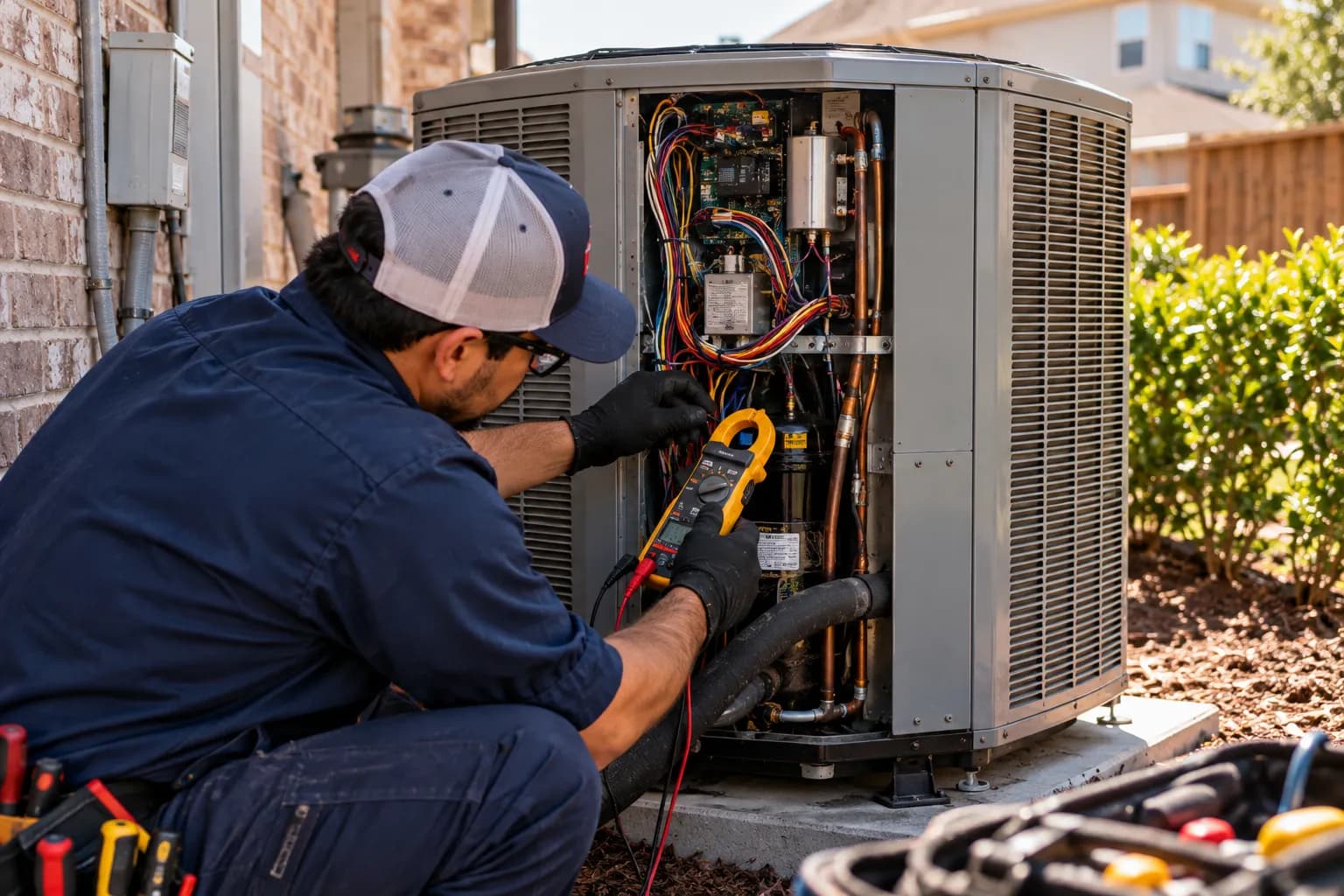
Why Does My Thermostat Say AUX HEAT? A Houston Homeowner's Guide
You wake up on a chilly Houston morning, adjust your thermostat, and notice a message you don't usually see: AUX HEAT.
Does that mean your heat pump is broken? Is your system using more electricity? Should you call an HVAC technician?
The short answer: Auxiliary heat is a backup heating source that helps certain heat pump systems when additional heating capacity is needed. Seeing AUX HEAT briefly during cold weather can be completely normal. However, if it operates continuously, appears during mild weather, or your home isn't getting warm, your system may need professional diagnosis.
For homeowners in Houston, Katy, Richmond, Sugar Land, and surrounding areas, knowing the difference can help prevent unnecessary energy costs and identify heating problems before a cold front.
What Does AUX HEAT Mean on Your Thermostat?
A heat pump normally heats your home by transferring heat from outdoor air into your living space. Unlike a conventional electric resistance heater, it moves heat rather than generating all its heating energy directly.
When outdoor temperatures fall or the thermostat determines that the heat pump needs additional assistance, a compatible system can activate auxiliary heating.
In many residential systems, auxiliary heat comes from electric heating elements installed inside the air handler. Other systems use a gas furnace as their backup heating source.
When AUX HEAT appears, the thermostat is indicating that supplemental heating has been requested. This message alone does not confirm an equipment failure.
Whether supplemental heat operates alongside the heat pump or replaces it depends on the system design.
AUX Heat vs. Emergency Heat: What's the Difference?
These thermostat settings are frequently confused, but they serve different purposes.
Auxiliary Heat: Automatic Heating Assistance
AUX heat normally activates automatically when the thermostat or equipment controls determine that additional heat is necessary.
Examples include:
• Outdoor temperatures becoming too cold for the heat pump to meet the home's heating demand by itself.
• A large difference between the actual indoor temperature and the thermostat setting.
• Certain heat pump defrost operations.
• Heating demand exceeding the capacity available from the heat pump alone.
Once the heating demand decreases, the system should transition according to its control settings.
Emergency Heat: A Backup Operating Mode
Emergency Heat, sometimes displayed as EM HEAT, is a separate operating mode available on many heat pump thermostats.
On typical electric-backup systems, selecting Emergency Heat prevents the heat pump compressor from operating and uses the backup heating system instead.
This setting is primarily intended for situations where the heat pump cannot operate properly.
Do not switch to Emergency Heat simply because the weather is cold. Many modern heat pumps are designed to operate in cold outdoor temperatures. Switching modes unnecessarily can increase energy consumption, depending on your equipment.
Some dual-fuel systems use different operating strategies, so always follow the manufacturer's instructions for your specific thermostat and HVAC system.
Three Situations Where AUX Heat Can Be Normal
1. A Cold Front Moves Through Houston
Houston winters often alternate between relatively mild afternoons and much colder mornings.
As outdoor temperatures drop, a heat pump's available heating capacity can decrease while the home's heating demand increases.
Under certain conditions, supplemental heat helps the system maintain the desired indoor temperature.
This doesn't automatically mean your heat pump is undersized or malfunctioning.
2. You Increase the Thermostat Several Degrees
Imagine your home is at 65°F and you raise the thermostat to 72°F.
Depending on the thermostat configuration, the system may activate auxiliary heat to recover the temperature more quickly.
Some smart thermostats manage backup heat based on indoor temperature, outdoor conditions, time, and equipment settings.
For heat pump owners, avoiding unnecessarily large temperature adjustments may reduce supplemental heating operation.
However, don't sacrifice safety or reasonable comfort just to avoid using backup heat.
3. Your Heat Pump Enters Defrost Mode
During cool, damp weather, frost can accumulate on an outdoor heat pump coil.
The equipment periodically enters a defrost cycle to remove that frost. Depending on the system, backup heat may activate to help maintain indoor comfort during the cycle.
You may notice steam around the outdoor unit, a temporary change in operating sound, or the outdoor fan stopping briefly.
Those symptoms can be normal during defrost.
The warning sign is heavy ice that does not clear, repeated abnormal operation, or a home that cannot maintain temperature.
Four Signs Your Heat Pump May Need Repair
1. AUX Heat Runs Continuously During Mild Weather
If the thermostat displays AUX HEAT for extended periods when outdoor temperatures are relatively mild, the system deserves further evaluation.
Possible explanations include improper thermostat settings, reduced heat pump capacity, restricted airflow, or equipment that isn't operating correctly.
The exact outdoor temperature at which supplemental heating becomes necessary depends on the equipment and home. There is no universal cutoff that applies to every Houston heat pump.
2. The Outdoor Unit Isn't Operating
In heating mode, a functioning heat pump will normally operate its outdoor unit when the controls call for compressor heating.
If the indoor blower runs and the house is heating only through electric backup, the outdoor unit may have a power, control, or mechanical problem.
Possible causes include an electrical fault, failed component, safety lockout, or thermostat configuration issue.
Some systems intentionally stop the compressor during defrost or under specific operating conditions, so a stationary outdoor fan alone isn't proof of failure.
3. Your Home Never Reaches the Thermostat Setting
If the heat pump runs for long periods while the indoor temperature continues to fall, something may be limiting its heating performance.
A technician may need to investigate airflow restrictions, refrigerant-system performance, defrost operation, controls, or available backup heat capacity.
An insulation problem, duct leakage, or an unusually high heating load can also contribute.
Replacing a thermostat or adding refrigerant without diagnosing the underlying issue may not solve the problem.
4. Your Electricity Usage Increases Unexpectedly
Electric resistance backup heat can use considerably more electricity than the heat pump would need to provide a comparable amount of heat under favorable conditions.
A sudden increase in backup heating operation may contribute to a higher utility bill.
However, weather, electricity rates, thermostat settings, and household usage also affect the bill.
Increased energy consumption is a reason to investigate—not enough evidence by itself to identify a failed HVAC component.
How Much Electricity Does Auxiliary Heat Use?
The answer depends on the type and capacity of your backup heating equipment.
Consider an illustrative 10-kilowatt electric heating stage:
If that stage operates at full output for two hours, it consumes approximately 20 kilowatt-hours of electricity.
That example is not a measurement from a MultiPoint customer's system. Your installed heating stages may have different capacities or operate for different durations.
An electric resistance heater converts electricity into heat. A heat pump, by comparison, transfers heat and can deliver substantially more heating energy per unit of electricity under suitable conditions.
This is why unnecessary electric backup operation can increase heating costs.
The goal isn't to eliminate auxiliary heat entirely. It's to make sure the system uses it when appropriate.
What Homeowners Can Safely Check Before Calling
Before scheduling a service visit, perform these basic checks:
Check your thermostat mode. Verify that it's set to Heat and not accidentally left in Emergency Heat mode.
Review the temperature setting. Avoid repeatedly making large adjustments while trying to force the house to warm faster.
Inspect your air filter. Replace a visibly dirty filter with the correct size and compatible filtration rating. Restricted airflow can affect both heating performance and equipment safety controls.
Look at the outdoor unit from a safe distance. Note whether it appears to be operating normally, has unusual noises, or remains heavily iced over. Do not remove panels, touch wiring, or attempt to chip ice from the coil.
Also note when the AUX HEAT message appears and whether the house reaches the thermostat setting.
If a breaker repeatedly trips, stop attempting to reset it and arrange professional service.
These observations provide useful information for an HVAC technician without requiring homeowners to work inside energized equipment.
How a Professional HVAC Technician Diagnoses Excessive AUX Heat
Persistent auxiliary heat operation requires more than simply checking the thermostat display.
A proper diagnosis may include several system-level checks.
Thermostat Configuration and Heating Stages
The technician can verify that the thermostat is configured for the installed equipment, including the appropriate heat pump and backup heating stages.
Incorrect setup can cause supplemental heating to activate unnecessarily or prevent the compressor from operating as intended.
Outdoor Heat Pump Performance
The technician can evaluate compressor operation, reversing-valve control, defrost behavior, electrical components, and refrigerant-system performance using the manufacturer's procedures.
Airflow and Ductwork
Insufficient airflow can reduce heating performance and contribute to high-temperature safety trips or other equipment problems.
Depending on symptoms, checking filter condition, blower operation, duct restrictions, and external static pressure can help identify the underlying cause.
Backup Heating Operation
On electric-backup systems, technicians can confirm that the installed heating elements and their controls operate correctly.
For dual-fuel systems, the changeover between heat pump and furnace must follow the approved equipment control sequence.
The objective is to determine why backup heat is being requested, not simply disable it and leave the home without sufficient heating capacity.
Should You Repair or Replace Your Heat Pump?
An AUX HEAT message is not, by itself, a reason to replace an HVAC system.
If the problem involves thermostat configuration, airflow, controls, or a repairable component, correcting that issue may restore normal operation.
Replacement becomes a discussion when the equipment has significant age-related deterioration, major component failure, repeated expensive repairs, or inadequate capacity for the home.
The proper decision should consider the actual diagnosis, equipment condition, repair estimate, and replacement options.
MultiPoint AC & Heating provides "heat pump repair, installation, and maintenance services in Houston" (https://multipointacheat.com/services/heat-pump). Homeowners can also review our "heat pump repair troubleshooting guide" (https://multipointacheat.com/blog/heat-pump-repair-houston-costs-solutions) for additional information.
Frequently Asked Questions About AUX Heat
Is it bad if AUX HEAT comes on?
Not necessarily. Auxiliary heat is designed to assist your heat pump when additional capacity is needed. Frequent or unexplained use during mild weather deserves inspection.
Can I turn auxiliary heat off?
Homeowners generally should not disable backup heating through wiring or advanced equipment settings. Your system may depend on it for adequate heating or certain operating functions. Have a qualified technician review the configuration if it appears to operate unnecessarily.
Why does AUX HEAT come on when I raise the thermostat?
Some thermostats activate supplemental heat when the difference between the indoor temperature and the requested setting is large. The exact behavior depends on the thermostat and system configuration.
Does AUX HEAT mean my heat pump is broken?
No. It may indicate normal supplemental heating. If the outdoor heat pump isn't functioning, however, backup heat may be compensating for an equipment problem.
When should I schedule a heat pump inspection?
Schedule service if AUX HEAT runs unusually long during mild conditions, the system struggles to maintain temperature, the outdoor unit behaves abnormally, or energy consumption increases without a clear explanation.
Heat Pump Repair in Houston, Katy, Richmond & Sugar Land
If your thermostat keeps displaying AUX HEAT and you're unsure whether the system is operating correctly, MultiPoint AC & Heating can help evaluate your heating equipment.
We provide residential HVAC diagnostics, heat pump repairs, heating-system maintenance, and equipment replacement services throughout Greater Houston, including "Katy" (https://multipointacheat.com/service-areas/katy-tx), Richmond, Sugar Land, and nearby communities.
Our standard diagnostic fee is $69, charged separately from approved repairs. An additional $100 after-hours/weekend service fee applies when applicable.
We'll explain the findings and recommended work before proceeding with repairs.
Call MultiPoint AC & Heating at (832) 963-3789 or "contact us online" (https://multipointacheat.com/contact-us) to request heat pump service.
MultiPoint AC & Heating — Residential Heating & Cooling Service Throughout Greater Houston.