Heat Pump Repair in Houston, TX — What's Wrong, What It Costs, and What to Do
Learn about heat pump issues, costs, and solutions in Houston. Expert guidance on when to repair or replace, ensuring efficient performance.
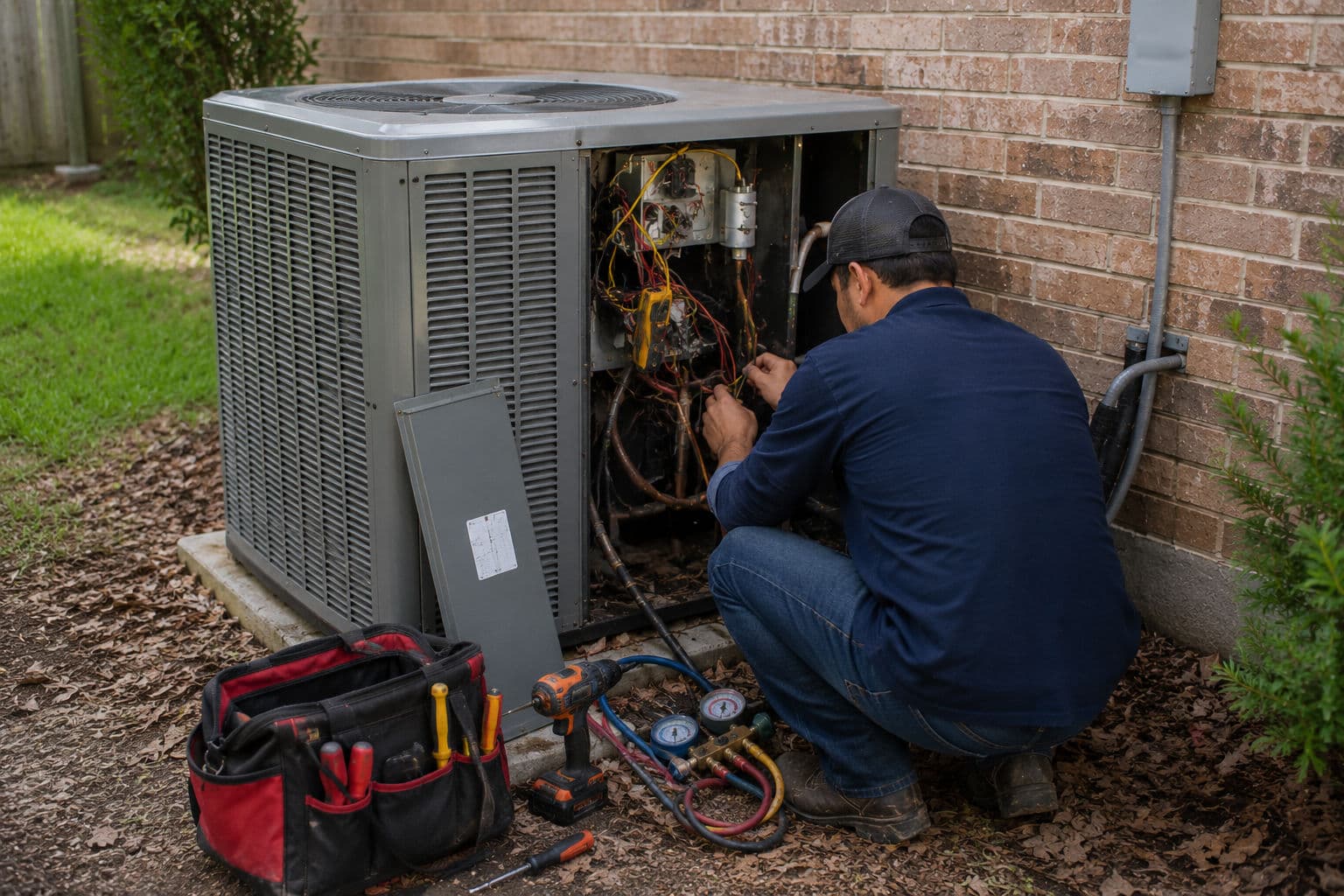
Heat pumps handle both heating and cooling from a single system, which makes them an efficient and practical choice for Houston's climate — mild winters, long cooling seasons, and temperatures that rarely drop far enough below freezing to push heat pump performance outside its efficiency range. That same dual-function design means that when a heat pump develops a problem, it can affect the system in either mode, and the diagnostic approach is different from what applies to a conventional split system with separate AC and furnace components.
If your heat pump isn't working correctly — not cooling in summer, not heating in winter, making noises it wasn't making before, or producing higher energy bills without explanation — this guide covers what's most likely wrong, what the repair involves, and what it costs in the Greater Houston area.
HEAT PUMP BASICS — WHAT MAKES THEM DIFFERENT TO REPAIR
A heat pump operates on the same refrigeration principles as a conventional AC system — refrigerant circulates between indoor and outdoor coils, absorbing heat in one location and releasing it in another. The critical difference is the reversing valve — a component that doesn't exist in conventional AC systems. The reversing valve controls the direction refrigerant flows through the circuit, which determines whether the system is operating in cooling mode or heating mode.
When the reversing valve is in the cooling position, the heat pump operates exactly like a conventional AC — absorbing heat from indoor air at the evaporator coil and releasing it to the outdoor air at the condenser coil. When the reversing valve shifts to the heating position, the refrigerant flow reverses — the outdoor coil becomes the evaporator, absorbing heat from outdoor air, and the indoor coil becomes the condenser, releasing that heat to the indoor air.
This reversing valve is the component that makes heat pump diagnosis more complex than conventional AC diagnosis. A problem with the reversing valve produces symptoms in one mode that don't appear in the other — or symptoms that appear in both modes — in ways that require specific diagnostic experience to interpret correctly.
Heat pumps also have a defrost system that conventional AC units don't require. During heating mode in cold weather, the outdoor coil operates below the dew point and frost can form on it — a normal occurrence. The defrost system periodically reverses the cycle briefly to melt that frost and then returns to heating mode. A defrost system that's not working correctly produces ice buildup on the outdoor unit that eventually impairs heating performance significantly.
Understanding these heat pump-specific components is part of understanding why heat pump diagnosis and repair requires a technician with specific heat pump experience rather than assuming that anyone who services conventional AC systems can service a heat pump equally well.
COMMON HEAT PUMP PROBLEMS IN HOUSTON HOMES
Heat pump not cooling in summer. During the cooling season — which in Houston runs from late March through October — a heat pump that isn't cooling is experiencing one of the same problems that affect conventional AC systems. Low refrigerant from a system leak, a dirty condenser coil reducing the outdoor unit's ability to reject heat, a frozen evaporator coil blocking airflow, a failing compressor losing capacity, or a capacitor failure preventing the system from starting are all causes that apply to heat pumps in cooling mode just as they apply to conventional AC systems.
The diagnostic approach for a heat pump that's not cooling in summer is similar to diagnosing a conventional AC — check refrigerant pressure, evaluate coil condition, test electrical components, measure temperature differential across the evaporator coil, and assess overall system capacity. The same conditions that cause conventional AC failure in Houston's summer heat cause heat pump cooling failure for the same reasons.
Heat pump not heating in winter. When a heat pump fails to heat adequately during a Houston cold front, the diagnostic possibilities expand beyond what a gas furnace diagnosis would consider.
The reversing valve may not be switching to heating mode. If the heat pump is running but producing cool air in heating mode, the reversing valve hasn't shifted — the system is still operating in cooling mode despite the thermostat calling for heat. This can be caused by a failed reversing valve solenoid, a valve that's mechanically stuck, or a control board that isn't sending the reversing signal correctly.
The system may be in defrost mode. During cold weather, a heat pump periodically reverses to defrost mode — running briefly in cooling mode to melt frost from the outdoor coil before returning to heating. During defrost, the system produces cool air from the vents for a period of typically five to fifteen minutes. This is normal behavior. A heat pump that seems to blow cool air during heating season may simply be in a defrost cycle rather than having a malfunction. If the cool air persists beyond fifteen to twenty minutes without the system returning to warm air production, the defrost system may be malfunctioning.
The defrost board may have failed. A defrost control board that's failed can cause the system to remain in defrost mode rather than returning to heating mode after frost has been cleared — producing extended periods of cool air during heating season. It can also prevent the defrost cycle from occurring at all, leading to ice buildup on the outdoor coil that progressively impairs heating performance.
The outdoor unit may have excessive ice buildup. Some frost on the outdoor coil during cold weather is normal and clears during the defrost cycle. Heavy ice accumulation that encases the outdoor unit's coil and fan is a sign that the defrost system isn't functioning correctly, that refrigerant levels are low, or that airflow through the outdoor unit is restricted. An outdoor unit encased in ice cannot extract heat from the outdoor air effectively and produces little to no heat output.
Low refrigerant affecting heating mode. In heating mode, refrigerant charge affects performance differently than in cooling mode, but low charge still impairs the system's ability to extract heat from outdoor air and deliver it to the indoor space. A heat pump that's maintaining heating output but running longer than expected to reach the set temperature, or that's falling short of the set temperature on cold days, may have a refrigerant charge issue even when the cooling mode performance seemed adequate.
Heat pump running continuously without reaching the set temperature. In Houston's mild winters, a heat pump should be able to maintain indoor temperatures comfortably in all but the most extreme cold front conditions. A system that runs continuously without reaching the thermostat setpoint during a typical Houston winter cold front — temperatures in the 35 to 45 degree range — is either undersized for the home, low on refrigerant, or has a capacity-limiting problem that's affecting heating output.
During the infrequent periods when Houston temperatures drop below freezing, particularly extended freeze events like the February 2021 winter storm, heat pump performance is reduced compared to milder conditions — this is normal for heat pump technology and isn't a repair issue. For homes in the northern parts of the Greater Houston metro — upper Montgomery County communities like Willis, Conroe, and New Caney where below-freezing temperatures are somewhat more common — discussing supplemental heat backup with a qualified technician is worth doing as part of any heat pump installation or evaluation.
Heat pump making unusual noises. The same noise diagnostic framework that applies to conventional AC systems applies to heat pumps, with a few heat pump-specific additions.
A clicking or chattering sound when the system switches modes — from cooling to heating or heating to cooling — can indicate a reversing valve that's not shifting cleanly. The reversing valve produces a brief sound when it shifts, but persistent clicking or chattering during or after the mode switch is abnormal.
A whooshing or gurgling sound when the system enters or exits defrost mode is normal — this is the sound of refrigerant flow changing direction during the defrost cycle. Knowing this prevents unnecessary service calls from homeowners who notice the sound for the first time.
Grinding, squealing, or loud rattling sounds follow the same diagnostic logic as in conventional systems — motor bearing wear, compressor developing a mechanical issue, or debris in the outdoor unit fan are the primary causes.
Heat pump short cycling. A heat pump that starts and stops frequently — running for only a few minutes before shutting off — may have a refrigerant pressure issue, a compressor fault, a reversing valve that's causing pressure imbalances, or a thermostat and control system issue. Short cycling puts mechanical stress on the compressor and should be diagnosed promptly rather than allowing the system to continue in that pattern.
HEAT PUMP REPAIR COSTS IN HOUSTON
Repair costs for heat pump systems in Greater Houston reflect the specific components involved. Standard repairs that are common to both heat pumps and conventional AC systems — capacitors, contactors, refrigerant leak repair and recharge, coil cleaning, blower motor — are in the same price range as the equivalent conventional system repair.
Capacitor replacement runs $150 to $350 and is one of the most frequent heat pump repairs in Houston's climate — the same sustained heat and electrical stress that degrades capacitors on conventional systems affects heat pump capacitors equally.
Refrigerant leak repair and recharge ranges from $250 to $600 depending on the location of the leak and the volume of refrigerant required. Heat pump systems use the same refrigerant as conventional AC systems of the same generation — R-22 in older systems, R-410A in systems installed between approximately 2010 and 2023, and newer refrigerants in the most recently manufactured equipment.
Contactor replacement is $150 to $350 and addresses the electrical component that controls power delivery to the compressor and outdoor fan.
Reversing valve replacement is a heat pump-specific repair with no equivalent in conventional systems. The reversing valve itself is a moderately expensive part — typically $200 to $400 for the component — and the labor for replacement involves recovering the refrigerant, removing and replacing the valve, recharging the system, and verifying operation in both modes. Total cost for reversing valve replacement in Houston typically runs $600 to $1,200 depending on the system and the labor involved.
Defrost control board replacement addresses the board that controls when and how long the defrost cycle operates. The board itself is $100 to $300, and installation adds labor bringing the total to $250 to $500 in most cases.
Outdoor fan motor replacement — a component that affects both cooling and heating performance in a heat pump — typically costs $300 to $600 installed.
Compressor replacement is the most expensive heat pump repair at $1,200 to $2,500 or more, and as with conventional systems, it's the repair that most frequently leads to the replacement conversation on older systems. A heat pump compressor failure on a system past 12 years in Houston's climate warrants honest evaluation of repair versus full system replacement rather than automatic compressor replacement.
WHEN TO REPAIR VERSUS REPLACE A HEAT PUMP IN HOUSTON
The same fundamental framework that applies to conventional system replacement decisions applies to heat pumps — system age, repair cost, maintenance history, and the specific nature of the repair being considered all factor into whether continuing to repair makes financial sense.
Heat pump systems in Houston's climate have similar service life expectations to conventional split systems — approximately 12 to 15 years with consistent maintenance. A heat pump that's 10 years old with a straightforward component repair and a history of annual maintenance has a different outlook than a 14-year-old heat pump that's had multiple repairs and hasn't been consistently maintained.
The reversing valve and defrost board are heat pump-specific components that don't have equivalents in conventional systems. When these components fail on a relatively young system with otherwise good condition, repair is typically the right decision. When they fail on a system that's past its mid-life with other age-related wear developing, the repair cost relative to remaining useful life warrants a more careful evaluation.
A compressor failure on a heat pump past 12 years of Houston service life is almost always the replacement decision point — the compressor cost, combined with the refrigerant recovery and recharge that compressor replacement requires, represents a total cost that rarely makes financial sense relative to starting a new system life with a warranty.
HEAT PUMP MAINTENANCE IN HOUSTON — WHAT PREVENTS MOST REPAIRS
The heat pump repairs described above are consistently less likely on systems that receive annual professional maintenance. Coil cleaning that prevents the efficiency loss and compressor stress from fouled coils, refrigerant charge verification that catches slow leaks before they affect compressor operation, capacitor testing that replaces degrading capacitors before they cause motor damage, and defrost system verification that confirms the defrost cycle is operating correctly are all maintenance items that prevent the developing conditions that lead to the repairs described above.
For Houston homeowners with heat pump systems, annual maintenance should specifically include defrost system operation verification — confirming that the defrost cycle initiates correctly, runs for an appropriate duration, and returns the system to heating mode — alongside the standard cooling system maintenance items. This defrost system check is a heat pump-specific item that standard maintenance checklists for conventional systems don't include, and it's one that specifically requires heat pump service experience to evaluate correctly.
THE IMPORTANCE OF HEAT PUMP-SPECIFIC EXPERIENCE
Heat pump diagnosis and repair requires familiarity with the reversing valve, the defrost system, and the way heat pump refrigerant circuit behavior differs in heating mode from cooling mode. A technician who primarily services conventional split systems and has limited heat pump experience may approach a heat pump problem with diagnostic assumptions that don't apply — misinterpreting a normal defrost cycle as a system malfunction, or missing a reversing valve issue because the diagnostic approach assumes the conventional AC framework where that component doesn't exist.
When selecting a technician for heat pump service in the Greater Houston area, asking specifically about heat pump experience and whether they service heat pumps regularly is reasonable. Heat pump service is a routine part of our work at Multipoint AC & Heating throughout Greater Houston — we work with heat pump systems across Harris County, Fort Bend County, and Montgomery County and have the specific diagnostic experience that heat pump repair requires.
Multipoint AC & Heating provides heat pump repair, maintenance, and installation throughout Greater Houston, including Harris County, Fort Bend County, Montgomery County, and Austin County. For heat pump problems in any season, contact us at 832-963-3789 to schedule service.