Why Does My AC Smell Like Mold or Mildew in Houston?
Discover why your AC has a musty smell in humid Houston and how to fix it for better air quality.
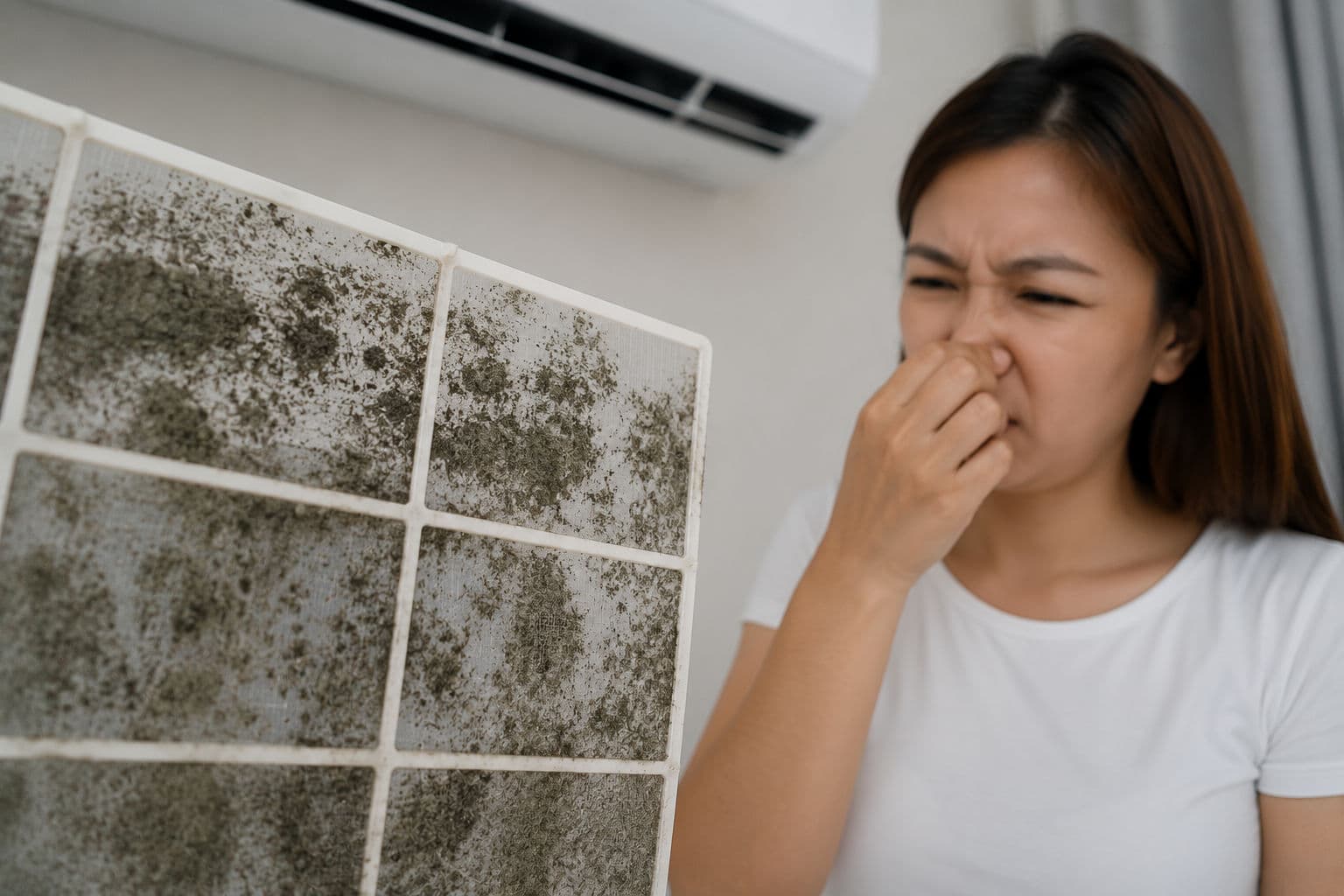
A musty or mildew smell coming from the AC vents is one of the most common complaints we hear from Houston homeowners, and it's one that tends to get dismissed or masked rather than addressed at the source. People buy air fresheners, change filters more frequently, and assume it's just something that happens with AC systems in a humid climate. It is common in Houston. It is not normal, and it's not something you have to live with.
The smell means something specific is happening inside your HVAC system, and in most cases it's fixable. Here's what's causing it, why Houston homes are more susceptible than most, and what the actual solution looks like.
WHAT THE SMELL ACTUALLY IS
The musty or mildew odor coming from your AC vents is almost always biological in origin. Mold, mildew, and bacteria growing somewhere in your HVAC system — on the evaporator coil, in the drain pan, inside the air handler cabinet, or in the ductwork — are releasing microbial volatile organic compounds into the airstream every time the blower runs. That airstream then carries those compounds through every supply vent in the home.
The smell isn't cosmetic. It's the direct output of biological organisms growing in your system, and those organisms are circulating through the air your household breathes every time the AC runs. For households with allergy sufferers, asthma, or respiratory sensitivities, this matters beyond the unpleasant odor.
WHY HOUSTON HOMES ARE ESPECIALLY VULNERABLE
No other factor makes a Houston home more susceptible to AC-related mold and mildew growth than the ambient humidity environment. The Gulf of Mexico keeps moisture levels elevated for most of the year, and that moisture finds its way into every aspect of the HVAC system.
The evaporator coil is continuously wet during AC operation — condensation forms on the coil surface as the warm, humid Houston air contacts the cold coil and moisture drops out of suspension. In drier climates, the coil surface dries relatively quickly during the off cycles between cooling runs. In Houston, ambient humidity is high enough that the coil surface stays moist for extended periods between cycles, particularly in the evening and overnight when outdoor humidity levels are at their highest. That persistent moisture on the coil surface is exactly what mold and mildew need to establish themselves.
The condensate drain pan sits below the evaporator coil collecting the water that drains off it. In Houston, that pan is handling significant volumes of water every day the system runs and it never fully dries out during the cooling season. The standing or slow-draining water in the pan is a direct biological growth environment — warm, wet, and dark, inside a cabinet that doesn't get cleaned between maintenance visits.
The ductwork in Houston homes runs through attic spaces that cycle between hot and dry during the day and cooler and more humid at night. That thermal cycling causes condensation to form on duct surfaces when temperatures drop and humidity rises, and in older duct systems with deteriorating insulation, moisture intrusion into the duct interior creates conditions for biological growth to establish itself inside the ducts where it's invisible and where cleaning is difficult.
Homes that have experienced flooding add a specific dimension to this vulnerability. Communities in Kingwood, Atascocita, Highlands, Crosby, Baytown, and other areas near the San Jacinto River system and Galveston Bay that have been affected by flooding events may have residual biological growth in wall cavities, subfloor spaces, and ductwork that continues to affect indoor air quality long after the visible water damage was remediated. This growth circulates through the HVAC system whenever the blower runs.
THE MOST COMMON LOCATIONS FOR MOLD AND MILDEW GROWTH IN YOUR HVAC SYSTEM
Evaporator coil. This is the most common location for the biological growth that produces musty AC odors in Houston homes. The coil surface is continuously wet during operation and stays moist between cycles in Houston's humidity. Without regular professional cleaning, biological growth establishes itself in the fin passages of the coil and builds up over successive cooling seasons. The growth acts as an insulating layer on the coil surface that reduces heat and moisture transfer efficiency — a performance problem alongside the air quality problem — and releases biological material into the airstream with every blower cycle.
Condensate drain pan. The pan directly below the evaporator coil is the second most common location. Algae, mold, and bacterial slime develop in the consistently wet environment of the drain pan and can build up to the point of restricting condensate flow through the drain line, contributing to drain line clogs that cause overflow and water damage. The biological material in the drain pan also gets introduced into the airstream directly — the blower pulls air across the coil and the pan surface simultaneously.
Condensate drain line. The drain line itself can develop biological growth along its length. In severe cases, the growth produces odors that travel back through the drain system and into the air handler cabinet, contributing to the musty smell from the vents even when the coil itself is relatively clean.
Air handler cabinet interior. The interior surfaces of the air handler cabinet — the sheet metal walls, insulation lining, and any other surfaces inside the cabinet — can develop biological growth in Houston's operating environment. This is less common than coil and drain pan growth but occurs on systems that have had ongoing moisture issues, inadequate drain pan management, or prior flooding exposure.
Ductwork. Biological growth inside the duct system is the most concerning location from an air quality standpoint because the ductwork extends throughout the entire home and growth anywhere in the system affects air quality everywhere. Duct mold growth typically develops where moisture has been introduced — through leaky duct connections that allow humid attic air into the duct interior, through condensation on duct surfaces in inadequately insulated sections, or as residual growth from a flooding event that affected the ductwork.
THE DIFFERENCE BETWEEN A SMELL AT STARTUP VERSUS CONTINUOUS ODOR
A musty smell that appears when the system first starts up and dissipates within a few minutes of operation is typically surface biological growth on the coil or in the air handler that gets disturbed by the initial airflow. This is a maintenance issue that warrants a professional coil cleaning but isn't necessarily severe.
A musty smell that persists throughout AC operation, gets stronger when the system has been off for a while and then restarts, or is present consistently regardless of how long the system has been running indicates more established biological growth that has reached levels where cleaning is overdue and may require a more thorough approach than a standard maintenance visit.
A musty smell that seems to come from specific vents rather than evenly throughout the home suggests biological growth in the ductwork serving those areas rather than at the air handler or coil — a different problem with a different solution.
HOW TO FIX A MUSTY-SMELLING AC IN HOUSTON
Professional evaporator coil cleaning is the most direct solution for the most common cause. A technician accesses the air handler, applies an appropriate coil cleaner to penetrate the fin passages where biological growth has accumulated, and rinses or allows the cleaner to drain through the condensate system. The improvement in air quality after a thorough evaporator coil cleaning on a Houston system that's been operating with significant biological growth on the coil is usually immediate and noticeable.
Condensate drain pan cleaning and drain line flushing address the second most common source. During a maintenance visit, the drain pan is inspected and cleaned of biological growth, and the drain line is flushed clear of any algae or debris that has accumulated. Algaecide tablets placed in the drain pan provide ongoing biological growth suppression between maintenance visits and are a standard part of Houston HVAC maintenance in humid conditions.
UV germicidal system installation is the most effective long-term solution for Houston homeowners whose musty smell returns between maintenance visits. A UV-C germicidal light installed in the air handler — positioned to continuously irradiate the evaporator coil surface and drain pan area — prevents biological growth from establishing itself on the coil by continuously exposing those surfaces to ultraviolet light at wavelengths that disrupt biological reproduction. Systems with UV germicidal lights installed as part of a maintenance visit consistently have better air quality outcomes between annual cleanings than systems without them, and the musty smell complaint is almost entirely eliminated in homes where a UV system is operating correctly alongside regular maintenance.
The UV light itself requires periodic bulb replacement — typically annually — since UV-C bulbs lose effective output before they visibly stop working. A UV system with an expired bulb provides no germicidal benefit and should be treated as a maintenance item alongside filter replacement.
Duct cleaning is appropriate when biological growth in the ductwork itself is suspected — indicated by a musty smell that's localized to specific vents, that persists after the air handler and coil have been cleaned, or in homes that have experienced flooding. Duct cleaning is more involved and more expensive than coil cleaning and is not something every Houston home needs annually, but for homes where the ductwork itself has been contaminated it addresses the source rather than working around it.
Whole-home dehumidification addresses the underlying condition that makes Houston homes susceptible to biological growth in the HVAC system in the first place. By maintaining indoor relative humidity at 40 to 50 percent rather than the 60 to 70 percent that Houston's ambient environment drives toward, a whole-home dehumidifier creates conditions that are significantly less favorable to mold and mildew growth throughout the home — including in the HVAC system. It doesn't replace cleaning of existing growth, but it reduces the rate at which growth reestablishes itself after cleaning and addresses the moisture environment that causes the problem in the first place.
WHAT DOESN'T WORK
Changing the air filter more frequently helps keep debris off the evaporator coil but doesn't address biological growth that's already established on the coil surface. A clean filter is a necessary maintenance step but not a treatment for existing mold growth.
Air fresheners and odor-eliminating sprays mask the symptom without addressing the source. The biological growth continues, the air quality impact continues, and the smell returns as soon as the masking effect wears off.
Running the fan continuously in the on position rather than auto in hopes of drying the coil between cycles is counterproductive in Houston's humidity. The fan running continuously redistributes moisture that has condensed on the coil back into the airstream during the off cycles, which increases indoor humidity rather than reducing it and makes the biological growth conditions on the coil worse rather than better.
WHEN TO BE CONCERNED BEYOND THE SMELL
If the musty smell is accompanied by visible dark spots or staining around supply vents, by household members experiencing worsening allergy or respiratory symptoms specifically at home, or by a smell that's distinctly different from musty — something more sharp, earthy, or chemical — having the system inspected promptly rather than waiting for the next scheduled maintenance visit is the appropriate response.
Visible mold around supply vents indicates that growth in the ductwork or at the vent itself has reached a level where spores are being deposited on the surrounding surfaces. This is a more advanced contamination situation than coil surface growth and warrants professional evaluation of the full system including ductwork condition.
Multipoint AC & Heating provides AC maintenance, coil cleaning, UV system installation, and indoor air quality services throughout Greater Houston, including Harris County, Fort Bend County, Montgomery County, and Austin County. If your AC vents are producing a musty or mildew smell, contact us to schedule a service visit.