How to Talk to Your HVAC Technician and Get the Most Out of Every Service Call
Improve your HVAC service call results by actively communicating with your technician. Learn how to ask the right questions and understand recommendations.
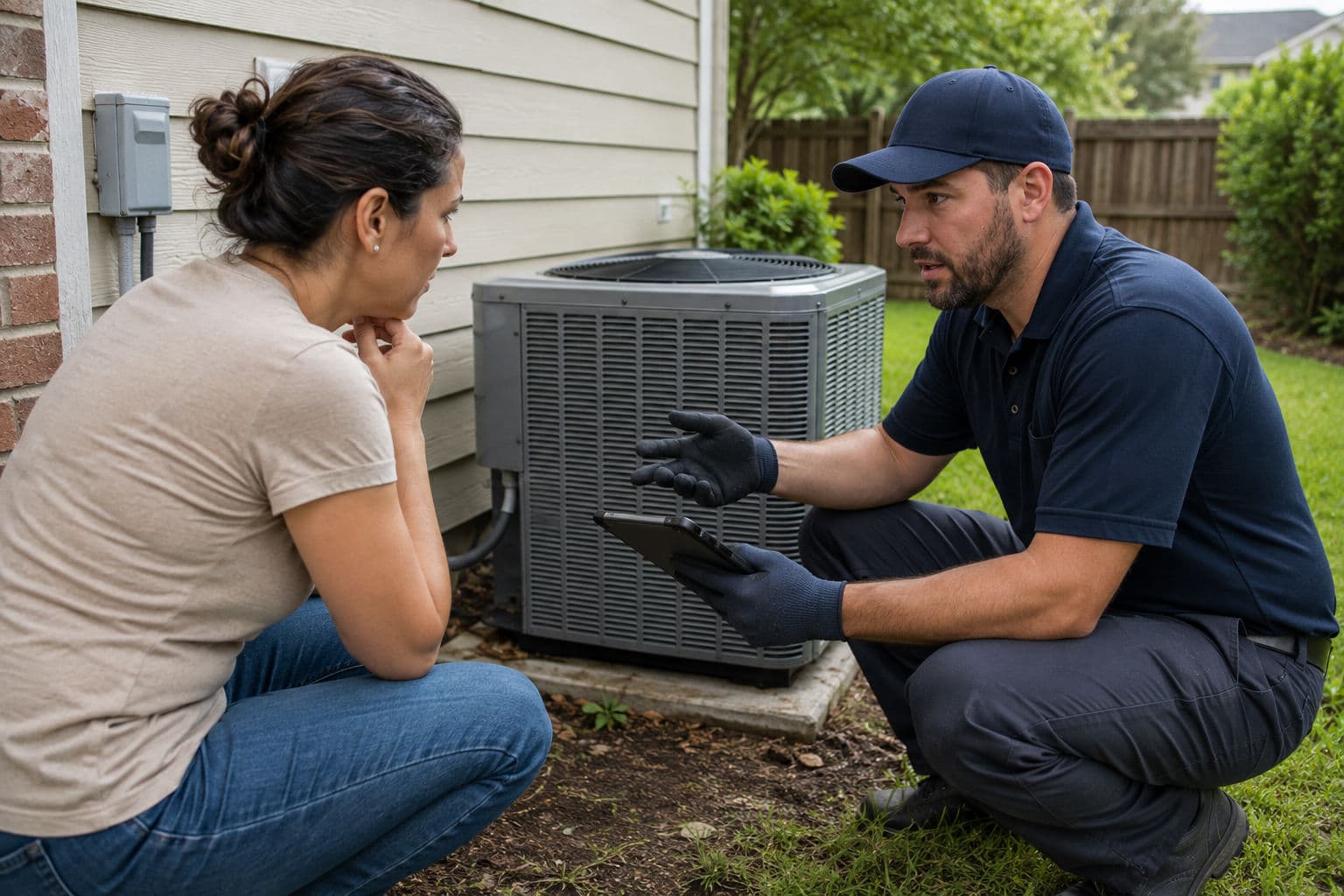
Most Houston homeowners approach an HVAC service call the same way — they describe the symptom, stand back while the technician works, and wait to hear what it's going to cost. That passive approach leaves a lot of value on the table. The quality of information you provide at the beginning of a service call directly affects how quickly and accurately the problem gets diagnosed. The questions you ask during the visit determine whether you understand what's being done and why. And what you do at the end of the call determines whether you leave with the full picture or just a repair invoice.
An HVAC service call is a two-way exchange, and homeowners who treat it that way consistently get better outcomes — faster diagnosis, more accurate repair recommendations, and clearer information for making decisions about their system.
Here's how to approach every part of the service call in a way that gets you the most out of it.
BEFORE THE TECHNICIAN ARRIVES — PREPARE USEFUL INFORMATION
The five minutes you spend before the technician arrives thinking through what's been happening with the system are some of the most valuable minutes of the service call. A technician who arrives to "the AC isn't working" has to start the diagnostic from scratch. A technician who arrives knowing that the system started making a clicking noise three weeks ago, that the house has been harder to cool since early June despite the same thermostat setting, and that the outdoor unit seems to shut off on the hottest afternoons but restart a few hours later has a meaningful head start on identifying what's actually happening.
Organize what you know into four categories.
What the symptom is specifically. Not just "it's not cooling" but how it's not cooling — is it not cooling at all, cooling less than it should, cooling some rooms but not others, producing air that's room temperature rather than cold, or something else? The more specific you can be about the actual symptom, the more it narrows the diagnostic space.
When it started. Did the problem start suddenly on a specific day, or has it been developing gradually over weeks? A sudden failure points to a specific component that stopped working. A gradual decline points to something losing capacity over time — refrigerant level, coil fouling, compressor wear.
Whether anything changed around the time it started. Did the problem start after a power outage, after a storm, after someone adjusted the thermostat settings, after you noticed the outdoor unit making a new noise? Context around the onset of a problem is often diagnostically significant.
What you've already checked or tried. If you've verified the thermostat settings, reset the breaker, changed the filter, or noticed ice on the refrigerant lines, tell the technician. This saves them from re-checking what you've already verified and tells them where the straightforward causes have already been ruled out.
WHEN THE TECHNICIAN ARRIVES — SET UP THE CONVERSATION
The first two minutes of the service call, when the technician is gathering initial information before starting work, are your opportunity to provide everything you've prepared and to calibrate the conversation.
Lead with the specific symptom, not the conclusion. "The system is running but the house won't get below 78 degrees on hot afternoons, which started about three weeks ago and has been getting progressively worse" is more useful than "I think the refrigerant is low." Your observation of the symptom is reliable information. Your interpretation of the cause may or may not be correct, and leading with a conclusion can inadvertently bias the diagnostic toward confirming what you've suggested rather than finding what's actually there.
Mention the system's history that you know. Approximately how old the system is, whether it's had recent repairs and what they were, whether you've been on a regular maintenance schedule or not, whether it's ever had refrigerant added. This context helps the technician calibrate what to expect before they start and tells them what's already been done to the system.
Point out anything specific you want them to look at that you might not mention when describing the primary symptom. A noise you've noticed that might not be related to the main complaint, a vent that's been producing less airflow than the others, a smell from the vents that appeared around the same time as the cooling problem — these details sometimes point to the actual cause of the problem or reveal additional issues worth addressing while the technician is already on site.
DURING THE VISIT — ASK QUESTIONS AS THEY WORK
A good HVAC technician doing a diagnostic is moving through a logical sequence — checking certain measurements, evaluating specific components, ruling out causes based on what they find. Understanding that sequence as it happens makes the visit more productive for both of you and ensures that you understand what's being recommended and why.
Ask what they're looking for when they start each phase of the diagnostic. "What does checking the refrigerant pressure tell you?" and "What does that reading mean compared to what it should be?" are questions that help you follow the diagnostic logic rather than just watching someone work on your equipment. A technician who can explain what they're doing and why as they do it is demonstrating competence and transparency simultaneously.
Ask to see the actual readings when measurements are taken. When the technician checks refrigerant pressure, capacitor readings, voltage, or temperature differential, ask to see the gauges or the meter. You don't need to interpret the numbers yourself — ask what the reading is and what the acceptable range is. A capacitor reading 28 microfarads against a rated value of 35 microfarads is a specific, verifiable finding. "The capacitor is getting weak" without showing you a measurement is a claim you have no way to evaluate.
Ask what's being found as the diagnostic progresses. If the technician has checked the refrigerant pressure and is moving to check the capacitor, ask what the pressure reading showed. Building a picture of what's been found at each step tells you what's been ruled out and what's been identified, which makes the final recommendation make more sense.
Ask whether the immediate problem appears to be isolated or part of a broader pattern. A capacitor failure on a three-year-old system is an isolated failure. A capacitor failure on a twelve-year-old system with a history of previous repairs might be one of several components approaching end of life simultaneously. Knowing which situation you're in helps you evaluate whether the proposed repair is a complete solution or a partial one.
WHEN THE DIAGNOSIS IS COMPLETE — UNDERSTAND WHAT YOU'RE BEING TOLD
The moment between the diagnostic and the repair proposal is the most important communication point in the service call. This is where misunderstandings that lead to unsatisfying outcomes most often occur.
Ask for the diagnosis in plain language before the pricing. "What specifically is wrong, and how did you determine that?" A clear answer to this question — a specific component that tested outside of specification, a measurement that confirmed a leak, a visual finding that identified a failure — is the basis for evaluating the proposed repair. A vague answer like "the system is low on refrigerant" without identifying why or where the refrigerant went is incomplete.
Ask what happens if the repair isn't done. This question serves two purposes. It tells you how urgent the repair actually is — some findings require immediate action, others can be monitored or addressed at a more convenient time. And it tells you something about the technician's communication style — a technician who answers this question honestly and specifically is someone you can trust more than one who defaults to worst-case scenarios without specifics.
Ask whether the repair addresses the root cause or the symptom. Adding refrigerant addresses the symptom of low refrigerant, but if the low refrigerant was caused by a leak that hasn't been repaired, the system will be low again in weeks or months. A complete repair addresses both the symptom and the cause. Understanding whether what's being proposed does both or only one helps you know what to expect after the visit.
Ask about warranty on both parts and labor. Replacement parts typically carry a manufacturer warranty — usually 12 months for standard components, longer for some refrigerant circuit components. The contractor's labor warranty covers their installation work. Both matter, and both should be confirmed before approving the repair.
Ask whether any other components showed signs of developing problems during the diagnostic. A technician who evaluated the full system during the diagnostic and found other components that are trending toward failure — a contactor showing burn marks, a blower motor drawing higher current than it should — should mention those findings and give you the option to address them. A technician who found these things but didn't mention them, and who you discover this about on a subsequent service call, is not serving your interests fully.
WHEN THE REPAIR RECOMMENDATION IS SIGNIFICANT — HOW TO EVALUATE IT
A repair estimate that's more than a few hundred dollars, or a recommendation to replace the system rather than repair it, warrants a more careful conversation than a straightforward component swap.
Ask for the specific findings that support the recommendation in writing. A repair invoice or estimate that describes exactly what was found, what was measured, and what the recommendation is based on gives you a record you can evaluate and reference. A verbal recommendation without written documentation is harder to evaluate and harder to use as the basis for a second opinion if you want one.
Ask the technician directly what they would do in your position. This is the most direct way to cut through the framing of a service call and get an honest assessment. A technician who gives you a genuine answer to this question — "at 14 years old with a compressor failure, I'd replace it" or "this is a straightforward capacitor repair and the system has good life ahead of it" — is worth trusting more than one who hedges the answer entirely.
Take the time you need before approving significant work. A professional HVAC company won't pressure you into an immediate decision on a multi-thousand dollar repair or replacement. If you want to get a second opinion before approving major work, that's a reasonable position to take and a legitimate contractor will respect it. What you shouldn't do is leave a system running in a condition that's causing damage — a compressor running low on refrigerant, for example — while taking time to get multiple opinions.
AFTER THE VISIT — WHAT TO DO WITH WHAT YOU'VE LEARNED
Get the written invoice or service report before the technician leaves. The invoice should describe what was found, what was done, what parts were installed, and what the warranty terms are. A verbal summary without documentation is insufficient for warranty purposes and for your own records.
Update your system records. If you've been keeping any records about your HVAC system — past repairs, maintenance visits, age of major components — add this visit's findings and any replaced parts. Over time this record becomes genuinely valuable for evaluating the system's overall health and making repair versus replacement decisions with full context.
Schedule follow-up if the technician identified developing issues that weren't addressed today. A recommendation to monitor a borderline capacitor or to evaluate duct condition at the next maintenance visit should go on your calendar rather than being noted and forgotten. The value of catching a developing problem is fully realized only when the follow-up actually happens.
Act on the filter recommendation if one was made. A filter check is part of most service visits, and if the technician noted that the filter was dirty or recommended a more frequent change interval, implementing that recommendation before the next service call is one of the most straightforward things you can do to protect the work that was just done.
If anything about the visit left you uncertain — a recommendation that didn't make full sense, a price that seemed significantly above market, a diagnosis that felt rushed — it's appropriate to ask for clarification or to seek a second opinion. Your HVAC system is a significant investment and the decisions you make about maintaining and repairing it deserve to be informed ones.
Multipoint AC & Heating provides diagnostic, repair, and maintenance service throughout Greater Houston, including Harris County, Fort Bend County, Montgomery County, and Austin County. Contact us to schedule a service visit with a team that communicates clearly and gives you straight answers throughout the process.