- Home
- Blog
- Smart Home Meets HVAC — How Houston Homeowners Are Using Technology to Beat the Heat in 2026
Smart Home Meets HVAC — How Houston Homeowners Are Using Technology to Beat the Heat in 2026
Explore innovative smart HVAC systems that help Houston homeowners save energy and costs in 2026. Learn what's worth it in AI and thermostat technology.
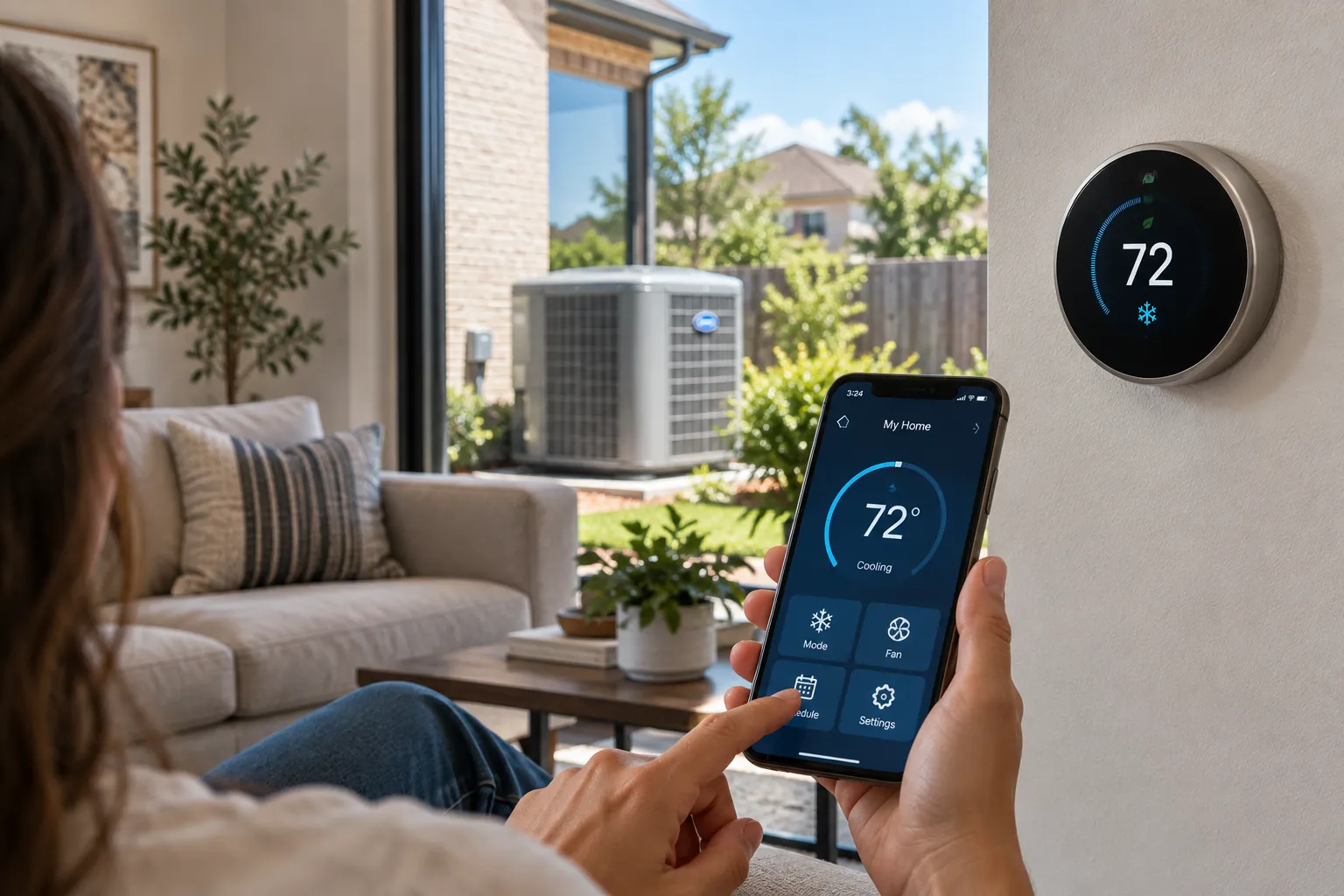
The conversation around smart home technology and HVAC has shifted significantly in the past few years. What started as a novelty — a thermostat you could control from your phone — has evolved into a category where AI-driven systems learn your preferences, predict your schedule, monitor equipment health in real time, and integrate with utility pricing to automatically shift energy consumption away from peak rate periods. In Houston's market, where the AC runs for most of the year and electricity costs during peak summer months are among the highest residential utility expenses in the country, that evolution matters more than it does in most other cities.
But the smart home HVAC category in 2026 also has more marketing noise than almost any other home improvement segment. Not every smart feature delivers real value in Houston's specific climate, not every integration works as advertised, and not every homeowner's situation benefits equally from the technology investment. Here's an honest assessment of what's worth it in 2026 for Greater Houston homeowners.
SMART THERMOSTATS — THE FOUNDATION THAT'S NOW ESSENTIAL, NOT OPTIONAL
Smart thermostats have moved from early adopter territory to the expected baseline for Houston homeowners who are serious about managing their AC costs. The fundamental value proposition — automatic schedule learning, remote control, energy usage reporting, and integration with utility demand response programs — is well established and consistently delivered by the major platforms.
The specific value in Houston's climate is higher than in most markets because the cooling season length means there are more hours per year during which the thermostat's optimization decisions translate into real energy savings. A thermostat that learns your schedule and adjusts setpoints automatically for an eight-month cooling season captures savings that a three-month cooling season market never sees.
What's changed in 2026 is the depth of the AI learning and the integration capabilities. Current-generation smart thermostats from the major platforms don't just learn when you're home and away — they learn how your specific home's thermal characteristics respond to different conditions. A thermostat that's been in your Houston home for a full summer has observed how quickly your home heats up on a west-facing afternoon, how long it takes to recover from a setback, and how the system's performance varies with outdoor humidity and temperature conditions. The scheduling recommendations it makes in year two are meaningfully better than the ones it made in year one because it has a season of your specific home's data to work from.
The utility integration feature deserves specific attention for Houston homeowners on time-of-use electricity plans. Several Houston-area utilities and retail electricity providers offer rate structures where the cost per kilowatt-hour varies by time of day — higher during peak demand periods, typically 3pm to 7pm on weekdays in summer, lower during off-peak hours. A smart thermostat that integrates with your utility's time-of-use pricing can automatically pre-cool the home during off-peak morning hours — running the AC harder when electricity is cheap — and then allow the setpoint to drift slightly upward during the peak pricing window before recovering in the evening. The home stays in a comfortable range throughout, but the energy consumption is shifted toward the cheaper rate window. In Houston's electricity market, where peak summer electricity rates can be two to three times off-peak rates on certain plan structures, this optimization is worth real money.
The platforms worth knowing in 2026 for Houston homeowners are Google Nest, Ecobee, and Honeywell Home — the three that have the most developed AI learning, the broadest utility integration ecosystem, and the most reliable track record in Houston's climate across a large installed base. Each has specific strengths and compatibility considerations that depend on your system type and existing smart home ecosystem.
AI-POWERED HVAC MONITORING — THE CATEGORY THAT'S DELIVERING IN 2026
Beyond smart thermostats, a new category of AI-powered HVAC health monitoring has emerged that's delivering genuine value for Houston homeowners in ways that weren't available a few years ago.
These systems — typically a combination of sensors installed at the air handler and outdoor unit connected to a cloud platform — continuously monitor the operating parameters of your HVAC system and use machine learning models to identify developing problems before they become failures. The sensor data includes refrigerant pressure, supply and return air temperature differential, electrical current draw from the compressor and blower motor, vibration patterns from the compressor, and run-time patterns from the system as a whole.
The AI layer compares this data to the expected parameters for your specific system under the current outdoor conditions and flags deviations that indicate developing problems. A capacitor that's beginning to fail changes the electrical signature of the compressor startup in ways that are detectable in the current draw data before the capacitor has failed completely. A refrigerant charge that's been slowly dropping produces a predictable change in the temperature differential across the evaporator coil that's detectable in the sensor data before the charge has dropped enough to produce obvious comfort symptoms. A compressor that's developing a mechanical issue produces vibration pattern changes that precede outright failure by weeks or months.
For Houston homeowners, this technology addresses the specific vulnerability that Houston's climate creates — systems that run for long seasons, accumulate wear faster than in moderate climates, and can develop problems that go undetected between annual maintenance visits. A monitoring system that's watching the system's operating parameters continuously is doing between professional visits exactly what the annual maintenance visit does at a single point in time.
The platforms delivering this capability in 2026 that are worth knowing include Sensibo, which started as a smart AC controller and has evolved into a full monitoring platform, and several newer entrants that have integrated directly with HVAC manufacturer ecosystems — Carrier's Connected Home, Trane's ClimaSense, and similar manufacturer-integrated platforms that have access to the system's own diagnostic data rather than relying entirely on third-party sensors.
The practical question for Houston homeowners is whether the subscription cost of these platforms — typically $10 to $30 per month — is justified by the value of early problem detection. In a market where a capacitor failure during peak summer produces an emergency service call at emergency rates, where compressor failure on a system that's been running on a degraded capacitor for weeks costs $1,200 to $2,500 or more, and where a refrigerant leak that's gone undetected for months has been stressing the compressor in ways that shorten its remaining service life, the early detection value is real and measurable.
VARIABLE-SPEED SYSTEMS AND AI INTEGRATION — THE EQUIPMENT TIER WHERE SMART HOME DELIVERS MOST
The smart home HVAC category delivers its most significant value when paired with variable-speed or inverter-driven HVAC equipment rather than conventional single-stage systems. This is an important nuance that marketing often glosses over.
A conventional single-stage system is either fully on or fully off. A smart thermostat controlling a single-stage system can optimize when the system runs but not how it runs — the system's output is fixed when it's operating. The optimization is in scheduling, not in performance.
A variable-speed or inverter-driven system modulates its output continuously from a low fraction of rated capacity to full capacity, and the AI layer that manages a smart thermostat's integration with a variable-speed system controls both when the system runs and how hard it runs. On a mild September morning in Houston when the cooling load is modest, a variable-speed system controlled by an AI-integrated thermostat might run at 35 percent of rated capacity for four hours continuously — removing humidity effectively, maintaining precise temperature control, and consuming a fraction of the energy that a full-capacity single-stage system would consume in the same period.
This combination — variable-speed equipment with AI-integrated thermostat control — is where the smart home HVAC category is genuinely transformative rather than incrementally better. The humidity management improvement in Houston's climate is the most practically significant benefit — variable-speed systems running long, low-capacity cycles remove substantially more moisture from the air per hour of operation than single-stage systems running shorter, full-capacity cycles, and the AI layer that manages these cycles optimizes them for the current outdoor conditions, the home's thermal history, and the utility's rate structure simultaneously.
For Houston homeowners who are evaluating system replacement, the upgrade to variable-speed equipment with an AI-integrated control system is a package that delivers meaningful returns in Houston's specific climate — better humidity management, lower energy costs, earlier problem detection, and utility rate optimization — that single-stage equipment with a standard smart thermostat doesn't match.
GEOFENCING AND OCCUPANCY DETECTION — GENUINELY USEFUL IN HOUSTON'S CLIMATE
Geofencing — using your smartphone's location to automatically adjust the thermostat when you leave and return home — has been available for years but has become more precise and more reliable in the current generation of smart thermostat platforms. In Houston's climate, where the setback temperature matters more than in moderate climates and where the recovery time from a high setback is longer than in drier markets, geofencing that works reliably is more valuable than geofencing that works intermittently.
The current generation of geofencing integrations in major smart thermostat platforms has addressed many of the reliability issues that made early implementations frustrating — the phone that didn't register as departed because it connected to a nearby Wi-Fi network, or the arrival detection that triggered recovery too late to cool the home before occupants were uncomfortable. Current platforms use a combination of GPS, Wi-Fi, and historical pattern data to produce more reliable occupancy detection than the first-generation implementations.
Occupancy sensors — separate from geofencing, using radar or passive infrared sensors to detect actual presence in specific rooms — represent the next frontier of occupancy-based HVAC control that's becoming more accessible in 2026. A system that knows which rooms in the house are occupied at any given moment can direct cooling to occupied rooms and reduce conditioning in unoccupied ones — a zoning approach that doesn't require traditional motorized dampers and a dedicated zoning control board. For Houston's two-story homes where upper-floor comfort is a persistent challenge, occupancy-aware systems that direct more cooling to the occupied upper-floor bedroom while reducing it in unoccupied downstairs rooms during sleeping hours represent a practical and technology-driven approach to the two-story comfort problem.
DEMAND RESPONSE AND GRID INTEGRATION — THE 2026 TREND WORTH WATCHING IN HOUSTON
Texas's deregulated electricity market and the lessons of recent grid stress events have accelerated the development of demand response programs that integrate directly with smart home HVAC systems. In 2026, several Houston-area retail electricity providers offer programs that reward homeowners who allow the utility to temporarily adjust their thermostat during grid stress events — typically brief setpoint adjustments during peak demand periods that reduce grid load without significant discomfort to the homeowner.
The compensation structure for these programs varies — some provide bill credits, others provide reduced rate plans, and some provide incentive payments. The common element is that a smart thermostat with utility integration is required to participate, and the adjustment events are typically brief enough — a 2 to 3 degree setpoint shift for 15 to 30 minutes — that most homeowners report minimal discomfort while earning the program's incentives.
For Houston homeowners who are already on time-of-use rate plans and who have smart thermostats with demand response capability, participating in these programs is a straightforward way to reduce electricity costs with minimal lifestyle impact. The smart thermostat's AI layer typically manages these events by pre-cooling the home slightly before the demand response event begins — running the AC slightly harder during the low-rate period just before the adjustment event so the home has a temperature buffer when the system is briefly modulated by the utility.
This grid integration trend is likely to accelerate as Texas continues to manage peak demand events and as the deregulated electricity market develops more sophisticated rate structures that reward flexible demand. Houston homeowners who install smart thermostats with demand response capability in 2026 are positioning themselves to benefit from whatever demand response programs their retail electricity provider develops in the next several years.
WHAT'S NOT WORTH IT IN 2026 — THE SMART HOME HVAC HYPE TO AVOID
Not every technology trend in the smart home HVAC category delivers real value in Houston's climate in 2026.
Smart vents — motorized register covers that can be individually controlled through an app — have been marketed as a way to improve room-by-room temperature control without a traditional zoning system. The reality in 2026 is that smart vents work poorly with most conventional HVAC systems because closing individual vents increases static pressure in the duct system in ways that can cause the evaporator coil to freeze, reduce total system airflow, and stress the blower motor. They don't solve the underlying duct design and airflow distribution problems that cause room-to-room temperature variation in Houston homes — they rearrange the problem rather than addressing it. The specific room temperature control benefits that are advertised are more reliably achieved through proper duct design, traditional zoning systems, or mini split supplementation in the rooms that need it most.
AI-generated maintenance predictions from platforms without actual sensor data — services that claim to predict when your system will need service based on your zip code, system age, and general usage patterns without any real-time monitoring data from your specific system — deliver much less value than they claim. General predictions based on statistical averages don't tell you anything specific about your system's actual condition. The value of AI-powered maintenance prediction comes from monitoring your specific system's actual operating parameters, not from applying regional averages to your situation.
The subscription model for features that should be included at purchase — platforms that install a hardware monitoring device and then charge monthly for access to the data the device collects — deserve scrutiny before commitment. The hardware cost plus the ongoing subscription cost should be evaluated against the realistic value of the early detection benefit, which is real but not unlimited. At $30 per month over five years, the monitoring cost approaches $1,800 — a significant fraction of the cost of the component failures it's designed to prevent.
PUTTING IT TOGETHER — THE 2026 SMART HOME HVAC STACK FOR HOUSTON
For Houston homeowners who want to apply technology intelligently to their HVAC system in 2026, here's what the practical technology stack looks like in order of priority and value.
A smart thermostat with demand response capability, AI schedule learning, and utility time-of-use integration is the foundation and the highest-value single item in the stack. For Houston homeowners who don't have one, installing it is the first step. For homeowners who have an older smart thermostat that predates the current generation's AI capabilities and utility integration, evaluating whether an upgrade is warranted is worthwhile.
Variable-speed HVAC equipment when replacing an aging system, paired with the AI-integrated thermostat controls that get the most out of the variable-speed capability. This is the combination that delivers the most significant comfort and efficiency improvement in Houston's humidity environment and is worth prioritizing over equipment brand considerations when evaluating replacement options.
Real-time HVAC health monitoring through a sensor-based platform if the system is more than five years old and particularly if it's in a demanding Houston environment — waterway-adjacent communities, wooded settings with high condenser debris loads, or homes with specific concerns about system reliability heading into a Houston summer. The early detection value is highest for systems that are past mid-life and operating in conditions where failures have the most disruptive consequences.
Whole-home dehumidification with smart control integration — many current whole-home dehumidifier models include humidity sensors that communicate with smart home platforms, allowing humidity targets to be set through the same app interface as the thermostat and providing humidity data alongside temperature data in the home's climate monitoring. This integration makes the dehumidifier's operation visible and controllable in ways that standalone dehumidifiers aren't.
Occupancy sensing for room-level conditioning decisions is an emerging addition to this stack that's becoming more accessible in 2026 and is worth considering for Houston's two-story homes where room-level conditioning control delivers the most practical benefit.
Multipoint AC & Heating provides installation, maintenance, and repair of HVAC systems throughout Greater Houston, including Harris County, Fort Bend County, Montgomery County, and Austin County. For questions about smart thermostat compatibility with your current system or about variable-speed equipment options for your next replacement, contact us at 832-963-3789.