How to Stop Paying Too Much for Electricity in Houston This Fall
Learn how to cut your Houston electricity costs this fall by optimizing your power usage and choosing the best plan.
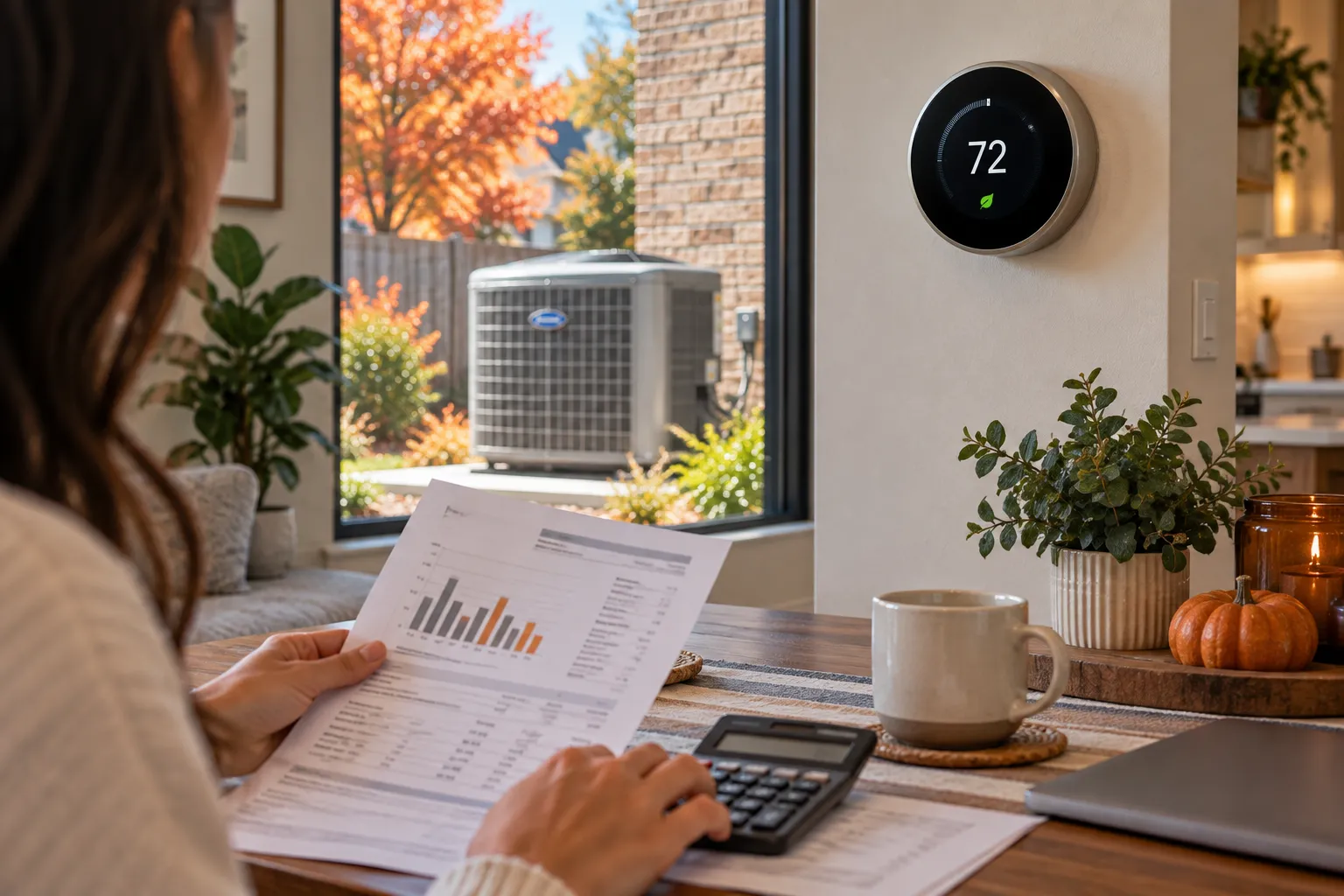
September in Houston means the worst of the summer electricity bills are behind you. July and August produced the peak cooling costs of 2026 — the months where the AC ran twelve or more hours a day against heat indexes pushing 105 degrees and Gulf humidity that never let up. Those bills are paid. The question now is what happens to your electricity costs through September, October, and into the fall transition — and whether there are specific actions you can take right now to reduce what you pay for the rest of 2026.
The answer is yes, and the timing of September makes several of those actions more effective than they would be at any other point in the year. Here's what actually reduces your Houston electricity bill as summer transitions to fall.
UNDERSTAND WHAT YOU'VE BEEN PAYING AND WHY
Before making changes, understanding the structure of your recent electricity bills tells you where the savings opportunities are largest.
Pull your July and August bills and find the kilowatt-hour consumption for each month. This number — not the dollar total, which varies with rate fluctuations — is the most direct measure of how much energy your home used during peak cooling season. For a typical Houston home between 1,800 and 2,500 square feet with a mid-efficiency AC system, summer monthly consumption commonly runs 1,500 to 2,500 kWh. Significantly above this range for your home's size indicates the AC system or the home envelope is less efficient than it should be.
Compare this summer's consumption to the same months in 2025. If consumption is higher this year with similar outdoor temperatures and the same household habits, efficiency has declined — in the AC system, in the home envelope, or both. That decline doesn't reverse on its own, and the gap between what you spent and what you should have spent represents money that more efficient operation would have saved.
Look at your electricity rate structure. Houston's deregulated electricity market means rate structures vary significantly between retail providers and between plan types. If you're on a flat-rate plan, the per-kilowatt-hour cost is the same regardless of when you use electricity. If you're on a time-of-use plan, electricity costs more during peak demand hours — typically 3pm to 7pm on weekdays — and significantly less during off-peak hours. Understanding which you have determines which optimization strategies produce the most savings.
THE IMMEDIATE ACTIONS THAT REDUCE BILLS STARTING THIS MONTH
Adjust the thermostat setpoint upward now that peak heat has passed. The hottest days of the 2026 Houston summer are behind you. September still produces warm afternoons, but the sustained 100-degree-plus heat indexes of July and August are increasingly rare as the month progresses. A thermostat that was set to 74 degrees to maintain comfort through the peak of summer can often be raised to 75 or 76 degrees in September without meaningful reduction in comfort — because the outdoor conditions that made 74 degrees feel necessary at peak are moderating. Each degree increase in the cooling setpoint reduces cooling energy consumption by approximately 3 to 5 percent. Moving from 74 to 76 degrees saves 6 to 10 percent on cooling energy for the days that setting applies.
Start using the setback strategy more aggressively as temperatures moderate. The setback temperature that was appropriate during peak Houston summer — 80 to 82 degrees while away from home — can be pushed higher as September outdoor temperatures moderate, because the home heats up more slowly on a 90-degree September day than on a 100-degree August day, and the recovery time when you return is shorter from a higher setback. A setback to 83 to 85 degrees while away is more feasible in September than in August without the same recovery time penalty.
Turn off unnecessary electronics and appliances that are generating heat indoors. This matters less as September outdoor temperatures moderate, but it's still a relevant factor on warm September afternoons. Every watt of electricity that appliances, electronics, and lighting consume inside the home becomes heat that the AC has to remove. LED lighting that produces minimal heat versus incandescent lighting that converts a significant fraction of its energy consumption to heat, electronics powered off rather than in standby mode during the day, and appliances run in the early morning or evening rather than the afternoon all reduce the internal heat load the AC is fighting.
Take advantage of natural ventilation on cooler September evenings. As the month progresses, September evenings in Houston increasingly reach temperatures where opening windows provides comfortable natural ventilation. On evenings when the outdoor temperature drops below the indoor temperature — which in Houston typically happens after 9pm or 10pm on September nights — opening windows and turning off the AC for the overnight period captures free cooling that reduces the morning restart cost. Close the windows again before 7am before outdoor temperatures begin climbing and before the AC has to fight against the daytime heat. This overnight ventilation strategy becomes more effective as September progresses and outdoor nighttime temperatures moderate further.
THE ELECTRICITY PLAN REVIEW — SEPTEMBER IS THE RIGHT TIME
September is one of the best months of the year to evaluate your electricity plan in Houston's deregulated market, for a specific reason — you have a full summer's worth of consumption data that accurately represents your peak usage behavior, and you have the next several months of lower-demand transition season ahead of you before the next peak period.
Shopping for a new electricity plan in September with full summer consumption data means you can accurately evaluate which plan structure — flat rate, time-of-use, indexed rate, or other structures — matches your actual usage pattern and produces the lowest cost over a full year. A flat-rate plan that seemed appropriate last year may not be the best option if your usage pattern has changed, if you've added an electric vehicle, or if your home's energy efficiency has improved through insulation or equipment upgrades.
Texas's deregulated electricity market allows switching retail providers relatively easily — typically with a few weeks notice before the new plan takes effect. Plan comparison tools available through the Public Utility Commission of Texas's Power to Choose website allow side-by-side comparison of available plans from all retail providers serving your address. Using this tool in September with your actual summer consumption data produces a more accurate cost comparison than using it without that data.
If your current plan is a fixed-rate plan that's approaching its contract end date, September is the time to evaluate renewal versus switching. Locking in a new rate in September — before winter demand affects market pricing and before any spring capacity concerns affect summer forward pricing — may produce better rate terms than waiting until the contract actually expires.
THE HVAC EFFICIENCY ACTIONS THAT REDUCE BOTH SEPTEMBER BILLS AND NEXT SUMMER'S BILLS
Several HVAC efficiency actions taken in September have a dual benefit — they reduce costs for the remaining weeks of the 2026 cooling season and they establish a starting condition that carries forward into next summer.
Professional condenser coil cleaning if the system hasn't had one since before summer. A condenser coil that's been accumulating debris for the full 2026 cooling season is operating at reduced efficiency — the fouling increases the compressor's workload and the electrical energy it consumes per unit of cooling produced. Cleaning the coil in September restores efficiency for the remaining weeks of cooling operation — producing energy savings for September and October — and removes the accumulated debris that would otherwise sit on the coil through fall and winter, affecting how efficiently the system restarts next spring.
Refrigerant charge verification if the system's performance declined during the summer. A system that was cooling adequately in June but seemed to struggle more in August — longer run times, higher bills, rooms that were harder to condition — may have experienced refrigerant loss from a slow leak during the season. Verifying the charge in September, while the system is still running regularly enough to test accurately, identifies this condition and allows it to be corrected. A system operating with a depleted refrigerant charge through the fall and winter — with the leak continuing to reduce the charge further — restarts next spring in a worse condition than it ended this summer.
Duct sealing if your home has significant duct leakage. Homes in established Houston communities with ductwork from the 1980s or 1990s commonly have significant leakage at joints and connections. Every cubic foot of conditioned air that leaks into the attic through a supply duct leak is energy paid for but not delivered to the living space. The Department of Energy estimates that homes with significant duct leakage lose 20 to 30 percent of conditioned air before it reaches the living space — a loss that shows up directly in the energy consumption and in energy bills. Duct sealing addressed in September reduces energy waste for the remaining cooling weeks, improves comfort in the shoulder season, and carries into next summer as a permanent efficiency improvement.
Attic insulation upgrade if the home's attic is significantly under-insulated relative to Houston's climate zone recommendations. Bringing attic insulation from R-13 or R-19 to the recommended R-38 to R-49 reduces the heat that enters the home through the ceiling — reducing the cooling load the AC has to manage and the energy it consumes managing it. This improvement applies to both the remaining September cooling weeks and to the full 2027 cooling season. The payback period for attic insulation in Houston's climate is typically three to five years through reduced cooling energy costs — a return that's better than most other home improvements in financial terms.
THE TIME-OF-USE OPTIMIZATION FOR HOUSEHOLDS WITH SMART THERMOSTATS
If you're on a time-of-use electricity plan and have a smart thermostat with demand response or scheduling capability, September is the month to set up the pre-cooling strategy that shifts energy consumption from expensive peak hours to cheaper off-peak hours.
The pre-cooling strategy for Houston's fall season works as follows. Program the thermostat to cool the home to one to two degrees below the normal comfort setpoint between 11am and 2pm — the period when electricity rates are typically in the mid-range on time-of-use plans before the afternoon peak pricing period begins. Then allow the thermostat to drift upward by one to two degrees from 3pm to 7pm — the peak pricing window on most time-of-use plans — before returning to the normal comfort setpoint for the evening.
The home's thermal mass — the floors, walls, furniture, and building materials that store and release heat — acts as a thermal battery. Pre-cooling stores cool energy in the thermal mass during the off-peak period, and that stored cool energy releases slowly during the peak period as the thermostat allows the temperature to drift slightly upward. The home stays in a comfortable range throughout — the drift from the pre-cooled temperature to the slightly elevated peak-period setpoint is gradual and typically imperceptible — while the energy consumed during peak pricing hours is reduced.
In September, as outdoor temperatures moderate and the cooling load decreases relative to peak summer, this strategy becomes more effective because the thermal mass retains the pre-cooled temperature for longer before the peak-period drift reaches the upper edge of the comfort range. A home that could only hold a two-degree pre-cooling benefit for an hour in August may hold it for two to three hours in September — a longer period during which peak-priced electricity consumption is reduced.
THE NATURAL GAS BILL THAT'S COMING — PREPARING FOR HEATING SEASON COSTS
Houston homeowners who heat with natural gas — the majority of homes with conventional split systems — have been paying minimal gas bills through the summer. The fall transition brings the first heating demand that will begin producing gas consumption and the associated costs.
Texas's natural gas market is deregulated in a similar structure to the electricity market, and the pricing that retail gas customers pay is affected by wholesale market conditions, storage levels, and demand patterns. The winter of 2025-2026 gas pricing is something that was determined by market conditions in the months preceding the heating season — and the winter of 2026-2027 pricing is being shaped by the same factors right now.
For Houston homeowners who are on variable-rate natural gas plans — plans where the gas price per therm adjusts monthly based on market conditions — locking into a fixed-rate plan for the heating season may produce cost certainty that the variable rate doesn't provide. Whether a fixed rate is better or worse than staying on a variable rate depends on market conditions that are difficult to predict, but the certainty of a known rate has value when budgeting for winter heating costs.
A furnace that's operating efficiently — clean burners, correctly sized for the home, properly calibrated controls — uses less gas per BTU of heat delivered than a neglected furnace. The fall heating inspection that's been described as an HVAC readiness action also has a direct energy cost benefit — a furnace that's been tuned for efficient combustion consumes less gas per heating cycle than one that hasn't been serviced.
THE BIGGER PICTURE — WHAT FALL ENERGY MANAGEMENT LOOKS LIKE IN HOUSTON
September through November in Houston represents a transitional energy period that most homeowners manage less intentionally than they manage peak summer or peak winter. The cooling costs are moderating but not zero. The heating costs are beginning but not yet significant. The opportunity to make changes that carry forward into both the remaining cooling weeks and the next heating season is at its highest because the urgency of peak demand isn't dictating every decision.
The households in Greater Houston that manage their energy costs most effectively through this transition aren't the ones with the newest equipment or the most sophisticated smart home technology — they're the ones who understand their consumption, know their rate structure, maintain their equipment consistently, and make adjustment decisions at the right time in the seasonal cycle.
September 2026 is that time. The actions described above — thermostat adjustments, plan evaluation, professional maintenance, duct sealing, insulation assessment — are all more effectively and more easily done now than they will be when the next peak season is approaching and urgency is compressing the decision timeline.
Multipoint AC & Heating provides HVAC maintenance, duct sealing, system repair, and installation throughout Greater Houston, including Harris County, Fort Bend County, Montgomery County, and Austin County. For questions about your system's efficiency heading into fall or to schedule end-of-season service, contact us at 832-963-3789.