Should You Leave Your AC Running When You Leave the House in Houston?
Learn how to set your AC for energy savings and home protection when you're away in Houston's heat.
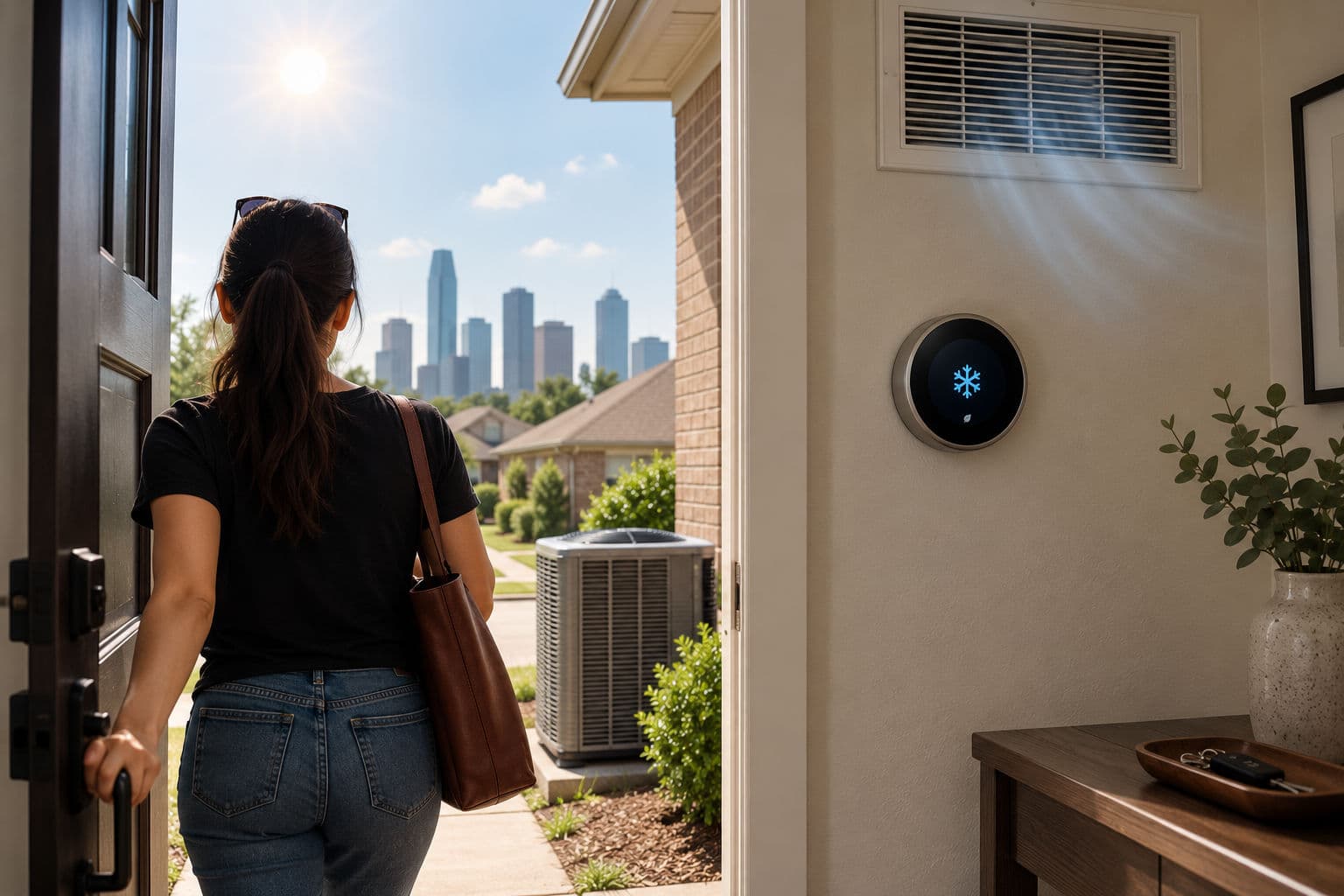
This is a question Houston homeowners debate every summer, and the answer matters more here than it would in a more moderate climate. Do you turn the AC off when you leave for work, leave it running at the normal setting, or find some middle ground? The stakes are higher in Houston than in most cities because the consequences of getting this wrong go beyond a higher electric bill — in peak summer conditions, a home without air conditioning in Houston can reach temperatures that damage belongings, promote mold growth, and create conditions that are dangerous for pets.
Here's what actually makes sense for Houston homeowners based on how the climate and your equipment actually work.
THE CASE FOR TURNING IT OFF — AND WHY IT DOESN'T HOLD UP IN HOUSTON
The logic behind turning the AC off when you leave seems straightforward: if no one is home to benefit from the cooling, why pay to cool an empty house? In a moderate climate with mild summers, this approach can save energy without significant consequences.
In Houston in July, it falls apart quickly.
When a Houston home sits without air conditioning on a peak summer day, indoor temperatures climb dramatically and faster than most people realize. On a day where the outdoor temperature is 98 degrees and the heat index is pushing 108, an unoccupied home with the AC off can reach indoor temperatures of 90 to 100 degrees within a few hours. At those temperatures, wooden furniture and flooring expand and warp. Electronics, candles, and other heat-sensitive items are damaged. Humidity levels inside the home spike rapidly because the AC is no longer removing moisture from the air, and at high temperature combined with high humidity, conditions favorable to mold growth in wall cavities, ductwork, and building materials develop faster than most homeowners expect.
If you have pets at home, turning the AC off in a Houston summer is genuinely dangerous. Indoor temperatures in an unventilated home can reach levels that are life-threatening to animals within hours of the AC being turned off on a peak summer day.
Beyond the comfort and safety issues, there's an equipment consideration. When an AC system is turned completely off and then restarted to cool a home that's reached 90 or 95 degrees indoors, it has to work against the maximum possible temperature differential — and it does so while the thermal mass of the home's walls, flooring, and furnishings are all radiating stored heat into the space. The system runs at maximum capacity for an extended period to pull the indoor temperature down, which puts significantly more wear on the compressor than maintaining a moderately elevated temperature throughout the day would have.
THE CASE FOR LEAVING IT AT YOUR NORMAL SETTING — AND WHY THAT'S ALSO NOT OPTIMAL
Leaving the thermostat at 72 or 74 degrees all day while the house is empty is comfortable when you walk in the door, but it means paying to cool an unoccupied home to full comfort levels for eight or more hours. In Houston's peak summer, that's a meaningful energy cost that serves no one while you're at work.
THE ACTUAL ANSWER — A SETBACK TEMPERATURE
The approach that makes the most sense for Houston homeowners is a setback temperature rather than a complete shutdown. Rather than turning the AC off or leaving it at full comfort settings, you raise the thermostat to a higher temperature while you're away — typically 78 to 82 degrees — and return it to your normal comfort setting before you come home.
This approach keeps the home from reaching the damaging temperatures that a complete shutdown produces, maintains a humidity level that doesn't promote mold growth, protects pets and heat-sensitive items, and reduces the energy cost of cooling an unoccupied home — while avoiding the compressor strain and recovery time that restarting a fully overheated home requires.
The Department of Energy recommends 78 degrees when home and as high as 85 when away during summer. In Houston's climate, 78 to 82 degrees is a practical setback range for most homes — high enough to meaningfully reduce energy consumption while away, but not so high that the home's thermal mass stores enough heat to make recovery difficult when you return.
HOW MUCH DOES THE SETBACK TEMPERATURE MATTER
Every degree you raise the thermostat above your normal comfort setting reduces cooling energy consumption by roughly 3 to 5 percent for that period. A home set to 80 degrees for eight hours while you're at work instead of 74 degrees is using meaningfully less energy to maintain that temperature than it would to maintain 74 degrees, while still keeping the home within a range that protects its contents and allows for reasonable recovery time when you return.
The recovery time question matters for Houston homeowners. A home that's been holding at 80 degrees all day while you're at work can typically return to 74 degrees within 30 to 45 minutes when the thermostat is adjusted — faster in well-insulated homes, potentially longer in older homes with inadequate attic insulation. If the setback temperature is too high — say, 88 or 90 degrees — the recovery time extends significantly and the system runs at full capacity for a long period, which reduces the energy savings from the setback and puts compressor strain back into the equation.
A SMART THERMOSTAT MAKES THIS EFFORTLESS
The practical challenge with a manual setback strategy is remembering to adjust the thermostat every day when you leave and remembering to set it back before you return. A programmable or smart thermostat solves this entirely. You program the schedule once — temperature goes up when you leave, comes back down to your comfort setting before you return — and the system handles it automatically every day without any action required.
Smart thermostats with geofencing capability can use your phone's location to detect when you've left home and when you're returning and adjust the temperature accordingly without a fixed schedule. For Houston homeowners with irregular schedules, this is more practical than programming specific times.
If your home doesn't have a programmable or smart thermostat, installing one is one of the lowest-cost, highest-return HVAC improvements available. The energy savings from consistent setback scheduling during a Houston cooling season typically pay back the cost of a basic programmable thermostat within a single summer.
WHAT ABOUT HUMIDITY WHEN YOU RAISE THE SETBACK TEMPERATURE
This is a valid concern specific to Houston's climate. When the thermostat is set higher and the AC runs less frequently, the system removes less moisture from the air during those hours. In Houston's ambient humidity environment, indoor relative humidity can climb meaningfully during a setback period — particularly in homes near waterways or in parts of the metro with consistently elevated outdoor humidity.
For most Houston homes, a setback to 78 to 82 degrees doesn't push indoor humidity high enough to cause problems during a normal workday absence. The system runs often enough at those settings to keep humidity from climbing to the range where mold growth is actively promoted. Setting the thermostat back to 85 or higher is where humidity management starts to become a more significant concern in Houston's climate.
For homeowners with whole-home dehumidifiers, this concern is largely addressed — the dehumidifier maintains indoor relative humidity within a controlled range independently of the AC cycle, which allows a higher setback temperature without the humidity climbing to problematic levels.
SPECIAL CIRCUMSTANCES THAT CHANGE THE ANSWER
Pets at home change the calculus entirely. If you have pets in the home, the setback temperature should reflect what's safe for the animals rather than what's optimal for energy savings. Dogs and cats are vulnerable to heat stress at indoor temperatures above 80 to 85 degrees, particularly in Houston's humidity, and the setback temperature should stay within a safe range for whatever animals are in the home.
Extended absences — vacations, multi-day trips — warrant a different approach than a daily work commute. For extended periods away from home in Houston summer, a setback to around 80 to 82 degrees is the generally recommended range. High enough to save meaningful energy over several days, low enough to protect the home from the humidity and heat damage that a complete shutdown or very high setback would cause over an extended period.
Older homes with poor attic insulation or significant duct leakage recover more slowly from higher setback temperatures because they absorb more heat during the setback period and release it more slowly when the system works to recover. In these homes, a more conservative setback — 78 to 80 degrees rather than 82 to 85 — produces a better balance of savings and recovery time.
THE BOTTOM LINE FOR HOUSTON
Don't turn it off completely. Don't leave it at full comfort settings all day. Set it back to 78 to 82 degrees while you're away, program a smart thermostat to handle the adjustment automatically, and let the system maintain a reasonable holding temperature that protects your home and equipment without paying to cool an empty house to full comfort levels.
In Houston's climate, that middle ground is the approach that makes the most financial sense, protects the equipment, and keeps the home in a condition that's easy to recover from when you return.
Multipoint AC & Heating provides AC repair, maintenance, and installation throughout Greater Houston, including Harris County, Fort Bend County, Montgomery County, and Austin County. Contact us for any questions about your HVAC system or to schedule a service visit.