How New Construction HVAC in Houston Differs From Replacing an Existing System
Discover the key differences in HVAC systems for new construction versus replacements in Houston, impacting home comfort and efficiency.
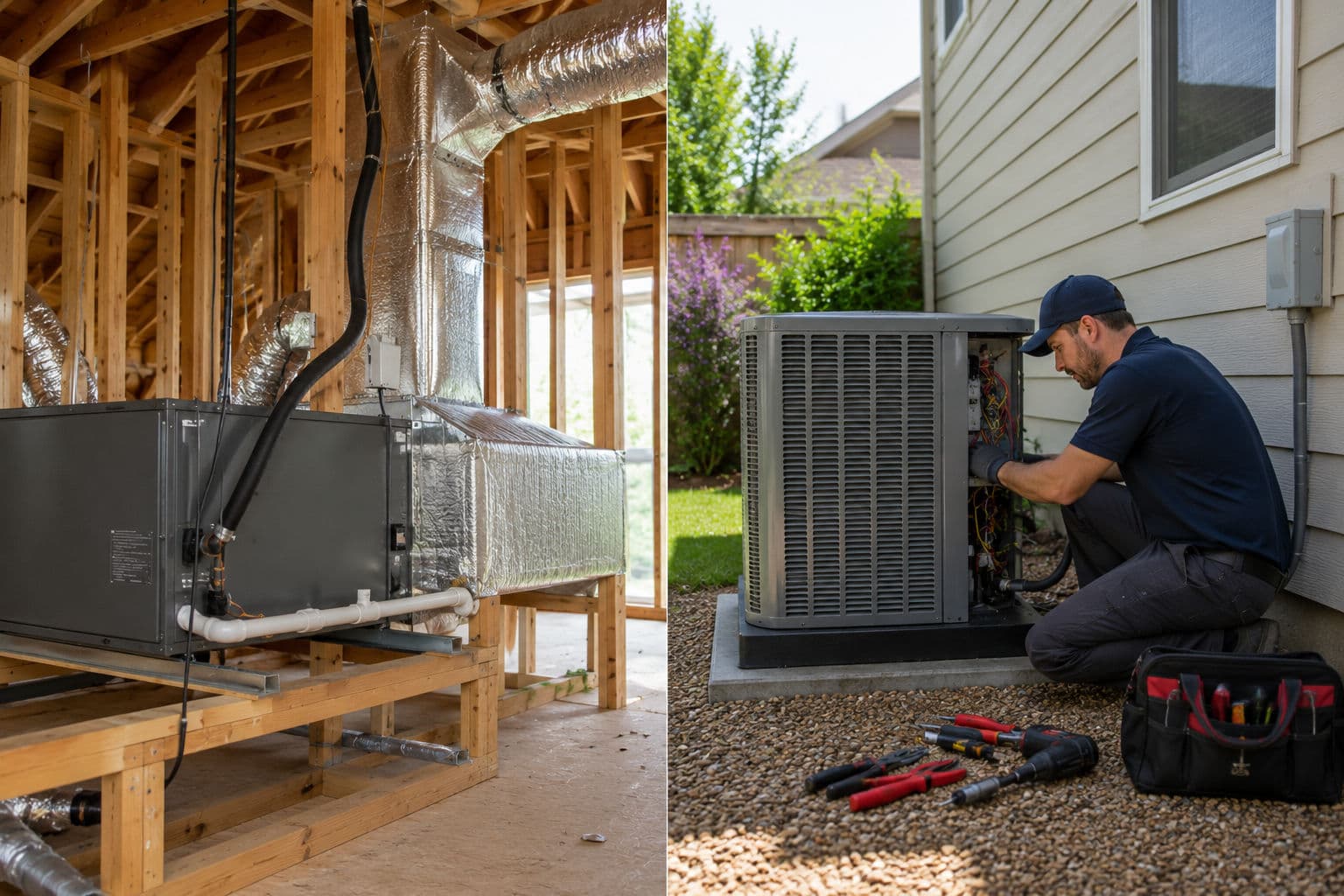
Houston's residential construction market has been one of the most active in the country for the past decade. Communities like Fulshear, Conroe, New Caney, Tomball, Cypress, and the expanding edges of virtually every major Fort Bend County and Montgomery County suburb have seen substantial new home construction that shows no sign of slowing. For every one of those new homes, an HVAC system goes in during construction — and the decisions made at that point, by the builder or the HVAC contractor they use, determine how the system performs for the next twelve to fifteen years.
New construction HVAC is a different conversation from replacing a system in an existing home, and the differences matter more in Houston's climate than they would in a more moderate market. Here's what those differences are and what homeowners moving into newly constructed Houston homes — or planning new construction — should understand about the system that was installed before they arrived.
THE LOAD CALCULATION PROBLEM IN NEW CONSTRUCTION
In an existing home, the load calculation can be performed on a building that's physically present — the insulation is in, the windows are installed, and the actual characteristics of the home can be measured. In new construction, the load calculation often happens before any of those elements are finalized, based on design documents and specifications rather than what's actually built.
This creates a specific risk. When a builder or their HVAC subcontractor sizes equipment based on design specifications, and those specifications change during construction — a different window package, adjusted insulation specifications, a floor plan modification — the load calculation doesn't automatically update. The system that goes in may be sized for a home that's different from the one that was actually built.
In Houston's construction boom, where subcontractors are often working at high volume across multiple projects simultaneously, the thoroughness of the load calculation process varies significantly. Some builders require their HVAC contractors to perform proper Manual J calculations that are updated if specifications change. Others allow sizing by square footage rule of thumb or by matching standard equipment packages to floor plan ranges without site-specific calculation.
The practical consequence shows up in the home's comfort and energy performance after move-in. Oversized equipment — the most common error in new construction — produces the short-cycling and humidity management problems that Houston homeowners in newer communities frequently experience: a home that reaches the temperature setpoint quickly but never feels dry and comfortable because the system doesn't run long enough per cycle to remove adequate moisture from the air.
DUCT SYSTEM QUALITY IN NEW CONSTRUCTION
The duct system is where the largest quality variation in new construction HVAC exists, and it's also where problems have the most persistent effect on comfort and energy performance.
In new construction, ductwork is typically installed after framing is complete but before walls are closed, which means it's accessible for inspection before the drywall goes up. After the drywall is installed, ductwork is hidden inside walls and ceilings and not accessible for inspection without opening the structure. This creates a situation where duct quality at installation determines performance for the system's entire service life, but the window for catching problems is narrow and not always utilized.
Common duct quality issues in new Houston construction include flex duct installed with excessive length and slack that creates kinks and restrictions affecting airflow, duct connections at fittings that are secured but not properly sealed allowing significant air leakage from day one, return air systems that are undersized for the equipment installed or that pull return air exclusively from a single central location rather than from multiple points near the actual loads, and attic duct routing that puts supply ducts in close proximity to hot roof surfaces without adequate insulation separation.
Energy codes in Texas require duct systems to meet a leakage standard verified by post-construction testing — typically a blower door test or duct pressurization test before occupancy. Whether this testing is actually performed, how rigorously it's interpreted, and whether identified leakage is corrected before the certificate of occupancy is issued varies by jurisdiction and by builder practice. In some Houston-area jurisdictions the enforcement is thorough. In others, the required testing becomes a procedural checkbox rather than a meaningful quality verification.
Homeowners moving into newly constructed Houston homes who have concerns about duct system quality can request a duct leakage test as part of a new home inspection, or commission one independently from a qualified HVAC contractor. A duct system that tests within the code threshold for leakage is performing acceptably. A duct system that tests significantly below threshold may still benefit from improvement even if it technically passes — the code threshold is a minimum standard, not an optimal target.
REFRIGERANT CHARGING IN NEW CONSTRUCTION
One of the most common installation quality issues in new construction HVAC throughout the Houston area is incorrect refrigerant charge at commissioning. Setting the correct refrigerant charge on a new system requires measuring actual system performance — pressures, temperature differentials, subcooling and superheat — under operating conditions and adjusting the charge until all parameters are within specification.
This process takes time and requires the technician to run the system through a full operating cycle while measuring performance. In new construction environments where multiple systems are being commissioned on tight schedules, the thorough commissioning process is sometimes abbreviated — refrigerant is charged to a factory-specified weight rather than being tuned to actual operating conditions, or the commissioning is performed in weather that doesn't allow the system to operate at the conditions where correct charging can be verified.
A system with an incorrect refrigerant charge from commissioning performs below its rated capacity and efficiency from day one. In Houston's climate, where cooling capacity and dehumidification performance directly affect comfort, an undercharged or overcharged system produces comfort complaints that the homeowner attributes to the system having a problem when the actual issue is the commissioning quality.
If a newly constructed Houston home has comfort complaints — particularly if the home feels humid despite the AC running, or if cooling capacity seems lower than expected — refrigerant charge verification is one of the first things worth checking. An improperly charged system from a new installation is a commissioning issue, not necessarily an equipment defect.
EQUIPMENT SELECTION IN BUILDER PROGRAMS
Most production builders in Houston's residential market have preferred vendor relationships or builder programs with HVAC equipment manufacturers and distributors. These programs provide equipment at volume pricing in exchange for installation volume commitments, and the economics typically favor the builder rather than the homeowner.
The equipment selected under builder programs tends to be at the lower end of the efficiency range — meeting minimum code requirements rather than offering higher efficiency tiers — and is sized in standard configurations that may not precisely match the load calculation results for specific floor plans. A builder's standard HVAC package for a particular floor plan range may have been developed for average conditions rather than the specific orientation, window package, and insulation specifications of any individual home within that range.
This isn't inherently problematic — the equipment installed under builder programs is typically code-compliant and functional — but it means that homeowners who move into newly constructed Houston homes shouldn't assume that the installed system represents an optimal selection for their specific home. The first time a system reaches end of life in a newly constructed home is an opportunity to correct any sizing or efficiency decisions made during construction.
WHAT'S DIFFERENT ABOUT HVAC SERVICE ON A NEW CONSTRUCTION SYSTEM
New construction HVAC systems in Houston typically come with a manufacturer's warranty on parts and a contractor's warranty on labor — usually one year on labor from the installing contractor. What many homeowners don't fully understand is that the manufacturer's parts warranty is conditional on proper installation, commissioning, and annual maintenance.
A manufacturer warranty that's voided by improper commissioning, by operation at an incorrect refrigerant charge, or by missed maintenance visits in the first years of operation is a warranty that provides no protection when a component fails. Understanding the warranty terms and ensuring the conditions are met — starting with verifying that the system was correctly commissioned and then maintaining annual maintenance visits from year one — is the homeowner's responsibility even on brand-new equipment.
The first year maintenance visit on a newly constructed Houston home's HVAC system is particularly important because it's the first opportunity to evaluate whether the commissioning was done correctly. A technician verifying refrigerant charge on a one-year-old system who finds it significantly off from specification has identified a commissioning quality issue that's been affecting performance since installation — and that can be corrected before it's been affecting the system for years rather than months.
COMMON COMPLAINTS FROM NEWLY CONSTRUCTED HOUSTON HOMES
Several comfort and performance complaints are disproportionately common from homeowners in newly constructed Houston homes — complaints that trace to the new construction HVAC issues described above rather than to equipment failure.
The home feels humid despite the AC running. This is the most common complaint in newly constructed Houston homes and almost always traces to either an oversized system that's short cycling, an incorrectly charged system that's not dehumidifying effectively, or ductwork that's delivering less supply air to the living space than the equipment is producing because of installation leakage or restriction.
Specific rooms are significantly harder to cool than others from the first summer. This points to duct delivery issues — rooms that are receiving less supply air than they need because of duct restrictions, leaks, or balancing problems in the duct system. It can also indicate that the equipment sizing for the system's overall capacity relative to specific zone loads wasn't properly matched.
The system runs more than expected for a new, efficient home. A new system in a new, tight, well-insulated home should run less than an aging system in an older home. If a new construction system in Houston is running nearly continuously during summer afternoons, it may be undersized for the actual load — which can result from a load calculation that didn't account for actual as-built specifications — or there may be duct leakage that's reducing the effective capacity being delivered to the living space.
Energy bills that are higher than neighbors with similar homes. Comparing energy bills to neighbors' in the same development with the same or similar floor plans is an imperfect but useful sanity check on system performance. If a home with a similar floor plan, similar occupancy, and similar thermostat habits has significantly lower summer energy bills, the system's efficiency, the duct system's leakage rate, or both are worth evaluating.
WHAT TO DO IF YOU'RE MOVING INTO A NEWLY CONSTRUCTED HOUSTON HOME
Request documentation of the load calculation and commissioning from the builder before closing. A builder's HVAC contractor should be able to provide a load calculation document showing the basis for equipment sizing and a commissioning report showing the refrigerant charge and system performance at commissioning. Not all builders provide this proactively, but it's reasonable to request it and the documentation exists if the commissioning was done properly.
Schedule a first-year maintenance visit in the spring of the first cooling season. This verifies commissioning quality, establishes a maintenance baseline, and registers the system for warranty compliance. A technician who checks refrigerant charge on a one-year-old system and finds it within specification confirms that the commissioning was done correctly. One who finds it off provides an early opportunity to correct it.
If comfort complaints appear in the first summer, address them promptly rather than assuming they'll resolve. A new system with an incorrect refrigerant charge, duct leakage, or balancing problems doesn't correct itself with time — it continues performing at its current level until someone identifies and addresses the specific issue. The first cooling season is the right time to identify and correct new construction issues while the system is still within the contractor's labor warranty period.
Consider a whole-home dehumidifier if humidity complaints persist after other new construction issues have been addressed. Some newly constructed Houston homes in tight, well-insulated envelopes have humidity management needs that the AC system alone can't meet — particularly during shoulder seasons when the system doesn't run consistently enough to manage the moisture load. This is different from a system problem — it's an acknowledgment that Houston's humidity environment sometimes exceeds what the AC cycle can manage without supplemental dehumidification.
Multipoint AC & Heating provides HVAC diagnostic, commissioning verification, new installation, and maintenance throughout Greater Houston, including Harris County, Fort Bend County, Montgomery County, and Austin County. If you've moved into a newly constructed home and have questions about your HVAC system's performance, contact us to schedule a diagnostic visit.