Why Your Houston AC Smells Strange When It Runs
Discover the reasons behind strange AC smells in Houston homes, what they indicate, and when professional intervention is needed.
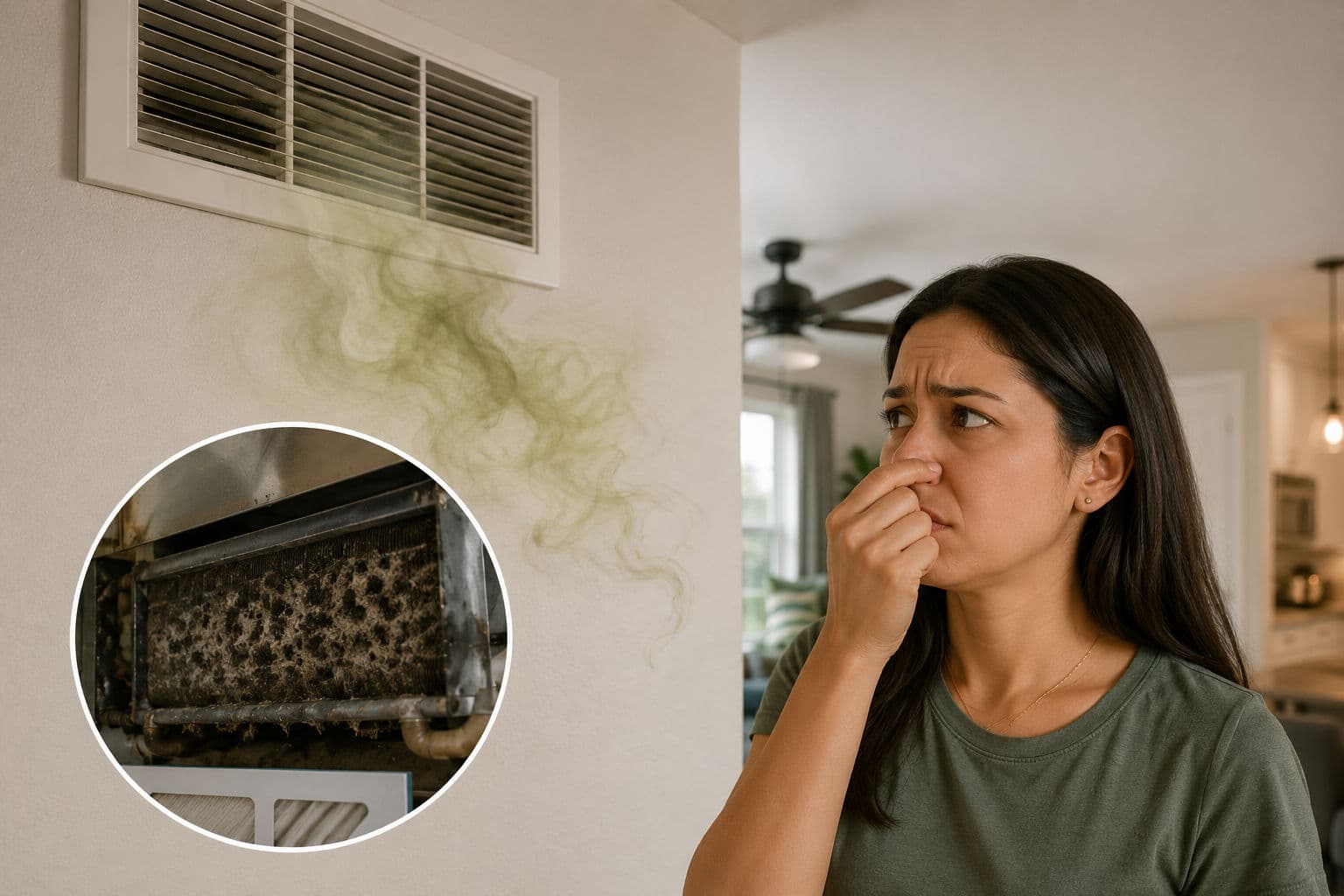
Most Houston homeowners notice it the same way — the AC kicks on and within a few minutes there's a smell coming from the vents that wasn't there before. Sometimes it's subtle. Sometimes it's strong enough to make you get up and investigate. Either way, an unusual odor from your air conditioning system is worth paying attention to because different smells point to very different causes, and a few of them warrant immediate action rather than a wait-and-see approach.
Here's what the most common AC smells in Houston homes actually mean.
MUSTY OR MILDEW SMELL
This is the most common AC odor complaint we hear throughout the Greater Houston area, and it's directly tied to Houston's humidity environment. A musty smell from the vents when the system runs almost always indicates biological growth somewhere in the system or ductwork — mold, mildew, or bacterial colonies that have established themselves in a moist environment and are getting circulated through your home every time the blower runs.
The most common locations where this growth develops are the evaporator coil surface, the condensate drain pan, the interior of the air handler cabinet, and the ductwork itself — particularly in older flex duct systems in established Houston communities where moisture has accumulated over years of operation.
In Houston's climate this isn't a rare or unusual finding. The combination of high ambient humidity, a coil that's constantly wet from condensation, and a drain pan that's always handling water creates exactly the conditions biological growth needs. What makes it more or less severe is how well the system is maintained — clean coils, a clear condensate drain, and a UV germicidal system at the air handler all significantly reduce biological growth in the system.
A musty smell that appears at the start of the cooling season after the system has been idle is sometimes just accumulated dust burning off the heat exchanger — this usually dissipates within a few minutes of operation. A musty smell that persists throughout operation or gets worse over time points to active biological growth that needs to be addressed.
Professional coil cleaning and condensate drain clearing resolve most musty smell complaints. For persistent odors or homes where the smell returns quickly after cleaning, a UV germicidal system installed at the air handler addresses biological growth at the source on an ongoing basis.
ROTTEN EGG OR SULFUR SMELL
This is the one smell on this list that warrants immediate action. Natural gas is odorless in its natural state, but gas utilities add mercaptan — a sulfur compound — to create the rotten egg smell that alerts you to a gas leak. If you smell rotten eggs or sulfur when your HVAC system runs, do not assume it's coming from the AC system itself.
Leave the home immediately without operating any electrical switches, open flames, or anything that could create a spark. Call your gas utility's emergency line from outside or from a neighbor's home. Do not re-enter until the utility has confirmed the home is safe.
Natural gas leaks near HVAC equipment are uncommon but not impossible — a gas furnace or heat pump with gas backup has gas lines in proximity to the air handler, and a leak at a fitting or connection can introduce gas odor into the airstream. This is a situation that requires emergency response, not investigation.
BURNING SMELL
A burning smell from the AC system has several possible causes that range from harmless to serious.
A burning dust smell at the beginning of the cooling season — particularly the first few times the system runs after a long idle period — is usually exactly what it sounds like: dust that settled on the heating elements, motor housings, or other warm components during the offseason burning off as the system runs. This typically dissipates within the first few minutes of operation and doesn't return. If it persists beyond the first run or returns every time the system starts, it's worth investigating further.
A burning plastic or electrical smell is more concerning. This typically indicates an electrical component that's overheating — a capacitor that's failing, a motor winding that's developing a short, a wiring connection that's loose and arcing, or a control board with a failing component. Electrical burning smells that persist or intensify during operation are a sign to turn the system off and call for service rather than continuing to run it. Electrical failures in HVAC equipment can progress from an overheating component to a more serious electrical problem if the system keeps running.
A burning rubber smell can indicate a belt-driven blower in an older system where the belt has slipped or is wearing — less common in newer equipment but still present in some older Houston homes with original or early-replacement systems.
EXHAUST OR CHEMICAL SMELL
An exhaust-like smell from the vents during AC operation can indicate refrigerant leaking into the airstream. Refrigerant has a faintly sweet chemical odor that some people describe as exhaust-like or chemical. In high concentrations refrigerant can cause dizziness and respiratory irritation, and a detectable refrigerant smell from the vents is a sign that a leak has reached a point where it needs immediate professional attention — both for health reasons and because the refrigerant loss is affecting system performance.
A chemical smell that comes from the outdoor unit area specifically, rather than from the indoor vents, may be related to the industrial environment in parts of the Greater Houston area — communities near the Ship Channel corridor, Baytown, Channelview, and Pasadena sometimes experience outdoor chemical odors that get pulled into the home through the AC system's return air. This is an air quality and ventilation issue rather than a system problem, but it's worth discussing filtration and ventilation solutions if it's an ongoing concern.
DIRTY SOCK SMELL
A smell sometimes described as dirty socks or locker room from the AC vents is specifically associated with a phenomenon called dirty sock syndrome — bacterial growth on the evaporator coil that produces a distinctive odor when the system starts up. It's most noticeable at startup and may fade as the system continues to run. In Houston's humidity, dirty sock syndrome is more common than in drier climates because the evaporator coil stays wet more consistently, providing the moisture environment the responsible bacteria need to establish themselves.
Professional coil cleaning addresses the immediate problem. UV germicidal systems prevent recurrence by continuously treating the coil surface where the bacterial growth establishes itself. Dirty sock syndrome is one of the most common reasons Houston homeowners ask about UV system installation after a service visit.
SWEET OR CHLOROFORM-LIKE SMELL
A sweet or slightly chemical smell similar to chloroform or ether from the indoor unit or vents is a relatively reliable indicator of a refrigerant leak at or near the evaporator coil. Different refrigerant types have slightly different odors, but most produce a faintly sweet chemical smell in small concentrations. This is different from the sharp chemical smell of a large refrigerant release — it's subtle enough that some homeowners describe it as almost pleasant before they realize something is wrong.
If you notice a consistent sweet chemical smell from your vents that you can't attribute to anything else — air fresheners, cleaning products, or other household sources — having the system checked for a refrigerant leak is worth doing. The system's cooling performance will be declining as the refrigerant level drops, and catching the leak before it progresses further protects the compressor from the damage that low-refrigerant operation causes over time.
STALE OR STUFFY SMELL
A stale, stuffy, or generally unpleasant non-specific odor from the vents is usually a ductwork issue rather than an equipment problem. In older Houston homes with aging flex duct systems — properties in Katy, Sugar Land, Missouri City, Humble, Spring, Pearland, and similar established communities where housing stock from the 1980s and 1990s is common — ductwork accumulates years of dust, debris, and biological material that gets disturbed and circulated every time the system runs. Duct sealing, duct cleaning, and in some cases duct replacement address the source of the odor rather than just masking it.
Stale odors can also indicate that the system is pulling air from attic or wall spaces through leaky return ducts — introducing whatever is in those spaces into the airstream. Attic air in Houston carries insulation particles, biological material, and the general smell of a very hot enclosed space, and return duct leaks that pull attic air into the system are a common finding in older Houston homes.
WHAT TO DO WHEN YOUR AC SMELLS WRONG
For a rotten egg or sulfur smell, leave the home immediately and call your gas utility. This is the only smell on this list that requires you to exit before doing anything else.
For a burning electrical smell that persists or intensifies, turn the system off and call for service. Don't continue running equipment that smells like it's overheating electrically.
For musty, dirty sock, sweet chemical, or stale odors, schedule a service visit. These are maintenance and repair issues that won't resolve on their own and in most cases get worse with continued operation — but they're not emergency situations that require immediately shutting the system off.
For a burning dust smell at the very start of the season that dissipates quickly, monitor it through the first few run cycles. If it clears up and doesn't return, it's likely harmless seasonal dust burnoff. If it persists, have it checked.
Multipoint AC & Heating provides AC diagnostic, repair, and maintenance service throughout Greater Houston, including Harris County, Fort Bend County, Montgomery County, and Austin County. For urgent AC issues or to schedule a diagnostic visit, contact us any time — our 24/7 emergency service is available when you need it.