How to Tell If Your AC Capacitor Is Bad in Houston
Understand signs of a failing AC capacitor in Houston's climate and learn when to seek professional help to prevent costly repairs.
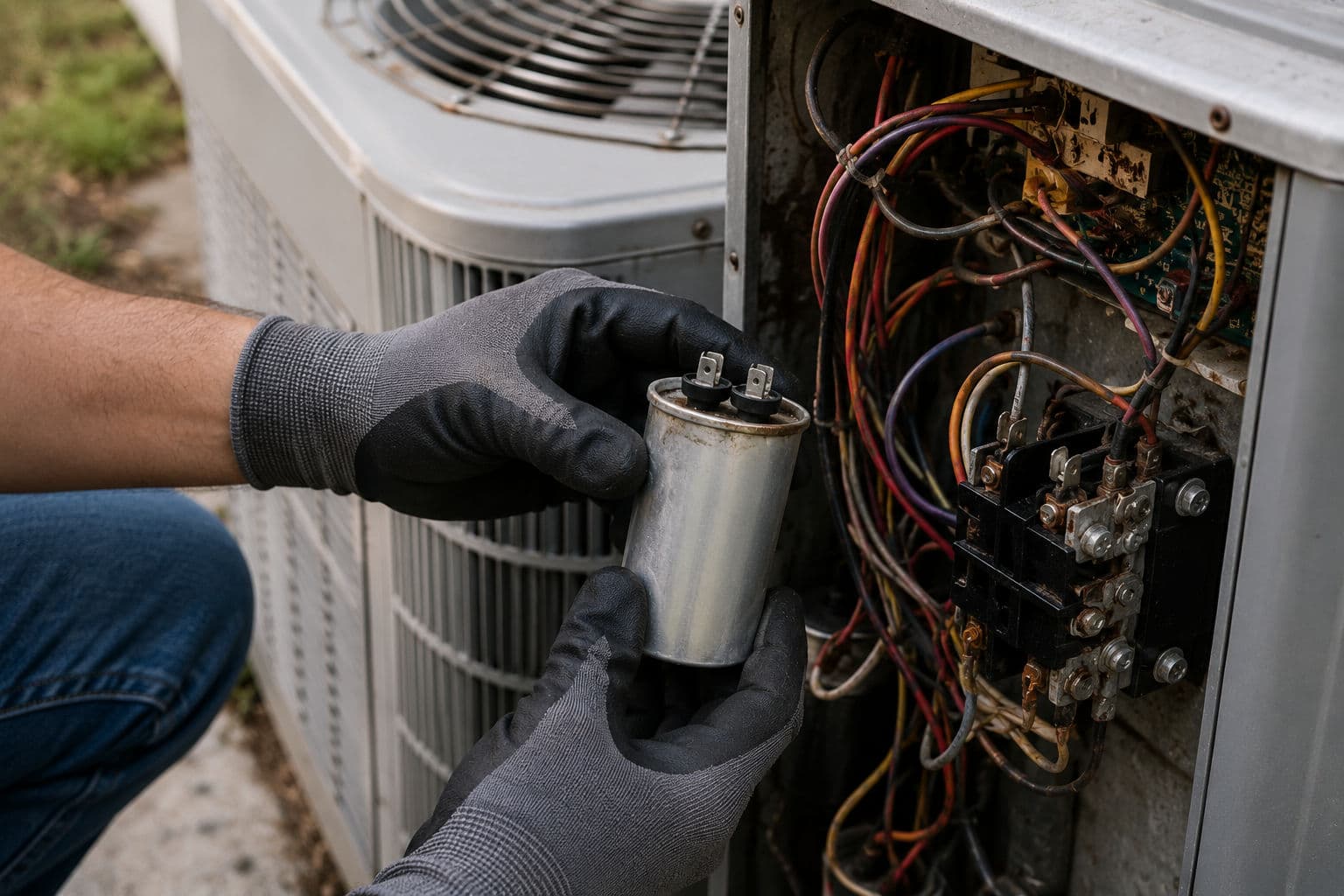
If there's one AC component that fails more consistently across Greater Houston than any other, it's the capacitor. Capacitor failure accounts for a significant percentage of the service calls we handle throughout Harris County, Fort Bend County, and Montgomery County during summer — and it's one of those failures that homeowners often don't see coming because the warning signs are easy to miss or misattribute to something else.
Understanding what a capacitor does, what it looks like when one is failing, and what to do about it helps you respond quickly when it happens rather than running a system that's damaging itself trying to compensate for a component that can no longer do its job.
WHAT A CAPACITOR DOES
Your AC system has two or three capacitors depending on its configuration — a start capacitor, a run capacitor, or a dual run capacitor that handles both functions in a single component. The most commonly replaced is the dual run capacitor, which manages both the compressor and the condenser fan motor.
The capacitor's job is to provide and sustain the electrical charge that starts and runs the motors in your AC system. Think of it as a short-term battery that delivers a powerful burst of electricity to get the compressor and fan motor started, then continues to supply supplemental power to keep them running efficiently. Without a functioning capacitor, the motors either can't start at all or run at reduced efficiency that puts excessive strain on the components they're meant to support.
In Houston's climate, capacitors are under more sustained stress than in moderate climates. The extended cooling season means they're working for eight or more months per year rather than three or four. The heat — both from the electrical load they carry and from the ambient temperature inside the outdoor cabinet, which can reach extreme levels during Houston summers — accelerates the degradation of the capacitor's internal components. The result is that capacitors on Houston-area systems fail earlier and more frequently than the same components on systems in cooler, shorter-season markets.
A capacitor that's within its service life in Minneapolis may be approaching failure after the same number of years in Houston because the total electrical and thermal stress it has accumulated is significantly higher.
SIGNS YOUR CAPACITOR IS FAILING
The symptoms of a failing capacitor are specific enough that recognizing them gives you a good initial indication of what's wrong before a technician confirms it.
The AC struggles to start. The system attempts to turn on, you hear a humming sound from the outdoor unit, but the compressor and condenser fan take longer than normal to reach full speed — or they try to start, hum, and then give up. This is one of the clearest signs of a capacitor that's no longer providing adequate starting power. The motors are trying to start but aren't receiving the electrical support they need to overcome the initial resistance.
The outdoor unit hums but doesn't run. You can hear the system attempting to operate — there's an electrical hum from the outdoor unit — but neither the compressor nor the condenser fan is actually running. This is a failing capacitor scenario in many cases. The contactor has closed and power is reaching the motors, but without adequate capacitor support they can't start.
The AC runs but doesn't cool as well as it should. A capacitor that's losing capacity rather than failing completely may still allow the system to start and run, but the motors operate less efficiently than they should when capacitor support is degraded. The compressor runs at reduced effectiveness, cooling capacity drops, and the system runs longer without reaching the set temperature. This is one of the more insidious manifestations of capacitor decline because it looks like a refrigerant problem or a coil issue rather than an electrical component problem.
The system shuts off shortly after starting. A capacitor that can't sustain the run charge needed to keep the motors operating at the correct current draw causes the system to overheat its motors and trip thermal protection switches shortly after startup. The system starts, runs for a minute or two, and shuts off — then may restart and repeat the same pattern.
Higher than normal energy bills without a clear explanation. A system running with a degraded capacitor works harder than it should to produce the same cooling, which shows up in increased energy consumption before any other obvious symptom appears. In Houston's summer, where the system runs for many hours per day, the energy cost of running on a weakening capacitor compounds quickly.
The outdoor fan is spinning slowly or not at all. If you look at the outdoor unit while the system is running and the condenser fan is spinning significantly slower than normal, or isn't spinning at all while the compressor appears to be running, the condenser fan capacitor has likely failed. Running the system in this condition is serious — the compressor depends on the condenser fan moving air across the coils to release heat. Without that airflow, the compressor overheats rapidly and can sustain serious damage within a relatively short period of continued operation.
WHAT HAPPENS IF YOU KEEP RUNNING A SYSTEM WITH A BAD CAPACITOR
This is the part that makes prompt capacitor replacement worth prioritizing rather than deferring.
When a motor is attempting to start or run without adequate capacitor support, it draws significantly more current than it does under normal operating conditions. That excess current draw generates heat in the motor windings. Run a motor in that condition long enough and the heat damages the winding insulation, which leads to motor failure. A compressor motor that fails because it was run on a bad capacitor is a $1,200 to $2,500 repair or a full system replacement decision. A capacitor that's caught and replaced before it causes motor damage is a $150 to $350 repair.
The cost difference between catching a failing capacitor during a diagnostic visit or maintenance check versus discovering it after the compressor has failed is one of the clearest illustrations of why preventive maintenance pays for itself in Houston's climate. Capacitor condition is checked and measured during every maintenance tune-up, and a capacitor reading below specification gets replaced before it reaches the point of causing motor damage.
HOW A TECHNICIAN DIAGNOSES A BAD CAPACITOR
Capacitor diagnosis requires a multimeter capable of measuring capacitance — the specific electrical property that determines whether a capacitor is functioning within specification. Every capacitor has a rated capacitance value printed on its label, measured in microfarads. A technician measures the actual capacitance of the installed capacitor and compares it against the rated value. A capacitor reading more than a few percent below its rated value is degraded and should be replaced even if it hasn't caused an obvious symptom yet.
Visual inspection can supplement but not replace electrical testing. A capacitor that's bulging at the top, showing oil leakage, or visibly corroded is clearly failed, but a capacitor can be significantly degraded electrically while still appearing physically normal. Electrical testing is the only reliable way to assess capacitor condition.
A technician who doesn't test capacitor capacitance with a meter but recommends replacement based on visual inspection alone or on system age is not giving you a fully verified diagnosis. Equally, a technician who tests the capacitor, finds it within specification, and still recommends replacement is recommending an unnecessary part.
THE HOUSTON SPECIFIC FACTOR — WHY CAPACITORS FAIL FASTER HERE
The primary enemy of a capacitor is heat. Capacitors contain a dielectric fluid and internal components that degrade faster at elevated temperatures, and a Houston outdoor unit cabinet reaches temperatures significantly higher than the outdoor ambient temperature during peak summer.
When the outdoor temperature is 98 degrees and the sun is heating the outdoor unit cabinet directly, the internal temperature of the cabinet — where the capacitor is mounted — can be considerably higher than that. Sustained exposure to those temperatures over an eight-month cooling season degrades a capacitor's internal components faster than the same capacitor would experience in a market with a shorter, milder cooling season.
This is why capacitor replacement is more common in Houston than in most other markets, why capacitors on Houston systems may need replacement earlier than their rated service life would suggest, and why checking capacitor readings during annual maintenance matters more here than it does in a market where the system runs six months per year in cooler ambient conditions.
WHAT CAPACITOR REPLACEMENT INVOLVES AND WHAT IT COSTS
Capacitor replacement is a straightforward repair. The technician disconnects power to the outdoor unit at the disconnect box, safely discharges the failed capacitor — capacitors store electrical charge and must be discharged before handling — removes the failed component, installs the replacement, and restores power. The full process typically takes 30 minutes or less on a straightforward replacement.
The repair cost in the Greater Houston area typically ranges from $150 to $350 for a standard dual run capacitor replacement, including parts and labor. Higher-end systems with specific OEM capacitor requirements or additional access challenges may be at the higher end of that range.
If a technician quotes significantly above this range for a standard capacitor replacement, or recommends additional services alongside the capacitor without specific diagnostic justification for each, asking for the specific findings that support each recommendation is reasonable.
SHOULD YOU REPLACE THE CAPACITOR YOURSELF
Capacitors store electrical charge even after power is disconnected, and handling a charged capacitor without proper discharge procedures can result in a serious electrical shock. This is not a component to replace based on a YouTube tutorial without understanding the safety procedures involved.
Beyond the safety issue, correct capacitor replacement requires matching the replacement to the exact specifications of the failed unit — voltage rating, capacitance value in microfarads, and physical dimensions. An incorrectly specified replacement capacitor can cause motor damage rather than resolving the problem.
For a repair that costs $150 to $350 professionally performed, the risk-to-savings ratio of DIY capacitor replacement doesn't favor the DIY approach the way some other basic maintenance tasks do.
IF YOUR SYSTEM HAS HAD MORE THAN ONE CAPACITOR REPLACEMENT
Capacitors on Houston systems typically last five to ten years, with systems in particularly hot, sun-exposed outdoor locations sometimes replacing them more frequently. If your system has needed capacitor replacement more than once in a relatively short period, or is past ten years of age and on its second or third capacitor, that's normal for Houston's climate and doesn't necessarily indicate a deeper problem.
What it does indicate is that the system is in the age range where other components are approaching similar end-of-life timelines. A compressor, contactor, and capacitor that have all been running through the same Houston summers for twelve years are all carrying similar accumulated stress. Addressing a failing capacitor is worth doing at any system age, but on a system past twelve years it's also a moment to have an honest conversation about the overall system's condition and how many more seasons it realistically has ahead of it.
Multipoint AC & Heating provides AC diagnostic, repair, and maintenance service throughout Greater Houston, including Harris County, Fort Bend County, Montgomery County, and Austin County. If your system is showing signs of capacitor failure or you'd like a capacitor check as part of a maintenance visit, contact us to schedule a service call.