What Happens to Your HVAC System During a Houston Power Outage
Discover how to protect your HVAC system during Houston power outages. Learn about surge protection, safe restart practices, and more.
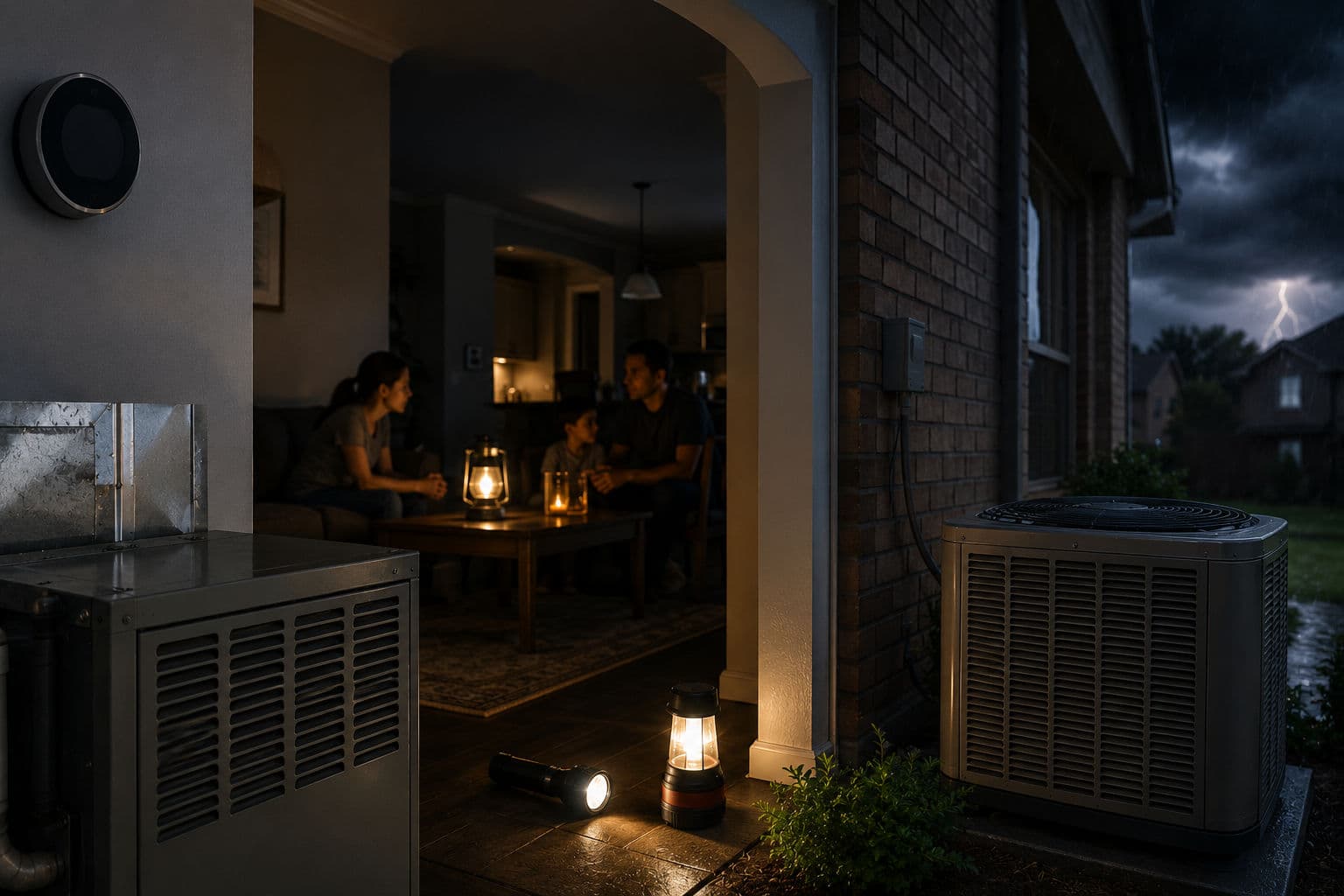
Houston's summer storm season runs alongside its peak cooling season, and the two collide regularly. Thunderstorms, tropical weather systems, and the occasional derecho that moves through the Houston area during summer months knock out power to hundreds of thousands of homes — sometimes for hours, sometimes for days. For most Houston homeowners, the first thought when the power comes back on is getting the AC running again as quickly as possible. The second thought, often too late, is whether turning everything back on immediately was actually the right move.
Power outages and the power restoration that follows them are one of the more common causes of HVAC damage and premature component failure in the Greater Houston area. Here's what actually happens to your system during an outage, what happens when power returns, and what you should do to protect your equipment through both.
WHAT HAPPENS TO YOUR AC DURING A POWER OUTAGE
When power goes out, your HVAC system stops completely. The compressor stops, the blower stops, and the refrigerant circuit depressurizes over time as the system sits idle. This is generally not harmful to the equipment in and of itself — air conditioners are designed to be turned off, and a normal shutdown from a power outage doesn't cause damage.
What can cause damage is how the power returns.
When utility power is restored after an outage, voltage doesn't always return cleanly. Power surges — brief spikes in voltage that occur at the moment power is restored — are common after outages and can damage sensitive electronic components in HVAC equipment. Control boards, capacitors, thermostats, and variable-speed motor drives are all vulnerable to voltage spikes, and a single surge at the moment of power restoration can damage or destroy components that were functioning perfectly before the outage.
Voltage fluctuations during the period immediately after restoration — when the grid is stabilizing and demand is surging as every home in the affected area tries to run their AC simultaneously — can also stress electrical components in ways that accelerate their degradation even without a single dramatic spike.
THE SURGE PROTECTION PROBLEM
Most Houston homeowners have surge protectors on their computers, televisions, and other electronics. Far fewer have surge protection on their HVAC system, which is typically the most expensive piece of electrical equipment in the home. A whole-home surge protector installed at the electrical panel protects all circuits in the home, including the HVAC system, from voltage spikes at the point of power restoration. A dedicated HVAC surge protector installed at the disconnect box near the outdoor unit provides targeted protection specifically for the AC system.
Neither is standard equipment in most Houston homes, and their absence is something homeowners often only discover after a storm-related surge damages their system. If your home doesn't have surge protection and you're in an area that regularly loses power during summer storms — which describes most of the Greater Houston area — it's worth discussing with your HVAC technician during the next service visit.
WHAT NOT TO DO WHEN POWER COMES BACK ON
The most common mistake Houston homeowners make after a power outage is immediately turning the AC back on to full cooling mode. Here's why that's a problem.
When an air conditioner has been off for more than a few hours, the refrigerant in the system migrates. In a system that's been idle for hours — particularly in Houston's summer heat, where the outdoor temperature during the outage may have been pushing the refrigerant in the outdoor unit toward a liquid state — refrigerant can accumulate in the compressor oil. Starting the compressor immediately after a prolonged outage without allowing the refrigerant to redistribute properly can cause what's called liquid slugging — liquid refrigerant entering the compressor in a way that causes mechanical damage to the compressor internals.
The solution is simple: before restarting your AC after a prolonged outage, turn the thermostat to off and switch the system's circuit breaker off. Wait at least 30 minutes — longer if the outage was several hours or more — before turning the breaker back on. This gives the refrigerant time to redistribute and the crankcase heater, if your system has one, time to warm the compressor oil. Then turn the thermostat back to your normal cooling setting.
This 30-minute waiting period feels counterintuitive when the house is already hot from the outage, but it protects the compressor — the most expensive single component in your AC system — from damage that would be far more disruptive and costly than a brief delay in restarting the system.
CHECK YOUR THERMOSTAT SETTINGS BEFORE RESTARTING
Power outages sometimes reset programmable and smart thermostats to factory default settings or cause them to lose their programmed schedules. Before restarting the system after an outage, check that the thermostat is in cooling mode, that the set temperature is correct, and that any programmed schedules are still in place. A thermostat that's defaulted to a different setting than you expect can cause confusion about whether the system is functioning correctly when it restarts.
If your thermostat has a battery backup, it may retain its settings through an outage. If it doesn't, or if the outage was long enough to drain the backup battery, reprogramming may be needed.
WHAT TO WATCH FOR WHEN THE SYSTEM RESTARTS
Once you've waited the recommended time and restarted the system, pay attention to how it behaves during the first 15 to 30 minutes of operation.
A system that starts normally, runs a full cooling cycle, and begins delivering cool air from the vents is functioning correctly. Monitor it through the first full cycle and check that it's reaching the thermostat setpoint within a reasonable time.
A system that starts, runs for a few minutes, and then shuts off may have tripped a high-pressure or low-pressure safety switch due to refrigerant redistribution during the outage. This sometimes resolves on its own after one or two restart attempts. If the system continues to shut off after multiple attempts, stop trying to restart it and call for service — repeated restart attempts on a system that's shutting off on a safety fault can cause additional damage.
A system that doesn't start at all after an outage may have experienced surge damage to the capacitor, control board, or another electrical component. Check the circuit breaker first — if it's tripped, reset it once. If the system still doesn't start, or if the breaker trips again immediately, there's an electrical issue that needs professional diagnosis.
A system that starts and runs but doesn't seem to be cooling as well as it did before the outage may have experienced compressor damage from liquid slugging if it was restarted too quickly, or may have sustained surge damage to components that affect cooling performance. This warrants a service call to evaluate.
GENERATOR USE AND YOUR HVAC SYSTEM
Many Houston homeowners added generators after Hurricane Harvey and subsequent storms, and generator-powered HVAC operation is now common during extended outages in parts of Harris County, Fort Bend County, and Montgomery County. There are a few things worth knowing about running your AC on a generator.
Generator capacity matters significantly. A central AC system is one of the highest electrical draw appliances in your home — a typical 3-ton system draws 3,500 to 5,000 watts at startup and 2,000 to 3,500 watts during normal operation. Running the AC on a generator that's undersized for the starting surge can damage both the generator and the AC system's compressor. Know your generator's rated wattage and starting wattage capacity before attempting to run the AC on it.
Generator power quality varies. Some generators produce cleaner power than others, and the voltage regulation of generator power is generally less stable than utility grid power. Sensitive electronic components in newer HVAC systems — variable-speed drives, communicating control boards, smart thermostats — are more susceptible to damage from low-quality generator power than simpler single-stage systems with conventional controls. If you're running a newer variable-speed or communicating system on a generator, a transfer switch and a quality generator with good voltage regulation are worth the investment.
Never run a generator indoors or in an attached garage. Carbon monoxide poisoning from generator exhaust is a serious and recurring cause of deaths in the Houston area during storm events. Generators should be operated outdoors with exhaust directed away from the home, and carbon monoxide detectors should be functioning throughout the home whenever a generator is in use.
AFTER AN EXTENDED OUTAGE — WHEN TO HAVE THE SYSTEM CHECKED
If your home experienced a power outage of more than 24 hours, particularly one that involved storm surge, flooding, or significant electrical disturbance at the utility level, having your HVAC system inspected before relying on it through the rest of the cooling season is worthwhile. An inspection after an extended outage or storm event checks for surge damage to electrical components, evaluates refrigerant circuit integrity, verifies that the system is operating at the correct performance level, and identifies any damage that may not yet be producing obvious symptoms but could develop into a more serious problem under continued operation.
This is particularly relevant for homes in Houston communities that have experienced flooding alongside power outages — Kingwood, Atascocita, Crosby, Highlands, Baytown, and other areas near the San Jacinto River system and Galveston Bay. HVAC equipment that was exposed to floodwater during an extended outage requires thorough evaluation before being returned to service, not just a restart check.
For storm-related HVAC damage, many homeowner's insurance policies cover electrical surge damage and in some cases flood-related equipment damage. Documenting the damage with a professional inspection and written assessment is the appropriate first step for any insurance claim related to storm damage to your HVAC system.
Multipoint AC & Heating provides HVAC diagnostic, repair, and emergency service throughout Greater Houston, including Harris County, Fort Bend County, Montgomery County, and Austin County. For storm-related HVAC issues or post-outage system concerns, contact us any time — our 24/7 emergency service is available when you need it.