The True Cost of Ignoring HVAC Maintenance in Houston
Learn why regular HVAC maintenance in Houston saves you money and prevents unexpected failures. Don't skip these vital tune-ups!
Every Houston homeowner who skips an annual AC tune-up makes a calculation — whether consciously or not — that the cost of the maintenance visit isn't worth paying right now. The system is running. Nothing obvious is wrong. The bill for a tune-up can wait until something breaks.
That calculation is wrong in Houston's climate, and it's wrong in a specific and quantifiable way. The cost of skipping maintenance isn't the cost of the tune-up you didn't pay for — it's the accumulated cost of everything that happens to a Houston AC system running without professional attention through the most demanding cooling season in the country. That cost is consistently higher than the maintenance visits that would have prevented it, and in the cases where deferred maintenance leads to compressor failure or premature system replacement, it's dramatically higher.
This isn't an argument designed to sell maintenance plans. It's an honest accounting of what skipping maintenance actually costs in the Greater Houston area, based on what we find on systems that haven't been serviced and what those findings lead to.
THE ENERGY COST OF A NEGLECTED SYSTEM
The most immediate and continuous cost of skipping AC maintenance in Houston is the energy cost of running a system that's operating below its design efficiency. This cost starts accumulating from the first season the system goes without maintenance and compounds with every additional season that passes without service.
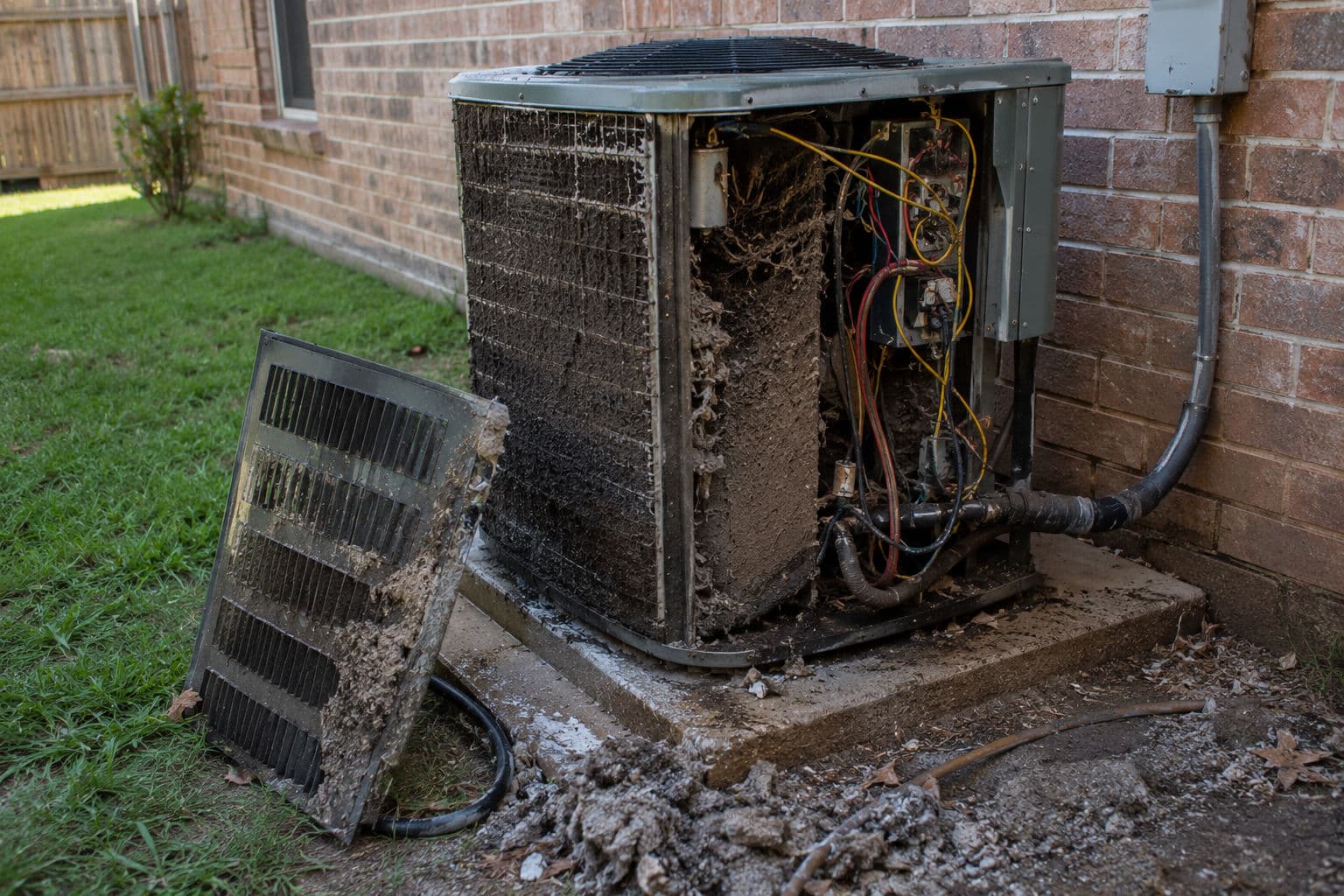
A dirty condenser coil is the primary driver. Research on residential AC systems consistently shows that a moderately fouled condenser coil reduces system efficiency by 10 to 30 percent compared to a clean coil. In Houston's environment — where organic debris accumulates faster than in drier climates, where the long cooling season means more debris accumulates per year than in short-season markets, and where the system runs enough annual hours that efficiency losses translate into significant dollar amounts — a condenser coil that hasn't been professionally cleaned in two or three years is likely operating at 15 to 25 percent below its rated efficiency.
For a Houston home spending $1,800 per year on cooling energy, a 20 percent efficiency reduction costs $360 per year in additional energy consumption. Over three years without maintenance, that's $1,080 in excess energy costs from the dirty coil alone — money that's been spent and isn't recoverable, and that would have paid for several annual maintenance visits at the rate that efficiency loss was accumulating.
A dirty evaporator coil adds to the efficiency loss from a different mechanism — reducing heat transfer from the air to the refrigerant at the indoor unit, causing the system to run longer to achieve the same cooling. A clogged condensate drain that allows biological growth in the drain pan adds resistance to condensate flow that makes the system work slightly harder to manage the moisture load. A capacitor reading 20 percent below specification causes the motors it supports to draw more current than they should, adding to electrical energy consumption directly.
None of these individually is catastrophic. Combined and running through eight months of Houston's cooling season, they represent a meaningful premium on every electricity bill during that period — a premium that's invisible because you don't know what the bill would have been without them, but real and consistent.
THE REPAIR COST OF COMPONENTS DAMAGED BY DEFERRED MAINTENANCE
The energy cost of a neglected system is continuous but modest per month. The repair cost of the damage that accumulates from neglected maintenance is intermittent and significant when it arrives.
The compressor is the endpoint that matters most, because compressor replacement is either the largest repair cost on an AC system or the decision point for full system replacement. A compressor that's been running for two or three seasons against a fouled condenser coil — operating at elevated pressures and temperatures — has accumulated wear that shows up as shortened compressor life. The compressor doesn't fail from this immediately. It fails earlier than it would have with proper maintenance, often without dramatic warning, on a hot July afternoon when the system is under peak load.
A compressor replacement on a system that's 8 to 10 years old costs $1,200 to $2,500 or more including parts and labor. On a system past 12 years, it's typically the decision point for full replacement at $5,000 to $12,000. Either way, it's a cost that has a partial causal connection to maintenance that wasn't performed — and while compressors do fail on well-maintained systems, the failure rate is meaningfully lower and the average age at failure is meaningfully higher on systems that receive consistent annual maintenance.
Capacitor failure from running at degraded specification causes motor damage that extends beyond the capacitor itself. A blower motor that's been running on a bad capacitor for a season draws excess current, runs hot, and accumulates bearing wear at a rate that shortens its service life. Blower motor replacement costs $300 to $600. Catching and replacing the degraded capacitor at an annual maintenance visit — typically $150 to $350 — prevents that motor from reaching the accelerated wear state the bad capacitor was producing.
Condensate drain clogs that go unaddressed cause water damage to the surrounding structure — ceiling tiles, drywall, insulation, and flooring near the air handler. The drain line clog itself is a $75 to $150 maintenance item to clear professionally. The water damage from an overflowing drain pan that went unnoticed for days or weeks while the system ran is a water damage restoration cost that starts at hundreds of dollars and can reach thousands depending on how long the overflow continued and what it damaged.
THE SYSTEM LIFE COST OF CHRONIC NEGLECT
The energy costs and repair costs of deferred maintenance are real but bounded — a dirty coil costs a predictable amount per year in efficiency loss, and a failed capacitor or clogged drain costs a specific repair amount. The system life cost of chronic maintenance neglect is potentially larger than both because it determines how many years you get from a several-thousand-dollar investment.
A Houston AC system that receives consistent annual maintenance — clean coils, verified refrigerant charge, tested and replaced capacitors before they cause motor damage, clear condensate drainage, overall system performance verification — reasonably targets 14 to 16 years of service life in the Greater Houston area. This is near the upper end of what Houston's climate allows given the operating hours the system accumulates, but it's achievable with consistent care.
The same system without consistent maintenance — running through multiple seasons with progressively fouled coils, a refrigerant charge that drops from a slow leak without detection, capacitors that degrade and stress motors before failing, and no opportunity for a technician to catch developing issues before they become failures — might reach 8 to 10 years before the accumulation of wear and damage makes replacement the only practical option.
The difference between 15 years and 10 years on a $8,000 system is five years of avoided replacement cost. At a 5-year average life extension from consistent maintenance, the maintenance visits over that period — approximately $300 to $500 per year including the tune-up and any minor repairs caught during it — total $1,500 to $2,500. The replacement cost deferred is $8,000. The math strongly favors maintenance.
This calculation understates the benefit because it doesn't account for the energy savings from running an efficient system during those additional years, or for the avoidance of the major mid-life repairs that chronic neglect produces. The true financial advantage of consistent maintenance over the life of an AC system in Houston is larger than the simple life extension calculation suggests.
WHAT MAINTENANCE NEGLECT LOOKS LIKE ON A REAL HOUSTON SYSTEM
To make the abstract costs concrete, here's a representative picture of what we find when we service a Houston AC system that hasn't been maintained in three or more years.
The condenser coil has accumulated significant fouling — in wooded communities, packed pine needles and organic debris throughout the fin depth; in open suburban settings, a dense layer of dust and debris on the coil surface. The system has been operating at 15 to 25 percent below rated efficiency for the entire period.
The evaporator coil has biological growth established on its surface — mold, mildew, and bacteria that have built up over multiple seasons of operation in Houston's humidity. The growth produces a musty odor from the vents and reduces heat transfer efficiency at the indoor coil. Occupants have likely been breathing air that's been carrying biological material from the coil throughout the period.
The capacitor is reading 20 to 30 percent below its rated value. The system has been starting under degraded capacitor support for some period — stressing the compressor and blower motor with every startup cycle.
The condensate drain line has biological growth throughout its length. The drain pan shows evidence of previous overflow — staining on the pan surface and possibly on the cabinet below — indicating that water damage to the surrounding structure has likely already occurred at some point.
The refrigerant charge is below specification. The system has been operating at reduced cooling and dehumidification capacity for an unknown period, possibly the entire time since the last maintenance visit or longer. There's a leak somewhere in the refrigerant circuit that hasn't been found and repaired.
The blower wheel has a significant debris accumulation on its blades — reducing blower efficiency and adding to the motor's current draw.
At this point, the maintenance visit involves professional coil cleaning on both coils, condensate drain clearing and treatment, capacitor replacement, refrigerant leak location and repair followed by recharge, blower wheel cleaning, and an overall system performance assessment. The cost of this remedial service is significantly higher than a standard annual tune-up on a well-maintained system — both because more is found and because some of the work takes longer when the degree of fouling is more severe.
And this remedial service, thorough as it is, doesn't undo the efficiency losses from the years of running on a fouled coil, doesn't restore the compressor wear from running on a degraded capacitor, doesn't undo any motor damage from the capacitor issue, and doesn't eliminate the risk that the slow refrigerant leak has been running the compressor at the wrong operating conditions for long enough to cause damage. It resets the starting condition for future maintenance, but it doesn't recover what the neglect cost during the period it occurred.
WHAT CONSISTENT MAINTENANCE ACTUALLY COSTS
For context, the cost of the consistent maintenance that prevents the above scenario in Houston is straightforward.
A spring cooling season tune-up that includes professional coil cleaning, refrigerant verification, capacitor and contactor testing, condensate drain clearing, blower inspection, and overall system assessment typically costs $150 to $300 for a standard single system. A fall heating inspection that covers the heat exchanger, ignition system, gas pressure and burner operation, and safety controls adds a similar amount.
An annual maintenance plan that bundles both visits and provides priority scheduling for service calls runs $200 to $450 per year depending on the company and what's included. At the lower end of that range over a 15-year system life, the total maintenance cost is $3,000 to $4,500 — against the multiple thousands in repair costs, energy premiums, and premature replacement costs that consistent maintenance prevents.
The return on investment for HVAC maintenance in Houston is among the highest of any home maintenance category — not because maintenance plans are inexpensive, but because the climate makes the cost of not maintaining so consistently high.
THE MOMENT MOST HOUSTON HOMEOWNERS REALIZE THIS
There's a predictable moment when most Houston homeowners who have been deferring maintenance understand the real cost of that decision. It's not when the energy bill is slightly higher than expected. It's when the compressor fails on a Saturday afternoon in August — when every HVAC company in the metro is fully booked, when the emergency service rate is two or three times the standard rate, when the replacement decision has to be made under time pressure and summer heat rather than thoughtfully — and the technician explains that the compressor failure shows signs of having been under stress for an extended period.
At that point the calculation that seemed to save money by skipping maintenance has produced an outcome that costs substantially more than all the maintenance visits combined would have cost. This isn't a hypothetical scenario — it's the pattern we see repeatedly in Greater Houston, and it's the straightforward financial case for treating AC maintenance as a non-optional annual expense rather than a discretionary one.
Multipoint AC & Heating offers maintenance plans and tune-up services throughout Greater Houston, including Harris County, Fort Bend County, Montgomery County, and Austin County. Contact us to schedule your spring maintenance visit before peak cooling season arrives and the cost of not having done it becomes apparent.