How Humidity in Houston Affects Your Sleep — and What Your HVAC System Can Do About It
Explore the impact of humidity on sleep in Houston and learn HVAC tips to create an optimal sleep environment.
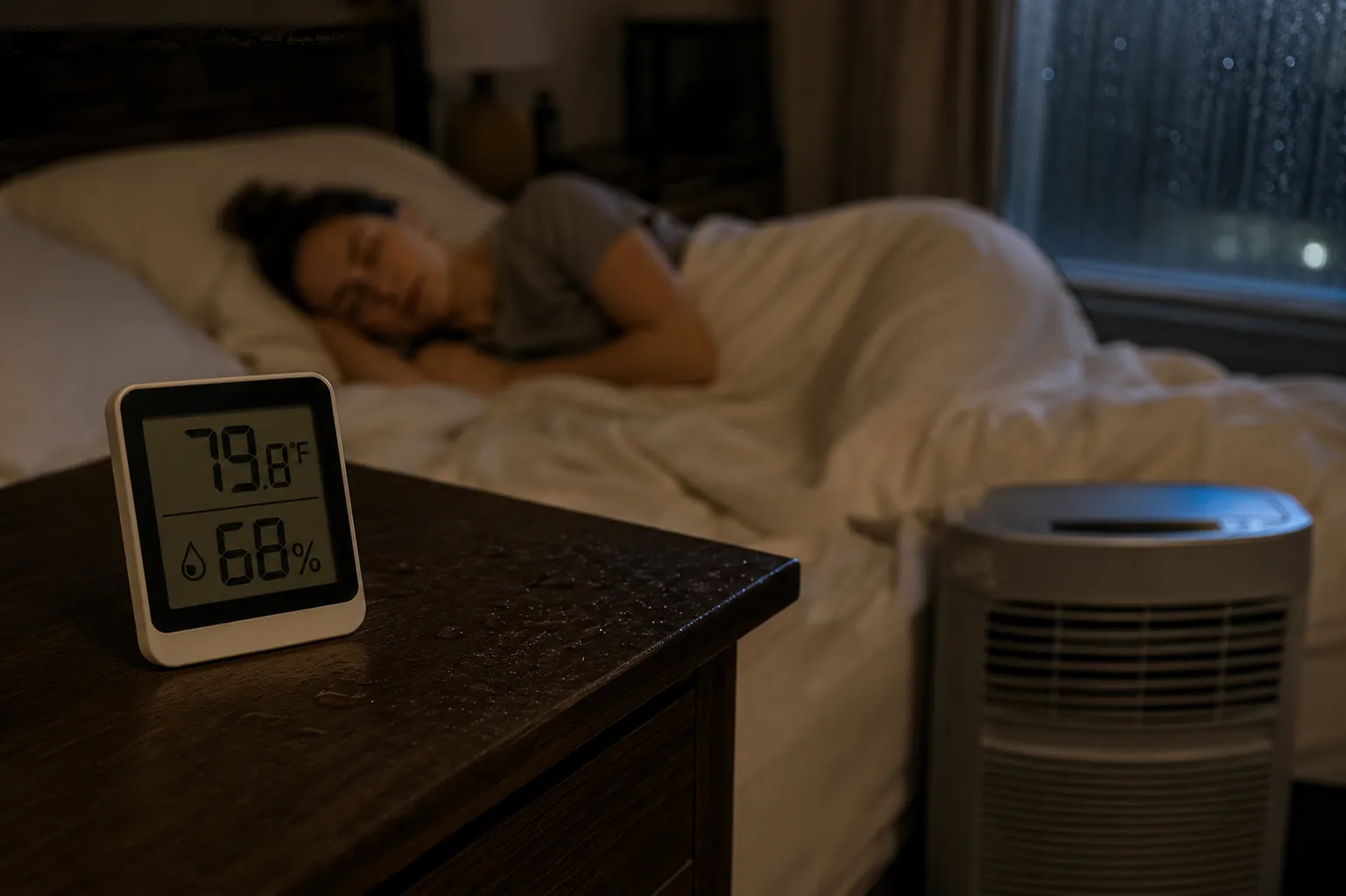
Sleep quality in Houston homes is an underappreciated casualty of the region's humidity environment. Most Houston homeowners who aren't sleeping well attribute it to stress, screen time, the wrong mattress, or any number of other factors before considering the thermal and humidity environment of their bedroom as a contributing cause. But the conditions under which humans sleep well are specific and measurable, and Houston's Gulf humidity creates indoor environments that work against those conditions in ways that HVAC systems can address — if they're set up and functioning correctly.
This isn't a minor quality-of-life issue. Sleep quality has documented effects on immune function, cognitive performance, mood, cardiovascular health, and weight regulation. A bedroom environment that chronically disrupts sleep is affecting health in ways that extend well beyond feeling tired in the morning.
Here's what the research on sleep and thermal environment actually shows, how Houston's humidity works against optimal sleep conditions, and what your HVAC system can do about it.
WHAT THE BODY NEEDS TO SLEEP WELL — THE THERMAL ENVIRONMENT
The human body has a well-documented relationship with ambient temperature and humidity during sleep. Core body temperature naturally drops in the hours before and during sleep — this temperature drop is part of the physiological cascade that initiates and maintains sleep. The body achieves this core temperature drop partly by releasing heat through the skin, which requires that the skin be in contact with an environment cool enough to accept that heat transfer.
Sleep research consistently shows that ambient temperatures between 65 and 68 degrees Fahrenheit are optimal for most adults. At these temperatures, the body can maintain its natural core temperature drop without working against a warm environment. Above 72 degrees, sleep quality begins to measurably decline — specifically, the proportion of restorative slow-wave sleep and REM sleep decreases, and wakefulness events increase. Above 75 to 77 degrees, sleep disruption becomes significant for most adults.
Humidity affects this process in a specific way. The body releases heat during sleep partly through evaporative cooling — moisture evaporates from the skin surface and carries heat away. This evaporative cooling depends on the ambient air being able to accept moisture. In a high-humidity environment — where the air is already carrying significant moisture — evaporative cooling from the skin is less efficient. The body has to work harder to maintain its core temperature drop, which disrupts the sleep physiology that depends on that drop occurring smoothly.
In Houston's summer humidity environment, where indoor relative humidity in many homes runs between 60 and 70 percent during the night, the bedroom is exactly the kind of high-humidity environment that interferes with evaporative cooling during sleep. The consequence is more restless sleep, more wakefulness events, less deep sleep, and waking feeling less rested than the number of hours in bed would suggest.
HOW HOUSTON'S NIGHTTIME HUMIDITY AFFECTS BEDROOM CONDITIONS
Houston's ambient humidity doesn't track the temperature — it doesn't decrease proportionally as the sun goes down and temperatures moderate. Gulf moisture keeps outdoor relative humidity elevated through the night, often reaching 80 to 90 percent in the overnight hours. That outdoor humidity infiltrates into the home through every gap in the building envelope, through ventilation, and through the normal air exchange that occurs as the home cools slightly overnight.
In homes without effective humidity control — either from an oversized AC system that short cycles and doesn't remove adequate moisture, from a system that's losing refrigerant capacity, or from a home envelope that allows significant overnight infiltration — indoor relative humidity during the hours when residents are trying to sleep can reach 65 to 70 percent or higher. At these humidity levels, the bedding, mattress, and pillows absorb moisture from the air and from the sleeper, creating the clammy feeling that Houston homeowners describe as sheets that feel damp even when they're not wet.
This moisture absorption by bedding is a compounding factor in sleep disruption. A mattress and pillow that have absorbed ambient humidity are less effective at heat dissipation from the sleeper, they create a tactile sensation that prompts wakefulness, and they provide the moisture environment that dust mites thrive in — a relevant consideration for Houston households where dust mite populations are already elevated by the region's year-round humidity.
THE AC'S ROLE IN NIGHTTIME HUMIDITY CONTROL — AND WHY IT OFTEN FALLS SHORT
The air conditioning system removes humidity from the bedroom air as a byproduct of the cooling process. As warm, humid air passes over the cold evaporator coil, moisture condenses on the coil surface and drains away through the condensate system. This moisture removal continues as long as the system is running and the coil is operating at the correct temperature.
The problem is that in Houston's summer, the AC often runs in a pattern at night that doesn't effectively manage humidity in the bedroom.
In many Houston homes, the thermostat is set lower during the day to manage peak cooling load and raised at night to save energy — a reasonable approach that creates a specific nighttime humidity management gap. When the thermostat setpoint rises for the night and the AC runs less frequently, the periods between cooling cycles allow indoor humidity to rise as outdoor moisture infiltrates and as the house's thermal mass releases heat and moisture absorbed during the day. The AC then runs a short cycle to bring the temperature back to the evening setpoint, but a short cycle that's sufficient for temperature control may not be long enough to meaningfully remove the humidity that accumulated during the off cycle.
An oversized system makes this worse. An oversized AC system reaches the thermostat setpoint quickly and shuts off before running long enough to dehumidify effectively. In the bedroom specifically — which may have less internal heat generation than common areas — an oversized system can cool the room quickly and cycle off, leaving the room at the correct temperature but at 65 to 70 percent relative humidity that the short cycle didn't reduce.
Systems that are losing refrigerant capacity, have dirty evaporator coils, or have been compromised in other ways that reduce their moisture removal efficiency produce the same result — adequate temperature control that masks inadequate humidity control until the bedroom discomfort draws attention to it.
THE THERMOSTAT SETPOINT AND SLEEP — WHAT ACTUALLY WORKS IN HOUSTON
The research on optimal sleep temperature — 65 to 68 degrees for most adults — creates a practical challenge for Houston homeowners that's more complex than simply setting the thermostat to 66 degrees at bedtime.
In a Houston home with adequate insulation and effective ductwork, setting the thermostat to 68 degrees at bedtime allows the system to run longer, more consistent cycles that maintain both the temperature and meaningfully lower indoor humidity. The longer cycles remove more moisture per hour than the shorter cycles of a system set to a higher nighttime temperature.
But a home with inadequate attic insulation, duct leaks that are allowing attic heat to enter the supply airstream, or an oversized system that short cycles even at the lower setpoint may not achieve the combination of lower temperature and lower humidity that the sleep research describes as optimal. The temperature drops but the humidity remains elevated because the system can't run long enough per cycle to address it at the lower setpoint — a paradox that leaves the bedroom cooler but no less humid.
For homeowners who find that setting the bedroom to 68 degrees doesn't produce the expected sleep quality improvement — the room is cooler but still feels heavy and clammy — the humidity dimension rather than the temperature dimension is the unresolved factor. This is where HVAC solutions beyond thermostat adjustment become relevant.
HVAC SOLUTIONS THAT ACTUALLY IMPROVE SLEEP IN HOUSTON
Whole-home dehumidification is the most direct solution for the sleep quality impact of Houston's nighttime humidity. A whole-home dehumidifier installed in the HVAC system operates independently of the AC's cooling cycle — it runs when the humidity sensor calls for dehumidification regardless of whether the AC is actively cooling. During the overnight periods when the AC cycles off between cooling runs, the dehumidifier continues operating to prevent humidity from rebounding to the levels that disrupt sleep.
Maintaining indoor relative humidity at 40 to 50 percent overnight — which a properly sized whole-home dehumidifier achieves — produces the sleep environment that the research on thermal comfort and sleep quality describes as optimal. The bedroom at 68 to 70 degrees and 45 percent relative humidity is a fundamentally different sleep environment from the same bedroom at 68 degrees and 65 percent relative humidity. The lower humidity allows evaporative cooling from the skin to work effectively, reduces the clammy feeling from bedding that has absorbed moisture, and creates conditions where dust mite populations are suppressed rather than thriving.
Correct AC system sizing. If the current system is oversized and short cycling — which is both the most common cause of inadequate nighttime dehumidification and one of the most common installation mistakes in Houston — the long-term solution is replacement with a correctly sized system when the current equipment reaches end of life. In the near term, a whole-home dehumidifier supplements the undersized dehumidification capacity of the oversized system. At replacement, a correctly sized system that runs longer cycles per hour of operation provides both better temperature control and better moisture removal than the oversized system it replaces.
Variable-speed or two-stage systems provide meaningfully better nighttime humidity control than single-stage systems. A variable-speed system modulates its output continuously, often running at 30 to 50 percent of full capacity for extended periods during overnight hours when the cooling load is lower than during peak afternoon demand. These long, low-capacity cycles are significantly more effective at removing humidity from the bedroom air than the full-capacity short cycles of a single-stage system — the extended coil contact time at lower airflow speeds removes more moisture per hour of runtime than the rapid high-airflow cycle of full capacity operation. For Houston homeowners replacing an aging single-stage system and prioritizing sleep quality, the humidity management improvement from a variable-speed system is a concrete benefit alongside the efficiency gains.
Bedroom-specific solutions for homes where the central system's humidity management is adequate throughout the rest of the house but the master bedroom presents specific challenges — sun exposure, room orientation, inadequate supply air, or other factors — include a ductless mini split with precise humidity management control or a standalone room dehumidifier sized for the bedroom's square footage. These targeted solutions address the specific room rather than requiring system-wide changes for a localized problem.
Duct sealing to address return duct leaks that are pulling humid outdoor air into the system overnight. Leaky return ducts that draw outdoor Houston air into the return airstream during overnight hours — when outdoor humidity is at its highest — are directly adding to the indoor humidity load that the AC has to manage. Sealing these leaks reduces the overnight humidity load and allows the AC system's moisture removal capacity to apply to the home's actual humidity rather than continuously offsetting the infiltration the leaks are introducing.
PRACTICAL STEPS HOUSTON HOMEOWNERS CAN TAKE TONIGHT
While HVAC system changes represent the most complete solution, several adjustments make an immediate difference in bedroom sleep environment quality in Houston homes.
Set the bedroom thermostat — or the whole-home thermostat if there's no zone control — to 68 to 70 degrees for sleep rather than raising it to 76 to 78 for overnight energy savings. The longer cycles that result from the lower setpoint remove more humidity per night than the energy saved from the higher setpoint is worth, particularly for households where sleep quality is a concern. The energy cost difference between sleeping at 70 degrees and sleeping at 76 degrees in a Houston home is real but modest — typically a few dollars per month — and the sleep quality benefit at the lower setpoint is measurably greater.
Use lightweight, moisture-wicking bedding rather than dense cotton or synthetic blends that absorb and retain moisture in Houston's humidity environment. Bamboo, linen, and performance fabric bedding materials handle moisture more effectively than standard cotton in a high-humidity environment and reduce the clammy feeling that elevated bedroom humidity produces.
Run a ceiling fan in the bedroom during sleep if one is available. Ceiling fans create airflow over the skin that improves evaporative cooling effectiveness — the same physical mechanism that makes a fan feel cooler even when it's not lowering the air temperature. In a humid bedroom where evaporative cooling is already compromised by high relative humidity, the additional airflow from a ceiling fan partially compensates for the reduced evaporative efficiency.
Keep the bedroom door open during sleep if your home has a central return air system rather than dedicated bedroom return air. A closed bedroom door creates positive pressure in the bedroom — supply air is being pushed in but has no return path — which pushes conditioned air out of the room rather than allowing it to recirculate through the system. An open bedroom door allows the system to pull air back through the central return and recondition it, maintaining better humidity control in the room throughout the night.
Check the air filter and replace it if it's loaded. A clogged filter restricts the airflow that the system needs to run the longer cycles that remove humidity effectively. In Houston's summer, a loaded filter at bedtime means the overnight cycles are shorter than they should be — less humidity removal per night, more restless sleep.
HOW SLEEP ENVIRONMENT QUALITY CONNECTS TO HVAC MAINTENANCE
The connection between HVAC maintenance and sleep quality is less obvious than the connection between maintenance and energy bills or equipment longevity, but it's real and it compounds over time in the same way those other connections do.
A system with a dirty evaporator coil removes less moisture from the bedroom air per hour of operation than a clean coil. A system running low on refrigerant from a slow leak has reduced dehumidification capacity alongside reduced cooling capacity. A condensate drain that's partially blocked allows less water to drain from the system per hour of operation, limiting the total moisture removal the system can achieve.
All of these maintenance-related conditions affect daytime comfort in ways that Houston homeowners often notice. They affect nighttime bedroom humidity and sleep quality in ways that homeowners rarely connect to the HVAC system. The person who's been sleeping poorly for a summer without understanding why, whose bedroom feels persistently clammy despite the AC running, and whose energy bills have crept up slightly may be experiencing the convergence of a system that needs maintenance and a bedroom environment that's been deteriorating as a result.
A spring maintenance visit that includes professional coil cleaning, refrigerant charge verification, and condensate drain clearing doesn't just protect the equipment and reduce energy bills. It restores the system's moisture removal capacity — which has a direct, if rarely discussed, effect on how well the household sleeps through the remainder of Houston's long, humid summer.
Multipoint AC & Heating provides AC maintenance, whole-home dehumidification installation, and HVAC repair throughout Greater Houston, including Harris County, Fort Bend County, Montgomery County, and Austin County. Contact us at 832-963-3789 to schedule a maintenance visit or to discuss humidity management solutions for your Houston home.