What Every Houston Renter Should Know About Their Apartment or Home's HVAC System
Understand HVAC rights for Houston renters. Learn maintenance responsibilities and landlord obligations for a comfortable rental experience.
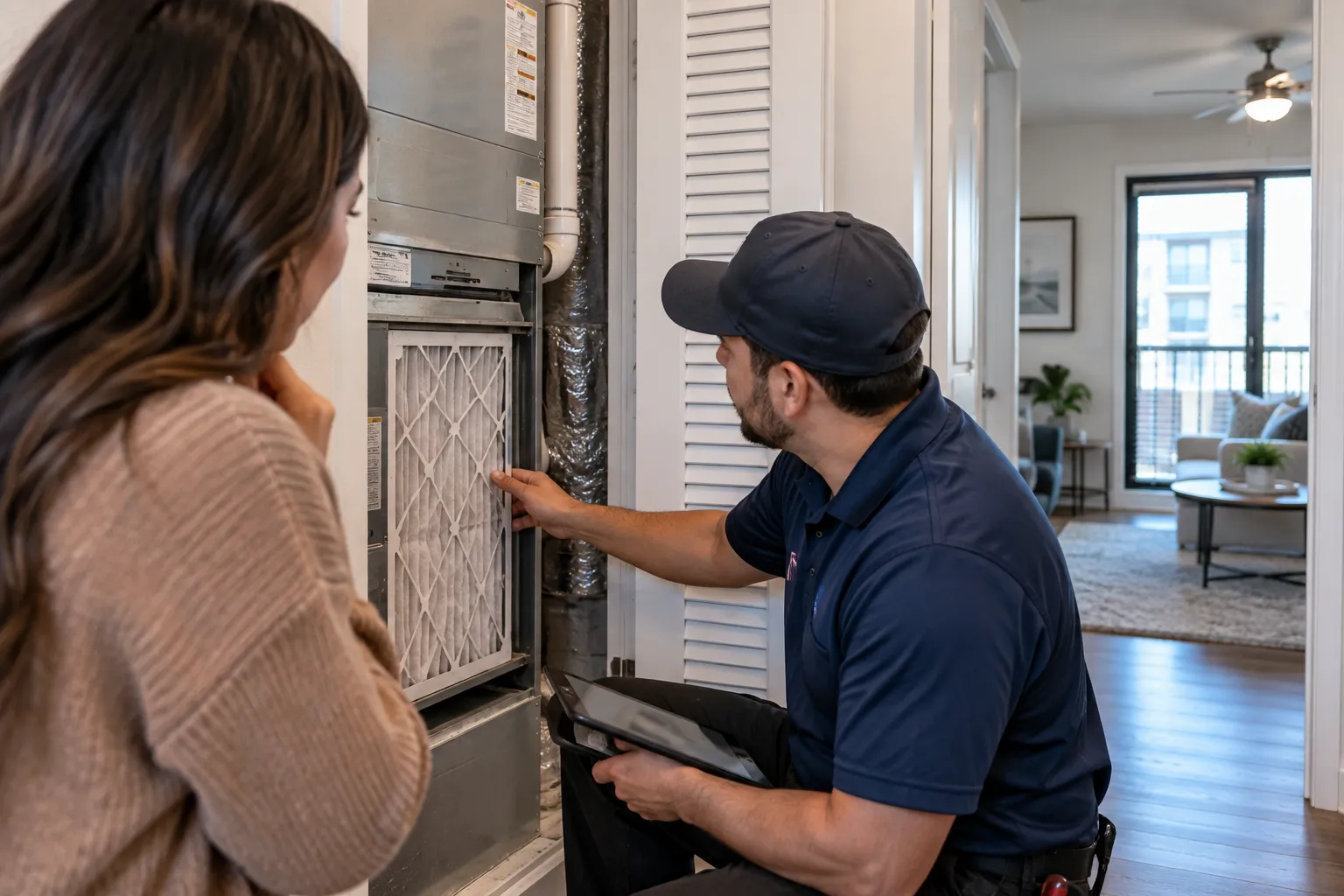
Renting in Greater Houston puts you in one of the most climate-demanding rental markets in the country. The nine-month cooling season, the Gulf humidity, and the cold fronts that arrive without warning in October and January make a functioning HVAC system less of a comfort preference and more of a basic habitability requirement. Yet most Houston renters don't fully understand their rights around HVAC maintenance and repair, their responsibilities for system care, what they can and can't require of their landlord, and what to do when the AC fails on a 98-degree afternoon and the landlord isn't responding.
This is information that matters — and that most people don't look up until they're already in the situation where they need it.
YOUR RIGHTS AS A HOUSTON RENTER — WHAT TEXAS LAW ACTUALLY SAYS
Texas Property Code Chapter 92 establishes the framework for tenant rights around habitability, repair, and maintenance in Texas residential leases. The relevant provisions for HVAC specifically are worth understanding in plain terms.
Under Texas law, a landlord is required to make repairs that materially affect the physical health or safety of an ordinary tenant. A malfunctioning air conditioner in a Houston summer has been interpreted by Texas courts and the Texas Attorney General's office as meeting this threshold — a non-functional AC in Houston's climate during summer months can create conditions that materially affect the health and safety of occupants, particularly in extreme heat. This means a landlord who fails to address a completely failed AC system in a timely manner may be in violation of their statutory obligations under Texas law, not just their lease obligations.
The procedure for exercising these rights matters. Texas law requires the tenant to give written notice to the landlord of the condition requiring repair. The notice should describe the specific problem clearly — the air conditioning is not functioning and indoor temperatures have reached a specific level — and it should be documented. Written notice can be by certified mail, email with delivery confirmation, or hand delivery with a witness or signed receipt. Verbal notice alone doesn't create the legal record that formal written notice creates.
After proper written notice, the landlord has a reasonable time to repair — the statute uses the term reasonable and case law has interpreted this in context. For a non-functional AC in Houston summer, courts have generally interpreted reasonable as a shorter period than for less urgent conditions. A landlord who receives written notice of a failed AC on a 100-degree day in July and takes two weeks to respond without a compelling explanation is in a much weaker legal position than one who responds within 48 to 72 hours.
If the landlord fails to repair within a reasonable time after proper notice, Texas Property Code provides specific remedies including the right to terminate the lease and vacate, the right to have the repair made and deduct the cost from rent — with specific procedural requirements that must be followed precisely — and the right to seek damages in court including rent reduction, court costs, and attorney's fees. These remedies have procedural requirements that must be followed correctly to be enforceable. Before pursuing any of these remedies, understanding the specific procedural steps required under Texas Property Code 92.0561 is essential — getting the procedure wrong can undermine rights that the law otherwise provides.
WHAT YOUR LEASE SAYS — AND HOW IT INTERACTS WITH STATUTORY RIGHTS
Texas allows considerable flexibility in lease terms around maintenance and repair responsibilities, and Houston rental leases vary significantly in how they allocate HVAC responsibilities between landlord and tenant.
A common lease structure places the landlord responsible for major HVAC system components — compressor, air handler, major mechanical failures — while placing the tenant responsible for routine maintenance items including air filter replacement, keeping the area around the outdoor unit clear, and in some leases, condensate drain maintenance.
Some Houston rental leases go further, placing the tenant responsible for AC maintenance entirely through a provision that requires the tenant to maintain a service contract or to pay for all HVAC repairs below a certain dollar threshold. These provisions are enforceable in Texas under most circumstances, which means reading your lease carefully before signing — and understanding what HVAC responsibilities you're accepting — is worth doing rather than discovering after the fact.
A few lease provisions related to HVAC that Houston renters should specifically look for:
Filter replacement responsibility. Most Houston leases place filter replacement responsibility on the tenant. This is reasonable and has a direct consequence — a filter that isn't replaced causes damage to the HVAC system over time, and a landlord can hold a tenant responsible for damage caused by failure to maintain the filter if the lease places that responsibility on the tenant. Understand your filter change responsibility, maintain it consistently, and keep records of when you changed the filter. If the AC fails and the landlord or their contractor identifies a severely clogged filter as a contributing cause, documentation of your filter maintenance history protects you.
Temperature standards. Some Houston leases specify a minimum cooling standard — the system must be capable of maintaining the unit at a specific temperature in defined outdoor conditions. Understanding whether your lease includes this standard and what it requires is relevant if a landlord disputes that the AC failure constitutes an emergency.
Maintenance request procedures. Most professional landlords and property management companies in Houston have specific maintenance request procedures — online portals, specific phone numbers, or documented request systems. Following the specified procedure rather than informal communication creates the documentation that the formal notice requirement depends on. A maintenance request submitted through the landlord's online portal has a timestamp and a record. A text to the landlord's personal phone may not.
Utility responsibility. In some Houston rental arrangements — particularly older single-family rentals and some apartment configurations — the tenant pays electricity directly to a retail provider and is responsible for the electricity consumption of the HVAC system. In others, electricity is included in the rent or managed by the landlord. Understanding which arrangement applies to your rental affects the urgency of HVAC efficiency issues — a tenant paying their own electricity has a direct financial interest in the AC system's efficiency that a tenant with electricity included in rent doesn't have in the same way.
WHAT YOU'RE RESPONSIBLE FOR AS A HOUSTON RENTER
Beyond what the lease specifies, several HVAC maintenance behaviors are within the tenant's control and directly affect both system performance and the landlord-tenant relationship around HVAC issues.
Air filter replacement is the most impactful tenant maintenance responsibility. In a Houston rental unit, the filter serves the same function it serves in an owned home — it protects the HVAC equipment from debris that would otherwise accumulate on the evaporator coil and blower. A filter that's allowed to become severely clogged causes the same problems in a rental unit that it causes anywhere else — reduced airflow, evaporator coil freezing, blower motor stress, and eventually system failure. If your lease places filter responsibility on you, treat it seriously. Monthly checks and 30 to 60 day changes during Houston's active cooling season are the appropriate interval. Keep a record of when you changed the filter.
Keeping the outdoor condenser unit clear is another tenant responsibility in most Houston rental houses where the tenant has access to the exterior of the property. Grass and vegetation that grow against the outdoor unit reduce airflow and affect system efficiency. Debris that accumulates around the unit — leaves, grass clippings, objects stored near it — should be cleared. If you're renting a house with a side yard or back yard where the condenser is located, maintaining clearance around the unit is part of reasonable care of the property.
Not blocking supply vents and return grilles is a basic tenant responsibility that affects system performance in ways that can create disputes. Furniture placed directly against or over supply registers and return grilles restricts airflow in ways that cause the system to work harder and that can cause the evaporator coil to freeze. Arrange furniture to maintain clearance from HVAC vents — a basic practice that affects your comfort and the system's performance simultaneously.
Reporting problems promptly rather than deferring. A tenant who notices that the AC isn't cooling as well as it was last month but doesn't report it to the landlord until the system has completely failed has allowed a developing problem to become a larger one. Prompt reporting through the landlord's specified maintenance request procedure — with documentation — serves both the tenant's interest in having the problem addressed before it becomes an emergency and the landlord's interest in knowing about developing issues before they become expensive failures.
WHAT TO DO WHEN THE AC FAILS IN YOUR HOUSTON RENTAL
When the AC fails in a Houston rental during summer — a situation where the urgency is real and the process matters — the steps to take are specific.
Document the failure and the conditions immediately. Take photos or video of the thermostat showing the set temperature and the actual indoor temperature. Note the date and time. If possible, note the outdoor temperature and heat conditions. This documentation establishes the conditions at the time of failure and the timeline of your notice and the landlord's response.
Submit formal written notice immediately through the landlord's specified maintenance request channel. If the landlord has a maintenance portal, submit through it. If the lease specifies a maintenance email or phone number, use that and follow up the phone call with a written email or text that creates a record. The notice should state specifically that the air conditioning has failed, the current indoor temperature, and that the condition requires immediate repair given Houston's climate conditions.
Follow up if you don't receive a response within a reasonable time. For a complete AC failure in Houston summer, a reasonable time for acknowledgment is hours, not days. If you haven't received any response within 24 hours, follow up in writing again, note that this is a second notice, and document the absence of response.
Take reasonable steps to manage the heat in the interim. Move to the coolest area of the unit. Close blinds and curtains on sun-exposed windows. Use fans to create airflow. If household members are vulnerable — infants, elderly individuals, anyone with health conditions affected by heat — take them to an air-conditioned location rather than waiting in the overheating unit.
Know your options if the landlord doesn't respond within a reasonable time. Texas law provides the remedies described above — lease termination, repair and deduct, or court action — but each requires specific procedural compliance. If the landlord is completely unresponsive to a genuine emergency AC failure during Houston's summer, consulting with a Texas tenant rights attorney or contacting the Texas Attorney General's office for guidance on the specific remedies available in your situation is appropriate.
THE AC EFFICIENCY QUESTION FOR RENTERS — WHAT YOU CAN AND CAN'T DO
Houston renters who are paying their own electricity bills have a direct financial interest in the HVAC system's efficiency — a system that runs more hours per day or at lower efficiency costs the tenant money in higher electricity bills. This creates a situation where the tenant is paying for the operating cost of equipment the landlord owns and is responsible for maintaining.
A few situations Houston renters commonly encounter around AC efficiency:
The system is old and inefficient but functional. A landlord generally has no obligation to replace HVAC equipment that's functioning — even if it's old, inefficient, and costing the tenant significantly more in electricity than a newer system would. The tenant's remedy in this situation is the lease negotiation — requesting a rent reduction or a landlord commitment to equipment replacement as a condition of lease renewal. Once the lease is signed with the existing equipment, the tenant has limited leverage on equipment replacement unless the lease specifies otherwise.
The system isn't maintaining the temperature the lease specifies. If the lease includes a temperature standard and the system isn't meeting it during normal conditions — not extreme heat events but typical Houston summer conditions — this is a maintenance issue that the landlord is obligated to address. Document the failure to meet the standard with specific temperature readings and weather conditions, and submit formal written notice through the specified procedure.
The filter was neglected by a previous tenant and the system is performing poorly because of accumulated coil fouling from a clogged filter history. This is a situation where the tenant may be living with reduced system performance that isn't their fault but that the landlord may be reluctant to address if the system appears to be cooling adequately. Requesting a professional coil cleaning as part of move-in condition maintenance is a reasonable request that a professional landlord should be willing to address.
The system freezes up repeatedly. A system that freezes up in a rental unit should be reported to the landlord immediately. The freeze may be caused by a clogged filter — which is the tenant's responsibility if the lease places filter maintenance on the tenant — or by a refrigerant issue or other mechanical problem — which is the landlord's responsibility. A tenant who discovers the system has frozen should turn it off, check the filter and replace it if it's clogged, and allow the system to thaw before restarting. If the system freezes again after the filter has been replaced, report the recurring problem to the landlord immediately as a mechanical issue requiring professional repair.
WHAT HOUSTON RENTERS SHOULD KNOW ABOUT MOVING INTO A NEW UNIT
The HVAC system in a rental unit is one of the conditions worth specifically evaluating when assessing whether to sign a lease, and the move-in inspection is the opportunity to document the system's condition at the beginning of the tenancy.
During the move-in inspection, test the HVAC system in both cooling and heating mode if the season allows. For a unit being rented in summer, set the thermostat to a cooling mode and verify that the system produces cold air, that the supply registers are delivering airflow, and that the system runs through a complete cooling cycle. Note any unusual sounds, smells, or performance observations in the move-in condition documentation.
Look at the outdoor condenser unit. Its condition tells you something about how the property has been maintained. An outdoor unit with visibly fouled condenser coils, a cabinet covered in rust and deterioration, or vegetation growing into the unit hasn't been maintained — which may predict the landlord's responsiveness to future HVAC issues.
Ask when the system was last serviced and when the filter was last changed. A landlord who can answer these questions specifically — with documentation — is a landlord who maintains their properties. A landlord who doesn't know or who becomes evasive is one whose maintenance practices you're entering the lease without evidence of.
Ask how old the system is if it's not obvious from the condition. A Houston rental unit with a fifteen-year-old AC system in a demanding environment is a unit where HVAC issues are statistically more likely during your tenancy than a unit with a five-year-old system. Understanding what you're taking on is information worth having before you sign.
Note the filter location and size during the move-in walkthrough so you know what you're responsible for maintaining from day one.
THE LANDLORD RELATIONSHIP AND HVAC — PRACTICAL REALITIES
Beyond the legal framework, the practical reality of being a Houston renter with HVAC issues depends significantly on the type of landlord relationship you have.
Professional property management companies with large rental portfolios typically have established maintenance request systems, vendor relationships with licensed HVAC contractors, and defined response time standards. A maintenance request submitted through their portal for a failed AC during Houston summer goes into a prioritized queue and receives a response within a defined service level — not always as quickly as you'd like, but through a predictable process.
Individual landlords — private owners renting one or a few properties — vary enormously in their responsiveness and in their HVAC maintenance practices. Some private landlords are highly responsive and maintain their properties proactively. Others are difficult to reach and reactive rather than proactive. If you're renting from a private landlord, the maintenance request procedure may be informal — a text to a personal phone, a call to a property manager who may or may not be reachable — and the formalization of any request into written documentation requires more deliberate action on the tenant's part.
Being a tenant who is easy to work with on maintenance issues — reporting problems promptly, maintaining what you're responsible for, following the specified procedure rather than informal channels — generally produces better outcomes than being a difficult tenant, because landlords who have positive relationships with tenants tend to prioritize their maintenance requests over those from tenants who are adversarial. This is a practical reality of the landlord-tenant relationship that exists alongside the legal framework.
WHAT TO KNOW IF YOUR RENTAL HAS CENTRAL AC VERSUS WINDOW UNITS
Some Houston rental properties — particularly older apartments and some older single-family rentals — are equipped with window AC units rather than central HVAC systems. The tenant rights framework applies differently in these situations.
Window units are typically easier for landlords to replace than central systems — if a window unit fails, a replacement can be purchased and installed relatively quickly compared to the timeline for central system repair. This makes the landlord's repair obligation more readily satisfied but also means the landlord may replace a failed window unit with a basic replacement rather than upgrading to central cooling.
In Houston's climate, window units in a full-size apartment or house typically struggle to manage the cooling load as effectively as central systems — particularly in terms of humidity management, which requires the longer run cycles that central systems can achieve. Renters in Houston properties with window units should understand that the comfort standard and the humidity management capability of a window unit installation is inherently different from central HVAC, and that the landlord's obligation extends to maintaining the installed system rather than upgrading to a different system type.
Multipoint AC & Heating provides HVAC repair, maintenance, and installation for both residential and light commercial properties throughout Greater Houston, including Harris County, Fort Bend County, Montgomery County, and Austin County. For landlords and property managers seeking reliable HVAC service for their rental properties, contact us at 832-963-3789.