How Houston's HVAC Market Has Changed in 2026 — What Homeowners Need to Know
Explore Houston's evolving HVAC market in 2026, focusing on new standards, refrigerant updates, and technological advances affecting homeowners.
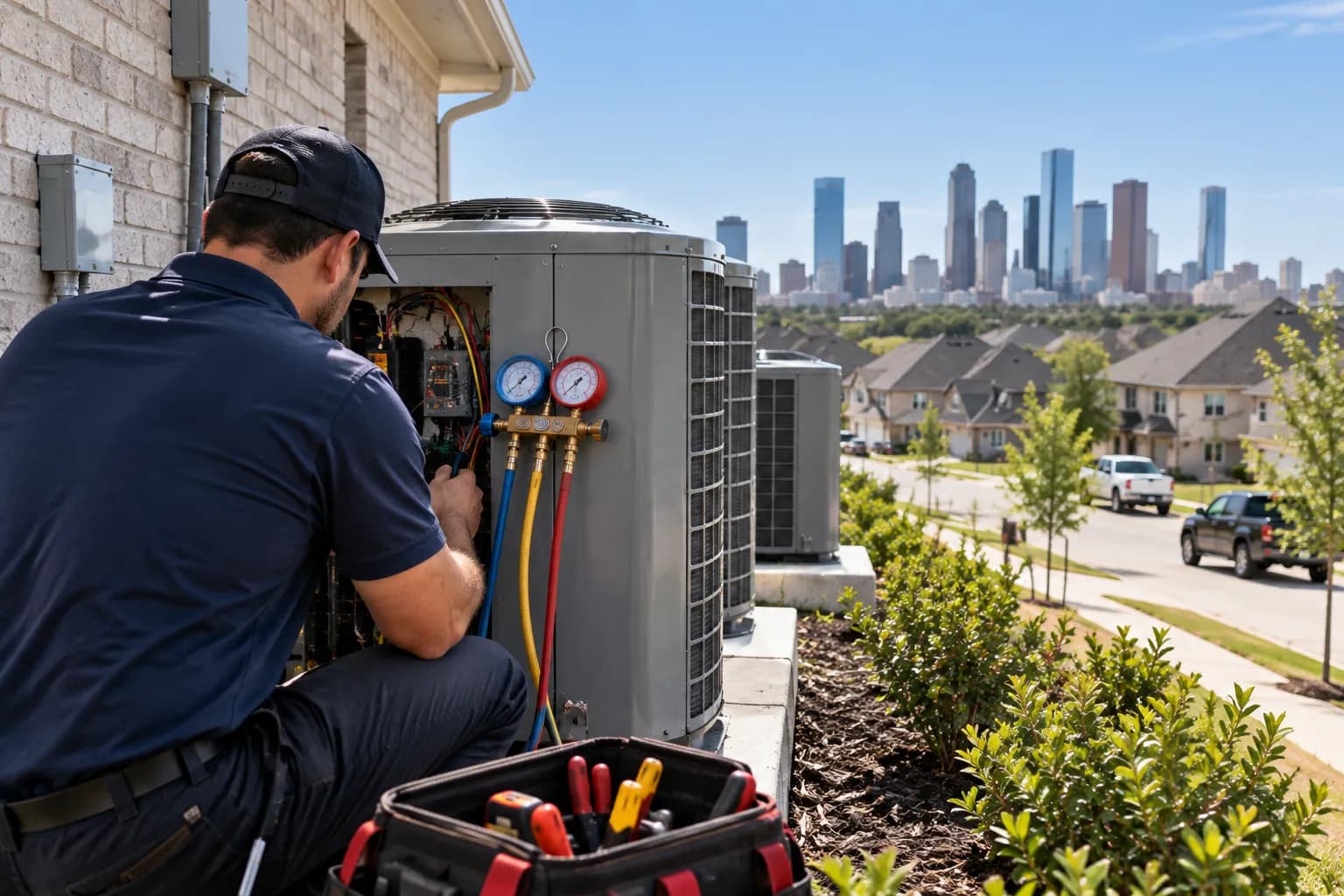
The HVAC industry in Greater Houston has gone through more change in the past three to four years than it did in the decade before that. Equipment standards have shifted. Refrigerant regulations have updated. The pricing environment has changed significantly from what homeowners used to expect. The technology in the systems being installed today is meaningfully different from what was standard even five years ago. And the way Google surfaces HVAC companies in Houston's search results has changed in ways that affect which companies homeowners find and which ones they don't.
Most of this change has happened gradually enough that individual homeowners haven't tracked it — you're not thinking about refrigerant regulations or SEER2 standards until you need a new system, and by then you're getting information from contractors whose incentives don't always align with giving you the clearest picture of what's actually changed and why it matters.
Here's an honest summary of what's different about Houston's HVAC market in 2026 and what it means for decisions you might be making right now.
THE EQUIPMENT STANDARD THAT CHANGED — SEER2 AND WHAT IT MEANS FOR YOUR NEXT PURCHASE
If you replaced an AC system five or more years ago, you probably remember the SEER rating — the efficiency metric that was the standard comparison point for residential AC equipment. In 2023, the industry transitioned to SEER2, a revised efficiency standard that uses testing conditions designed to better replicate real-world installation performance rather than the laboratory conditions of the original SEER test.
The practical effect is that the numbers on equipment labels are slightly lower than they would have been under the old standard for the same equipment. A system that would have been labeled 16 SEER under the old standard is approximately 15 SEER2 under the new one. The equipment's actual efficiency hasn't changed — only the measurement standard. But the number on the label is different, which creates confusion when homeowners are comparing quotes or evaluating what they had installed before versus what they're being quoted now.
For purchasing decisions in 2026, the minimum efficiency standard for new residential split system AC equipment in Texas's climate zone is 15 SEER2. Any new system being installed today should meet or exceed this threshold — equipment below this cannot be legally installed as new equipment in the Greater Houston area. Quotes that specify equipment below the 15 SEER2 minimum are either for old inventory being cleared out or for a contractor who isn't current on the regulations.
The efficiency tier options above the minimum in 2026 range from 15 to 16 SEER2 for standard single-stage equipment, 17 to 19 SEER2 for two-stage systems, and 20 SEER2 and above for variable-speed systems. The financial case for higher efficiency tiers in Houston's market is stronger in 2026 than it was several years ago because higher electricity rates mean the energy savings from each efficiency tier step translate into larger annual dollar savings than the same percentage improvement would have produced at lower rates.
THE REFRIGERANT TRANSITION — R-410A IS NOW WHERE R-22 WAS TEN YEARS AGO
For homeowners who remember the R-22 phase-out — the refrigerant that was standard in residential systems before 2010 and that became expensive and scarce as production ended — the next chapter of the refrigerant transition story involves R-410A, which has been the standard residential refrigerant since approximately 2010.
R-410A is now subject to phase-down under the EPA's AIM Act regulations targeting hydrofluorocarbons — a class of refrigerants with high global warming potential. The phase-down is not as abrupt as the R-22 phase-out was, but it's real. Equipment manufacturers have been transitioning new products to next-generation refrigerants — primarily R-454B and R-32 — and that transition is advancing meaningfully in 2026.
What this means practically for Houston homeowners depends on where they are in the equipment lifecycle.
If you have a system currently using R-410A that's performing well and has years of useful life remaining, the refrigerant transition doesn't require any immediate action. R-410A systems will be serviceable for the full remaining useful life of the equipment — the phase-down affects new equipment production, not the serviceability of existing systems. R-410A refrigerant for servicing existing systems remains available and will continue to be available throughout the remaining service life of R-410A equipment currently in the field.
If you're replacing a system in 2026, the equipment you're being quoted may use either R-410A or one of the next-generation refrigerants depending on the manufacturer and model. Ask specifically what refrigerant the proposed equipment uses and understand that next-generation refrigerant systems have slightly different service requirements than R-410A systems — not better or worse for the homeowner, but different in ways that require technicians to be trained and certified for the specific refrigerant type.
If you currently have an R-22 system — equipment installed before 2010 that hasn't been replaced — you're a decade into a phase-out that has made R-22 recharging expensive and that should be informing a near-term replacement decision if it hasn't already. An R-22 system with any refrigerant-related issue in 2026 is facing repair economics that almost always favor replacement over continued investment in phase-out refrigerant.
PRICING IN 2026 — WHAT'S HIGHER, WHAT'S STABILIZED, AND WHAT TO EXPECT
HVAC pricing in Greater Houston has been through a turbulent period. The supply chain disruptions of 2021 and 2022 produced equipment shortages and significant price increases that hit Houston homeowners during a period when demand from a hot real estate market and aging housing stock was already elevated. Those acute supply chain pressures have largely resolved, but the pricing environment of 2026 is not a return to pre-2021 norms.
Equipment costs have stabilized at levels higher than pre-pandemic pricing, reflecting both the manufacturer cost increases that flowed through the supply chain and the refrigerant transition costs that manufacturers are beginning to pass through as next-generation refrigerant equipment production scales. A complete AC system replacement that cost $5,000 to $7,000 installed in 2019 is more likely to cost $6,000 to $9,000 for equivalent equipment in 2026.
Labor costs have also increased meaningfully from the pre-pandemic period, driven by Houston's broader labor market conditions and by the increased training requirements for working with new refrigerant types and more complex variable-speed equipment. Service call rates, diagnostic fees, and per-hour labor charges are higher in 2026 than they were five years ago across the Houston market.
What has changed favorably for homeowners is the availability environment — the acute equipment shortages that were producing two to four week lead times for common residential equipment during 2021 and 2022 have largely resolved. Most standard residential equipment is available within days rather than weeks in 2026's Houston market, which means that replacement decisions don't need to be made under the time pressure of extended equipment lead times that characterized the most difficult supply chain period.
The practical advice for 2026 pricing is to get multiple quotes for any significant work — system replacement, compressor repair, or other major repairs — because the pricing spread between contractors in Houston's competitive market is meaningful, and the lowest quote isn't always the best value but the range tells you what market pricing actually is for the work being proposed.
THE GOOGLE BUSINESS PROFILE CHANGE THAT AFFECTED WHICH HVAC COMPANIES YOU FIND
In April 2026, Google updated its review policy in ways that specifically affected how HVAC companies rank in the Houston map pack — the three-company listing that appears at the top of local search results for queries like "AC repair Houston" or "HVAC company near me."
The change reduced the weight of raw review volume in favor of behavioral engagement signals — how many people click on the listing, how many call directly from the search result, how recently reviews have been posted, and the quality and specificity of the reviews rather than simply how many there are. A company with 500 recent, specific reviews from Houston homeowners describing their actual service experiences now ranks more competitively against a company with 5,000 older reviews spread across multiple Texas cities than it would have before the April 2026 update.
For Houston homeowners, this change is generally positive — it means the map pack is more likely to surface companies that are actively serving the local Houston community rather than companies that built review volume across multiple markets. The three companies that appear when you search for AC repair in your Houston neighborhood are more likely in 2026 to be companies that have earned their position through actual local service quality rather than through bulk review generation.
The operational implication for choosing an HVAC company from search results in 2026 is to look at the recency and specificity of reviews rather than just the star rating and total count. A company with a 4.9 rating from 200 reviews posted in the past twelve months that describe specific technicians, specific repairs, and specific interactions is giving you more reliable signal than a company with a 4.7 rating from 2,000 reviews posted over five years across multiple cities.
THE TECHNOLOGY SHIFT — WHAT'S IN THE SYSTEMS BEING INSTALLED IN HOUSTON IN 2026
The systems being installed in Houston homes in 2026 are meaningfully different from what was standard five years ago in ways that affect both performance and what you should expect from service and maintenance.
Variable-speed compressors and air handlers are increasingly the standard rather than the premium exception in the mid to upper efficiency tiers. Where variable-speed systems were the high-end option in 2019, they're now available across a broader price range and represent a larger fraction of new installations in the Houston market. Variable-speed systems are specifically beneficial in Houston's climate for humidity management — they run at lower speeds for longer cycles that remove more moisture per hour of operation than single-stage systems running full-capacity short cycles — but they also require technicians who understand the variable-speed control systems and can diagnose problems in communicating thermostat setups that single-stage systems don't have.
Communicating system architectures — where the thermostat, air handler, and outdoor unit communicate digitally rather than operating on simple on-off signals — have become more common in premium residential installations. These systems allow more precise control and more detailed diagnostics than conventional systems, but they also require that the thermostat, air handler, and outdoor unit be from compatible manufacturers or platforms. A replacement of one component in a communicating system architecture requires attention to compatibility in ways that replacing a component in a conventional system doesn't.
Smart thermostat integration as a standard feature rather than an add-on is now the norm for new installations in the Greater Houston market. Most new system installations include a smart thermostat as part of the package rather than leaving the homeowner to add one separately. The specific smart thermostat model and its compatibility with the installed equipment should be part of the installation conversation — not all smart thermostats work equally well with all equipment, and the integration quality matters for getting the full performance benefit from a variable-speed or communicating system.
Indoor air quality components are being specified as part of new installations more commonly than in previous years. UV germicidal systems, high-efficiency filtration in the air handler, and whole-home dehumidification are increasingly being included in installation packages rather than treated as aftermarket additions — reflecting both the growing homeowner awareness of indoor air quality and the specific relevance of these components in Houston's humidity and allergen environment.
WHAT HASN'T CHANGED — THE FUNDAMENTALS THAT MATTER AS MUCH AS EVER
Amid all of this change, several fundamentals of Houston HVAC ownership remain exactly as they've always been and are worth restating precisely because the volume of new technology and regulatory change can obscure them.
Proper load calculation remains the most important factor in any system installation. SEER2 ratings and next-generation refrigerants don't matter if the system is oversized for the home — oversizing remains the most common and most consequential installation mistake in Houston's market, and the equipment efficiency tier doesn't compensate for a system that short cycles because it was sized without a proper Manual J calculation.
Annual maintenance remains the single highest-return HVAC investment available to Houston homeowners. The technology in 2026's systems is more sophisticated than in previous generations, but the fundamental maintenance needs — clean coils, verified refrigerant charge, tested electrical components, clear condensate drainage — are the same regardless of whether the system is single-stage or variable-speed, R-410A or R-454B. More sophisticated equipment doesn't require less maintenance — it requires maintenance from technicians who understand the specific technology involved.
A licensed, insured local contractor remains the appropriate standard for choosing who to work with. The licensing and insurance requirements haven't changed with the equipment standards, the refrigerant transition, or the Google algorithm update. They exist for the same reasons they always have — safety, accountability, and the basic professional standards that protect homeowners when the work being done involves electricity, refrigerant, and in many cases gas lines.
Honest diagnosis before recommendation remains the test of whether a contractor is serving your interests. Variable-speed systems, smart thermostats, and next-generation refrigerants create more ways for contractors to upsell homeowners on features or upgrades that aren't necessary for a given home's situation. A contractor who explains specifically why a proposed feature or upgrade benefits your home in ways that are relevant to your situation is serving you honestly. One who presents upgrades as universally better without specific relevance to your situation is selling, not advising.
THE HOUSTON HOMEOWNER'S TAKEAWAY FOR 2026
The HVAC decisions you're making in 2026 are happening in a market that's different from the one that informed whatever mental model you built from previous system purchases or repairs. Equipment standards have updated, refrigerants are in transition, pricing has shifted, the technology has advanced, and the way you find and evaluate contractors through search results has changed.
None of these changes make HVAC decisions in Houston fundamentally different from what they've always been. The system still needs to be correctly sized, properly installed, consistently maintained, and honestly repaired by a licensed professional when something goes wrong. The fundamentals are the same. The specific context of those fundamentals is different in 2026 than it was in 2020, and understanding that context makes the decisions you make within those fundamentals better informed.
Multipoint AC & Heating provides HVAC installation, maintenance, repair, and 24/7 emergency service throughout Greater Houston, including Harris County, Fort Bend County, Montgomery County, and Austin County. Contact us at 832-963-3789 with any questions about the current Houston HVAC market or to schedule service.