- Home
- Blog
- What Houston Homeowners Should Know About R-22 Refrigerant and What to Do If Your System Still Uses It
What Houston Homeowners Should Know About R-22 Refrigerant and What to Do If Your System Still Uses It
Discover what Houston homeowners need to know about R-22 refrigerant, its phase-out, and available alternatives. Ensure your AC system's efficiency and compliance.
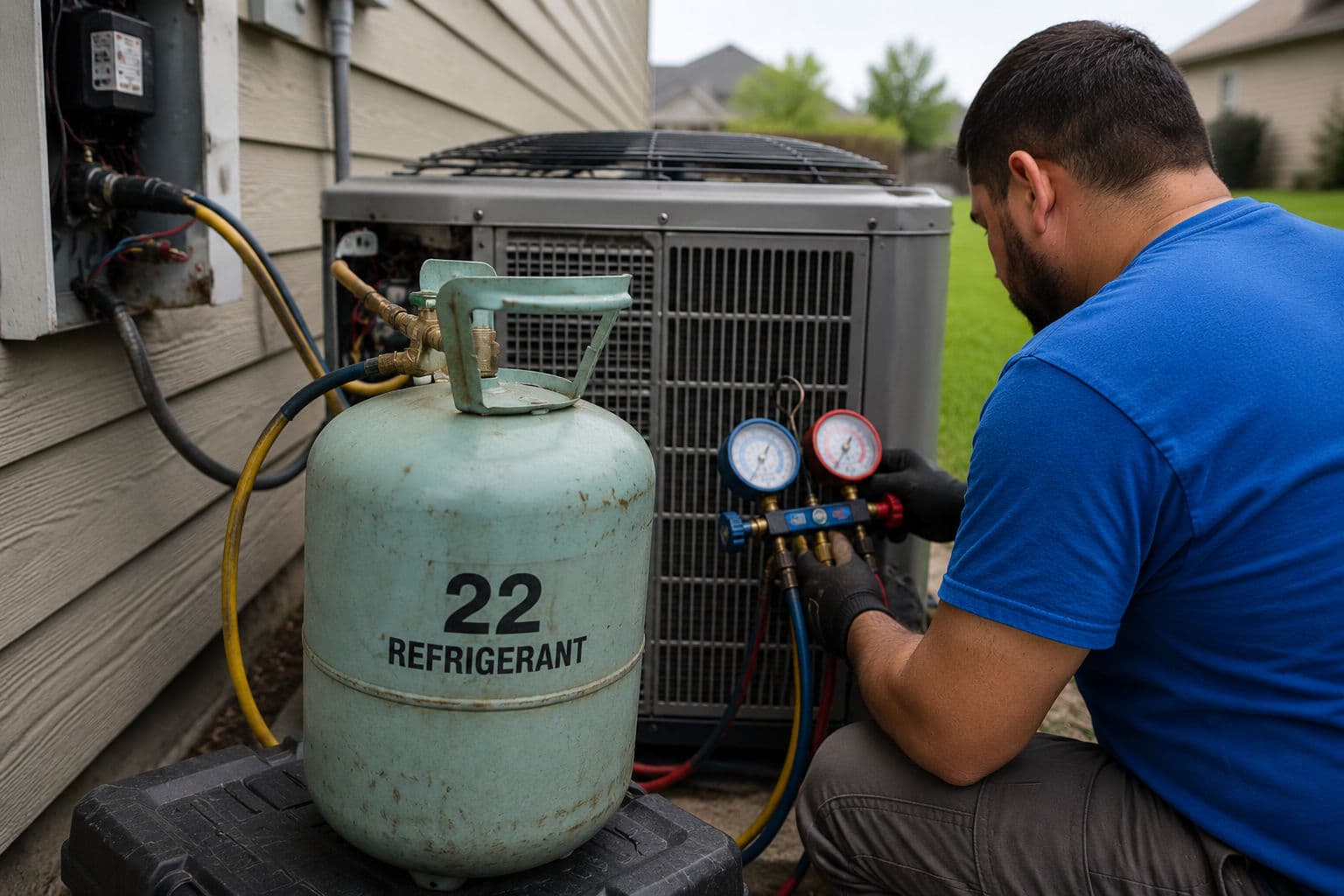
If your air conditioning system was installed before 2010 and hasn't been replaced since, there's a reasonable chance it uses R-22 refrigerant — a substance that's been phased out of production under federal environmental regulations and that's now expensive, limited in supply, and increasingly difficult to justify investing in as a long-term solution for an aging system.
R-22 is a topic that comes up regularly in service calls throughout the Greater Houston area. Many Houston homeowners don't know what refrigerant their system uses until a technician checks it during a repair or maintenance visit, and the discovery that a system uses R-22 often raises more questions than it answers. Here's what you actually need to know.
WHAT R-22 IS AND WHY IT WAS PHASED OUT
R-22 is a hydrochlorofluorocarbon refrigerant — commonly known by the brand name Freon — that was the standard residential AC refrigerant for decades. It's an effective refrigerant that works well in residential systems, which is why it was used so widely for so long.
The reason it was phased out has nothing to do with its performance in the AC system and everything to do with what happens when it's released into the atmosphere. R-22 is an ozone-depleting substance — when it escapes from refrigerant systems through leaks or improper handling, it reacts with and damages the stratospheric ozone layer. Under the Montreal Protocol, an international environmental agreement, the United States committed to phasing out ozone-depleting substances including R-22 on a defined schedule.
The phase-out proceeded in stages. Production and import of R-22 was significantly reduced year by year beginning in 2010, and as of January 1, 2020, the production and import of R-22 in the United States effectively ended. The only R-22 legally available today comes from existing stockpiles that were produced or imported before the cutoff date, and from reclaimed refrigerant recovered from systems being decommissioned. Both sources are finite and diminishing.
WHAT THE PHASE-OUT MEANS FOR YOUR HOUSTON AC SYSTEM
If your system uses R-22 and it develops a refrigerant leak — which is the primary situation where additional refrigerant is needed — the repair economics are fundamentally different from what they would be for a system using current refrigerants.
The cost of R-22 has increased dramatically as supply has tightened. Where R-22 once cost $10 to $20 per pound, the current market price ranges from $80 to $150 per pound or more depending on market conditions and regional availability. A typical residential AC system holds three to five pounds of refrigerant. A significant leak that requires a substantial recharge can cost $400 to $750 or more in refrigerant alone — before the cost of locating and repairing the leak and the labor for the service call.
For comparison, the current standard refrigerant — R-410A — costs $10 to $30 per pound. A refrigerant leak repair on an R-410A system is a straightforwardly manageable repair cost. The same repair on an R-22 system costs three to five times as much in refrigerant alone.
This cost difference changes the repair versus replacement calculation for R-22 systems significantly compared to what it would be for current-refrigerant systems of the same age. A repair that might clearly be worth doing on a 12-year-old R-410A system may not be worth doing on a 12-year-old R-22 system when the refrigerant cost alone approaches a significant fraction of new system cost.
HOW TO KNOW IF YOUR SYSTEM USES R-22
There are two easy ways to determine what refrigerant your system uses without calling a technician.
The nameplate on the outdoor condenser unit lists the system specifications including the refrigerant type. Look for a label on the side of the outdoor unit — typically a white or silver metal plate with the system's technical specifications. The refrigerant type will be listed as R-22, R-410A, or another designation. R-22 systems may list the refrigerant as R-22 or as HCFC-22.
The age of the system is also a reliable indicator. If the system was manufactured before 2010, it almost certainly uses R-22. Systems manufactured in 2010 and after use R-410A or in some newer cases R-454B or other next-generation refrigerants as the industry continues to transition. The manufacturing date is typically listed on the same nameplate as the refrigerant type, or can be decoded from the system's serial number — the first few digits of most residential HVAC serial numbers encode the manufacturing year and week.
SCENARIOS WHERE CONTINUING TO OPERATE AN R-22 SYSTEM MAKES SENSE
Not every R-22 system owner needs to rush to replacement. A few circumstances where continuing to operate an R-22 system is reasonable:
The system is functioning well and has no refrigerant leak. A well-maintained R-22 system that holds its charge and is cooling effectively has no immediate refrigerant cost exposure. The phase-out matters when you need to add refrigerant — a system that doesn't need it isn't directly affected by the supply constraint on a day-to-day basis.
The system is relatively young for an R-22 system. Some R-22 systems were installed as late as 2009 and 2010, meaning they may be 15 to 16 years old at most — not necessarily past end of life if they've been well maintained. A 14-year-old R-22 system in good condition with no refrigerant leak and a history of annual maintenance is a different situation than a 20-year-old R-22 system that's had multiple repairs.
The leak is small and the repair cost is manageable in context. A minor refrigerant leak on an R-22 system where the total recharge volume is small — one pound or less — may still be worth repairing if the system is otherwise in good condition and the total repair cost is modest relative to the remaining useful life.
SCENARIOS WHERE R-22 SYSTEM REPLACEMENT MAKES CLEAR SENSE
A significant refrigerant leak requiring several pounds of recharge. When the R-22 cost alone is $400 to $750 or more, the total repair cost including leak location, leak repair, and recharge approaches or exceeds what a substantial fraction of new system cost represents. On a system that's already 15 or more years old, spending $800 to $1,200 on a refrigerant repair to extend the life of aging equipment by an unknown additional period is rarely the most financially sound path.
A system past 15 years of age with any significant repair need. At this age in Houston's climate, multiple components have accumulated enough operating hours that subsequent repairs are likely — and each repair on an R-22 system carries the refrigerant premium if the repair disturbs the refrigerant circuit. A compressor replacement on an R-22 system requires opening the refrigerant circuit, which typically means recharging afterward — adding the R-22 cost to an already expensive repair.
Repeated refrigerant additions in recent years. If a system has needed refrigerant added more than once in the past two to three years, there's a persistent leak that hasn't been properly identified and repaired, and the refrigerant cost is a recurring expense rather than a one-time event. The cumulative refrigerant cost over several years of repeated additions is a significant number on an R-22 system.
A system showing efficiency decline alongside R-22 exposure. An aging R-22 system that's both losing efficiency from normal age-related degradation and facing refrigerant cost premiums when repairs are needed is experiencing a compounding cost disadvantage relative to new equipment on two separate fronts simultaneously.
YOUR OPTIONS IF YOU HAVE AN R-22 SYSTEM
Continue operating with the understanding of the refrigerant cost risk. If the system is performing well, holding its charge, and in otherwise reasonable condition, continuing to operate it while budgeting for eventual replacement is a valid approach. The refrigerant cost risk materializes only if a leak develops — a system that doesn't leak carries no ongoing R-22 premium.
Convert to a drop-in R-22 replacement refrigerant. Several alternative refrigerants have been developed as drop-in replacements for R-22 — refrigerants that can be used in R-22 systems without major equipment modification. R-421A, R-422D, and MO99 are among the options. These refrigerants are not subject to the same supply constraints as R-22 and are significantly less expensive per pound. The performance isn't perfectly identical to R-22 and manufacturer approval varies, but for an R-22 system where the cost of R-22 recharge is the primary concern, a drop-in replacement can extend the system's operating life at lower refrigerant cost.
The drop-in conversion approach makes the most sense for a system that has good remaining mechanical life but has developed a refrigerant leak — it addresses the immediate cost problem while buying additional time before replacement. It's not a permanent solution and doesn't change the underlying reality that the equipment is aging toward replacement.
Replace the system with current-refrigerant equipment. For systems that are clearly past their economic useful life based on age, repair history, efficiency decline, and the refrigerant cost factor, replacement is the cleanest solution. A new system on R-410A or the newest refrigerants eliminates the R-22 supply and cost concern entirely, starts a new manufacturer warranty period, and delivers the efficiency gains from current-generation equipment — which in Houston's nine-month cooling season translates into meaningful annual energy savings.
In the Greater Houston area, where the combination of system age, the climate's demands on equipment, and the R-22 cost factor compound the normal replacement calculus, replacement is the financially sound decision for more R-22 system owners than the simple equipment age would suggest when evaluated in isolation.
WHAT ABOUT R-410A — IS IT ALSO BEING PHASED OUT
Yes, and this is a question that's increasingly relevant for Houston homeowners who are making equipment decisions now.
R-410A, the refrigerant that replaced R-22 in residential systems and has been the standard since the late 2000s, is itself being phased out under newer environmental regulations targeting hydrofluorocarbons — a class of refrigerants that don't deplete the ozone layer but have high global warming potential. The EPA's AIM Act established a phase-down schedule for HFCs including R-410A, with equipment manufacturers required to transition to lower-global-warming-potential refrigerants.
The next-generation refrigerants — primarily R-454B and R-32 — are beginning to appear in new residential equipment. R-410A equipment continues to be installed and will remain serviceable for its full operating life, but homeowners buying new systems now should be aware that the refrigerant landscape is continuing to evolve and that the system they install today may be using a refrigerant that's in a phase-down period by the time the system reaches end of life.
For practical purposes, this doesn't change the immediate decision for most Houston homeowners. An R-410A system installed today will be serviceable throughout its expected 12 to 15 year Houston service life. The R-454B transition is occurring in new equipment, not in installed systems, and the supply and cost dynamics for R-410A are nothing like the severe constraint that R-22 faces today.
WHAT TO DO IF YOU'RE NOT SURE WHAT REFRIGERANT YOUR SYSTEM USES
If you're not sure whether your system uses R-22 or a current refrigerant, checking the nameplate on the outdoor unit is the simplest approach. If the label isn't readable or you can't locate it, a technician can identify the refrigerant type during any service visit — it's a standard part of the information a technician collects before working on the refrigerant circuit, since handling different refrigerants requires different equipment and procedures.
Knowing what refrigerant your system uses is information worth having before a repair need arises rather than discovering it under the time pressure of a hot-weather service call — it allows you to make the repair versus replacement evaluation thoughtfully rather than reactively.
Multipoint AC & Heating provides AC repair, maintenance, and installation throughout Greater Houston, including Harris County, Fort Bend County, Montgomery County, and Austin County. If you're not sure whether your system uses R-22 or would like an honest assessment of where your R-22 system stands, contact us to schedule a service visit.