How to Get Your Houston Home Ready for September — End of Summer HVAC Checklist
Prepare your Houston home's HVAC system for September with our end-of-summer checklist. Ensure cooling efficiency and transition seamlessly into fall.
August 28th in Houston means the calendar is approaching September but the weather hasn't gotten the memo. Temperatures are still regularly hitting the upper 90s, the AC is still running eight or more hours a day, and the system has been under sustained peak load since late May — roughly thirteen weeks of Houston's most demanding cooling conditions. September in Houston doesn't bring relief immediately. The first weeks of September are typically still hot enough that the AC runs daily, and meaningful temperature moderation usually doesn't arrive until late September or October.
What late August and early September do bring is a natural transition point — a moment to assess how the system has performed through the peak of the season, address anything that's developed over the summer, and begin thinking about the fall maintenance that prepares the heating system for when temperatures eventually drop.
Here's what Houston homeowners should be doing right now.
ASSESS HOW THE SYSTEM PERFORMED THIS SUMMER
Late August is the right time for an honest assessment of how your AC system performed through Houston's peak cooling season. If any of the following have been true this summer, they're worth addressing now while service demand is still high but the urgency of an emergency breakdown is less acute.
The house never felt quite as comfortable as it did last summer at the same thermostat setting. Comfort decline from one summer to the next — same thermostat, same household, similar outdoor temperatures, but the house feels slightly warmer or more humid than it did the year before — is the signature of an aging system that's lost some cooling or dehumidification capacity. This doesn't resolve on its own. Addressing it now, while the system is still in daily use and the condition is observable, produces a cleaner diagnosis than waiting until the system has been off for the fall and winter and the problem is harder to replicate.
The electric bill has been higher this summer than last summer without a clear explanation. Year-over-year energy consumption that's trending upward while thermostat habits, household occupancy, and outdoor temperature patterns are similar indicates declining system efficiency. A diagnostic visit now confirms whether the increase is from a dirty condenser coil that needs professional cleaning, a refrigerant charge that's dropped from a slow leak, a capacitor that's been running below specification all summer, or the normal efficiency decline of an aging system approaching replacement range.
The system made a noise at some point this summer that you noticed and then dismissed. A clicking that started and stopped, a brief rattling from the outdoor unit, a grinding sound that lasted a few seconds during startup — these transient symptoms are easy to dismiss when the system seems to recover and keep running. They're harder to dismiss when you understand that many of them indicate developing component failures that haven't produced a complete breakdown yet but are trending toward one. Late summer is the right time to have these investigated rather than waiting to discover them as a failure during the next heat wave.
One or more rooms were noticeably harder to cool this summer than in previous years. A room that's always been somewhat harder to cool is a duct or design issue. A room that was fine last summer and struggled this summer is a developing problem — possibly a duct that's partially collapsed or disconnected, a supply register that's become restricted, or a system that's lost enough capacity that the marginal rooms are no longer being adequately served. Either way, it's worth identifying rather than accepting as a new normal.
THE SYSTEM HAS BEEN RUNNING FOR THIRTEEN WEEKS AT PEAK — WHAT THAT MEANS
From late May through late August, a Houston AC system running daily has accumulated roughly 900 to 1,300 or more operating hours depending on how many hours per day it's been running. Over those thirteen weeks, several things have happened to the system regardless of whether any specific problem has been apparent.
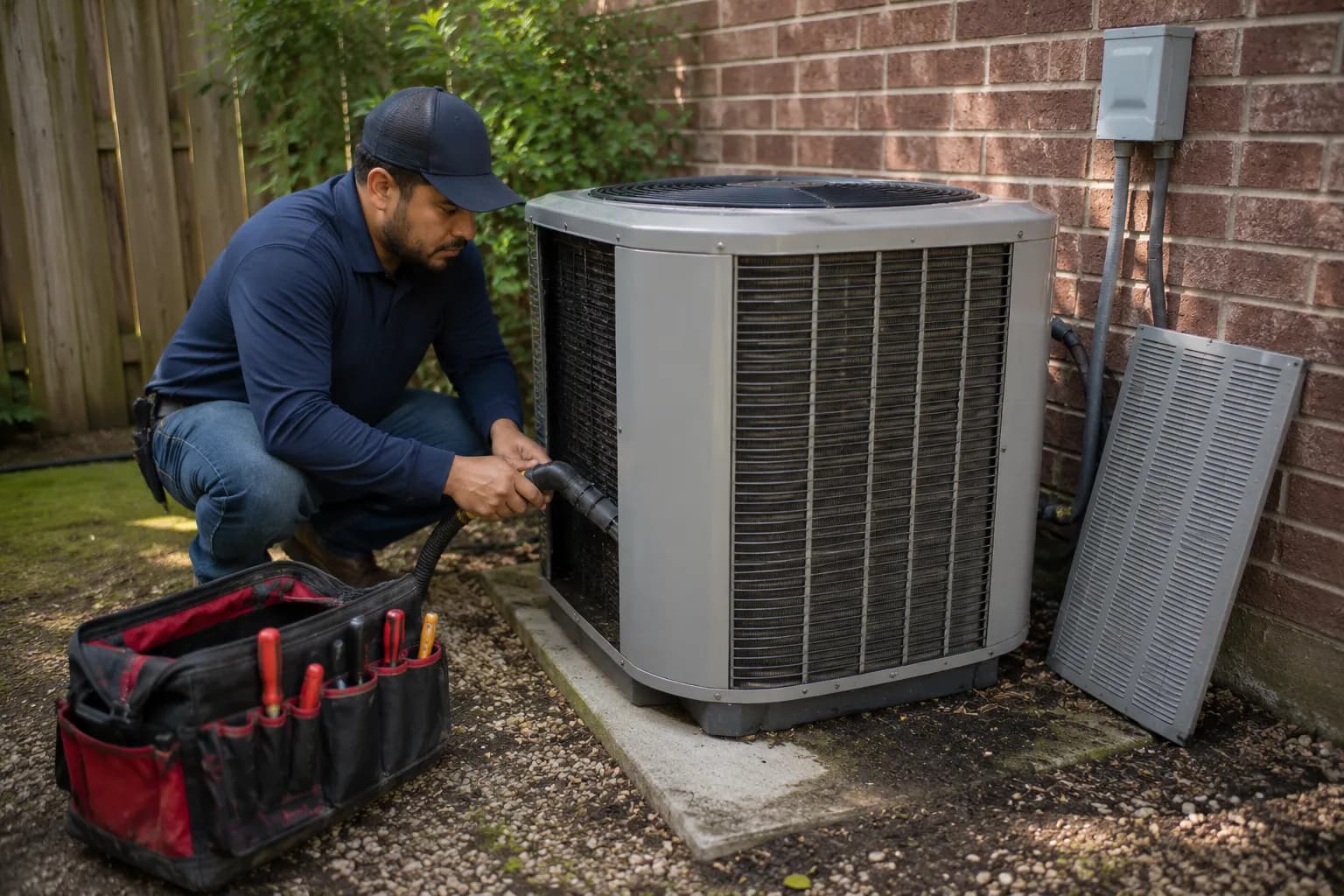
The condenser coil has accumulated a full season of debris. Pine needles in wooded communities, cottonwood, grass clippings, dust, and in some areas industrial particulates have been collecting on the condenser coil fins since the last professional cleaning. If the spring tune-up included a coil cleaning in March or April, the coil is now five months into a new accumulation cycle. If the system didn't have a spring tune-up — or if the last tune-up was fall of last year — the condenser coil may be carrying close to a full year's worth of debris. Either way, a condenser coil inspection and cleaning before the system transitions out of peak cooling mode is worth doing.
The condensate drain has been handling significant water volume for thirteen weeks. In Houston's humidity, the AC removes several gallons of water from the air every day it operates. The condensate drain line that handles all of that water for five months straight develops algae and biological growth at a rate that's faster than in drier climates. A drain line that was clear in April may be partially restricted or beginning to clog by late August. A drain line that clogs completely during the remaining weeks of the cooling season causes water overflow that damages the surrounding structure — catching it now before a complete clog prevents that outcome.
Electrical components have been under sustained load for thirteen weeks. Capacitors, contactors, and wiring connections that have been carrying their rated load through Houston's summer heat for five months have accumulated wear. A capacitor that was testing within specification in April may have drifted further below specification by late August from thirteen weeks of sustained thermal and electrical stress. This is the time of year when capacitors that have been borderline all summer are most likely to fail — and a late-summer failure, while the system is still running daily, is less catastrophic than an early summer failure, but it's still a service call that could have been anticipated.
WHAT TO DO RIGHT NOW — THE LATE AUGUST CHECKLIST
Check and replace the air filter. After thirteen weeks of peak operation, the air filter in most Houston homes is significantly loaded regardless of when it was last changed. Pull the filter out and look at it. If it's visibly loaded with debris — and it probably is — replace it now. A clean filter going into September allows the system to continue operating with proper airflow through the remaining weeks of the cooling season and provides a clean starting point when the system eventually transitions to heating.
Inspect the outdoor unit for debris accumulation. Walk around the outdoor condenser unit and look at the coil fin surfaces on the sides of the unit. In wooded communities, check for pine needle accumulation between the fins. In more open settings, look for grass clippings and dust coating the fin surface. If the coil is visibly fouled, either rinse it from the inside out with a garden hose after turning the system off or schedule a professional coil cleaning. A fouled condenser coil heading into September is still running the system below its rated efficiency for the remaining weeks of cooling demand.
Check the area around the outdoor unit for vegetation growth. Grass and vegetation that grew up around the outdoor unit during the summer may now be encroaching on the clearance zone — reducing the airflow the condenser fan needs and providing a habitat for insects inside the cabinet. Trim back vegetation to restore the minimum two-foot clearance on all sides.
Test the system from the thermostat and pay attention to what you observe. Run a deliberate test cycle — set the thermostat to call for cooling, go outside and confirm the outdoor unit starts and the condenser fan is spinning, confirm the indoor supply registers are producing cool air, and note approximately how long the system runs before reaching the set temperature. Compare this to your recollection of how the system has been performing through the summer. If anything seems different from what you've been experiencing — the outdoor unit takes longer to start, the supply air isn't as cold as it usually is, the run time seems longer than normal — note it for a service call.
Listen for any sounds from the system during this test cycle that you haven't noticed before or that have been present all summer but that you've been dismissing. New sounds at this point in the season warrant a call rather than continued dismissal.
SCHEDULE A LATE SUMMER SERVICE VISIT IF ANY OF THE FOLLOWING APPLY
Any of the comfort, efficiency, or noise concerns described above. Late August is still within the window where a diagnostic visit can identify and address developing problems while the system is actively running — which makes diagnosis easier and allows the technician to observe the system under load conditions rather than trying to replicate a problem the system isn't currently exhibiting.
The system hasn't had professional maintenance since last fall or earlier. A system that went through Houston's entire 2026 cooling season without a professional tune-up has been running for five months without a condenser coil cleaning, refrigerant charge verification, capacitor test, or condensate drain clearing. The condition of the system after five months of Houston summer operation without maintenance is worth assessing before the system transitions out of the cooling season — catching anything that needs attention now rather than leaving it to develop further over the fall and winter.
The system is more than ten years old and hasn't been evaluated recently. Older systems in Houston's established neighborhoods that have been running through the 2026 summer deserve a condition assessment that informs the repair versus replacement conversation for the upcoming season. A late August visit on a twelve-year-old system gives you current information about where it stands — whether it has several more seasons of reliable life ahead of it with proper care or whether replacement planning should be a near-term priority — in time to make that decision thoughtfully rather than reactively.
BEGIN THINKING ABOUT THE FALL TRANSITION
While the cooling season isn't over, late August is the right time to start thinking about the fall transition that's approaching in six to eight weeks.
The fall heating inspection should be scheduled in October — ideally early October — before the first cold front of the season and while the furnace hasn't been needed yet. Scheduling that appointment now, before October's calendar fills with others who waited until the last minute, secures the timing you want rather than accepting whatever's available when you remember to call in November.
If the system performed well this summer and is in good condition, the fall inspection is a routine confirmation that the heating system is ready. If the system has had a difficult summer — comfort complaints, efficiency decline, developing symptoms — the fall inspection is when those findings are addressed in the context of the system's overall condition and the replacement conversation may be the right outcome.
For homeowners in Montgomery County communities — The Woodlands, Conroe, Willis, Shenandoah, Oak Ridge North — where the first meaningful cold front typically arrives earlier and with more severity than in Fort Bend County or inner Houston, scheduling the fall inspection in September rather than waiting for October is worth considering. Being caught with a furnace that hasn't been inspected when the first cold front hits upper Montgomery County is a more serious situation than the same event in Sugar Land or Pearland.
THE BIGGER PICTURE — WHERE YOUR SYSTEM STANDS AFTER THE 2026 SUMMER
Every Houston cooling season is an opportunity to update your understanding of where your HVAC system stands in its service life. A system that performed well through the 2026 summer, maintained comfortable temperatures, kept energy bills in a normal range, and didn't produce concerning symptoms is a system that's earning its keep and is likely to do so for another season or more with proper maintenance.
A system that struggled this summer — comfort complaints, efficiency decline, developing symptoms, or a repair that was needed mid-season — has communicated something about where it stands in its service life. Taking that communication seriously and having an honest conversation about what it means for the upcoming season is more valuable now, at the end of the peak season, than at the beginning of the next one when the pressure of approaching hot weather creates decision-making urgency.
Multipoint AC & Heating provides AC diagnostic, maintenance, and repair service throughout Greater Houston, including Harris County, Fort Bend County, Montgomery County, and Austin County. If your system has anything to answer for after the 2026 summer, now is the right time to find out. Contact us at 832-963-3789 to schedule a late-summer diagnostic or to get on the calendar for your fall heating inspection.