How to Keep Your Houston Home Cool Without Overworking Your AC
Learn how to cool your Houston house efficiently and extend your AC's lifespan with these cost-effective strategies and tips.
Houston summers are long and the AC does most of the heavy lifting in keeping homes comfortable from late March through October. But how hard the AC has to work to maintain that comfort depends significantly on how much heat is getting into the home in the first place. Every BTU of heat that enters your home through the roof, walls, windows, and gaps in the building envelope is a BTU your AC has to remove — and in Houston's peak summer, that load is relentless.
Reducing the heat that gets into your home doesn't replace your AC system, but it reduces how hard the system has to work, which translates into lower energy bills, longer equipment life, and better comfort during the hottest parts of the day when the system is working against its heaviest load. Some of these steps cost nothing. Others are investments that pay back in energy savings over multiple seasons. All of them make a real difference in Houston's climate.
WHAT'S ACTUALLY HEATING YOUR HOME
Before getting into solutions it helps to understand where the heat is coming from, because different sources require different responses.
Solar heat gain through windows is one of the largest contributors to afternoon heat load in Houston homes, particularly on south and west-facing elevations. Direct sunlight through glass transmits heat into the home faster than almost any other pathway — a single large unshaded west-facing window can add thousands of BTUs of heat to the living space during a Houston afternoon.
Roof and attic heat transfer is the other major contributor. Houston attic temperatures reach 130 to 150 degrees Fahrenheit during peak summer, and that heat transfers through the ceiling into the living space continuously throughout the hottest part of the day. How much transfers depends on the amount and condition of the attic insulation, but in homes with inadequate insulation the ceiling essentially becomes a radiator pushing heat down into the living space that the AC has to constantly fight.
Air infiltration brings hot, humid outdoor air directly into the home through every gap, crack, and unsealed penetration in the building envelope. Around electrical outlets on exterior walls, at the tops and bottoms of door frames, around window frames, through attic access panels that aren't properly insulated and sealed — each of these is a pathway for Houston's summer air to enter the conditioned space.
Internal heat generation from appliances, lighting, cooking, and the body heat of occupants adds to the total cooling load. This source is smaller than solar gain and attic transfer but measurable, particularly in homes where heat-generating activities happen during the hottest part of the day.
THE HIGHEST-IMPACT CHANGES
Address attic insulation if your home is older. This is the single highest-impact improvement available to owners of older Houston homes for reducing cooling costs and taking pressure off the AC system. Houston's climate zone calls for R-38 to R-60 of attic insulation. Many homes built in the 1970s through early 1990s in established Houston communities — Katy, Sugar Land, Missouri City, Humble, Spring, Pearland, and similar neighborhoods — have original insulation that has settled and degraded to R-13 or lower. The difference in heat transfer through the ceiling between R-13 and R-38 insulation is enormous — it's roughly the difference between a ceiling that significantly resists the heat transfer from a 140-degree attic and one that barely slows it down.
Adding insulation to bring the attic to current standards is one of the most cost-effective energy improvements available in Houston's climate, with energy savings that typically pay back the investment in three to five years and improve comfort measurably from the first summer after installation. It also directly extends AC equipment life by reducing the continuous heat load the system is fighting, which reduces runtime hours and compressor stress.
Seal the attic air boundary alongside insulation. Attic insulation is most effective when the ceiling below it is well-sealed against air infiltration. Common air leakage points in Houston home attics include gaps around recessed light fixtures that penetrate the ceiling, attic access hatches that aren't insulated and weatherstripped, gaps around plumbing and electrical penetrations, and open wall cavities that connect directly to the attic. Sealing these before adding insulation above them captures the full benefit of the insulation upgrade.
Control solar heat gain through windows. The most effective and immediate step for west and south-facing windows is interior window coverings — cellular shades, blackout curtains, or reflective blinds — closed during the hours of direct sun exposure, typically noon through 7pm on west-facing windows and 10am through 3pm on south-facing ones. This single step costs nothing beyond what you may already own and can meaningfully reduce afternoon heat gain in rooms that receive direct summer sun.
For a more permanent solution, solar screen window treatments — mesh screens installed on the exterior of the window that block a significant percentage of solar radiation before it reaches the glass — are one of the most cost-effective window improvements for Houston homes. They allow light and outward visibility while blocking 80 to 90 percent of solar heat gain, and at a fraction of the cost of window replacement.
Exterior shading through vegetation or shade structures is even more effective than interior coverings because it stops solar heat before it reaches the glass entirely. Mature trees on the south and west sides of a Houston home can reduce cooling loads substantially. This is a long-term investment in new plantings but worth considering for a home that will be occupied for many years.
Seal air leaks in the building envelope. Weatherstripping on exterior doors that have visible gaps, caulk around window frames that have separated from the wall, door sweeps on doors with light visible at the bottom, and foam gaskets behind electrical outlet covers on exterior walls all reduce the volume of hot, humid outdoor air entering the home. In Houston's humidity environment, reducing air infiltration also reduces the indoor humidity load that the AC has to manage — making the home feel more comfortable alongside reducing energy costs.
CHANGES THAT COST NOTHING AND HELP IMMEDIATELY
Use ceiling fans strategically. Ceiling fans make a room feel several degrees cooler than it actually is through the wind chill effect on skin. Running ceiling fans in occupied rooms allows most people to be comfortable at a thermostat setting two to three degrees higher than they would be without the fan — a direct reduction in AC runtime. The important qualifier is that fans cool people, not rooms, so turning them off in unoccupied rooms prevents energy waste without losing any comfort benefit.
Manage internal heat sources during the hottest hours. Cooking on the stove and oven, running the dishwasher on heated dry, and using the clothes dryer all generate heat inside the home. Scheduling these activities in the early morning before the outdoor temperature peaks, or in the evening after it begins to drop, keeps internal heat generation from compounding the solar and attic heat load during the period when the AC is already working hardest. Using the microwave instead of the oven, air-drying dishes, and grilling outdoors rather than cooking inside are all small adjustments that reduce the indoor heat load during peak afternoon hours.
Keep interior doors open during the day. Closed interior doors prevent conditioned air from circulating through the home and can cause warmer areas to develop in rooms that aren't receiving adequate airflow. Open interior doors allow the system to distribute cooling more evenly throughout the home without increasing the total cooling load.
Check that the outdoor unit has adequate clearance and isn't in full sun exposure on the south or west side of the home. An outdoor unit that's in direct afternoon sun operates in a higher ambient temperature than one that's shaded, which reduces its ability to reject heat efficiently. If the outdoor unit is in a location where shade could be provided by a fence, trellis, or vegetation without restricting airflow, this is worth considering — with the important caveat that the shade structure must never block airflow around the unit.
CHANGES THAT REQUIRE MODEST INVESTMENT BUT PAY BACK QUICKLY
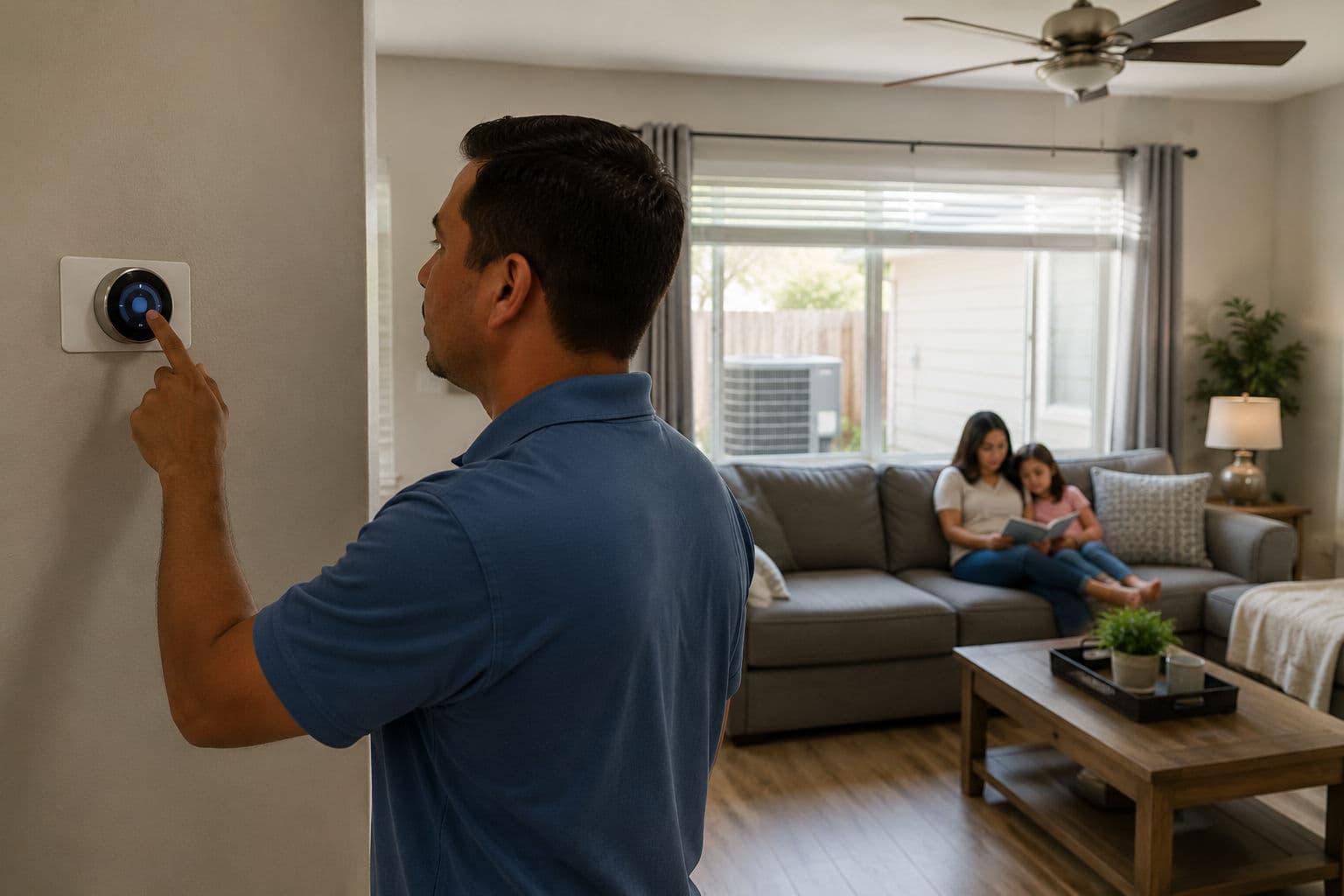
Install a programmable or smart thermostat if you don't have one. The most common source of unnecessary AC runtime in Houston homes is maintaining full comfort temperatures in an empty house. A programmable thermostat that raises the temperature automatically when the house is unoccupied and returns it before you arrive home captures energy savings every day without any reduction in comfort when you're actually home.
Replace incandescent and halogen lighting with LED. Incandescent and halogen bulbs convert a significant percentage of the electricity they consume into heat rather than light — heat that becomes part of the indoor cooling load. LED lighting produces the same light output with a fraction of the heat generation. In a Houston home where the AC is running for most of the year, every watt of heat that lighting doesn't generate is a watt of cooling the AC doesn't have to provide.
Add radiant barrier in the attic if your attic insulation is otherwise adequate. A radiant barrier is a reflective material installed on the underside of the roof decking that reflects radiant heat before it heats the attic air. In Houston's climate, radiant barriers have been shown to reduce attic temperatures by 20 to 30 degrees on peak summer days, which reduces the heat transfer through the ceiling into the living space. Combined with adequate insulation, a radiant barrier and insulation together are more effective than either alone. Radiant barrier installation is a relatively low-cost attic improvement that produces measurable cooling load reduction in Houston's high-radiation summer environment.
HOW THESE CHANGES INTERACT WITH YOUR AC SYSTEM
Each of these improvements reduces the total heat load that your AC system has to manage. The effect isn't that the system runs at a lower capacity — most single-stage systems run at the same capacity whenever they're on — it's that the system runs for fewer hours per day to maintain the same indoor temperature. Fewer running hours means lower energy consumption, less wear on the compressor and other components, and a longer service life for the equipment.
In Houston's nine-month cooling season, the difference between a system that runs twelve hours per day and one that runs nine hours per day because heat gain has been reduced is three hours of compressor runtime per day, multiplied across nine months of the cooling season. That's roughly 800 fewer operating hours per year — a meaningful reduction in accumulated wear that extends the system's service life and reduces the frequency of component replacements over the system's life.
For homeowners with AC systems that are struggling to keep up on peak summer days — running continuously without fully reaching the set temperature — addressing the heat load the system is fighting is sometimes as impactful as servicing the system itself. A system that's correctly maintained but undersized for a home with excessive heat gain may perform adequately after attic insulation and air sealing improvements reduce the load to a level the system can manage, without any change to the equipment.
Multipoint AC & Heating provides AC maintenance, repair, and installation throughout Greater Houston, including Harris County, Fort Bend County, Montgomery County, and Austin County. If your system is working harder than it should to keep your home comfortable this summer, contact us to schedule a diagnostic visit.