- Home
- Blog
- Heating Tune-Up in Houston, TX — What's Included, What It Costs, and Why October Is the Right Time
Heating Tune-Up in Houston, TX — What's Included, What It Costs, and Why October Is the Right Time
Discover what's included in a Houston heating tune-up, costs, and why October is the perfect time. Keep your system ready and reliable.
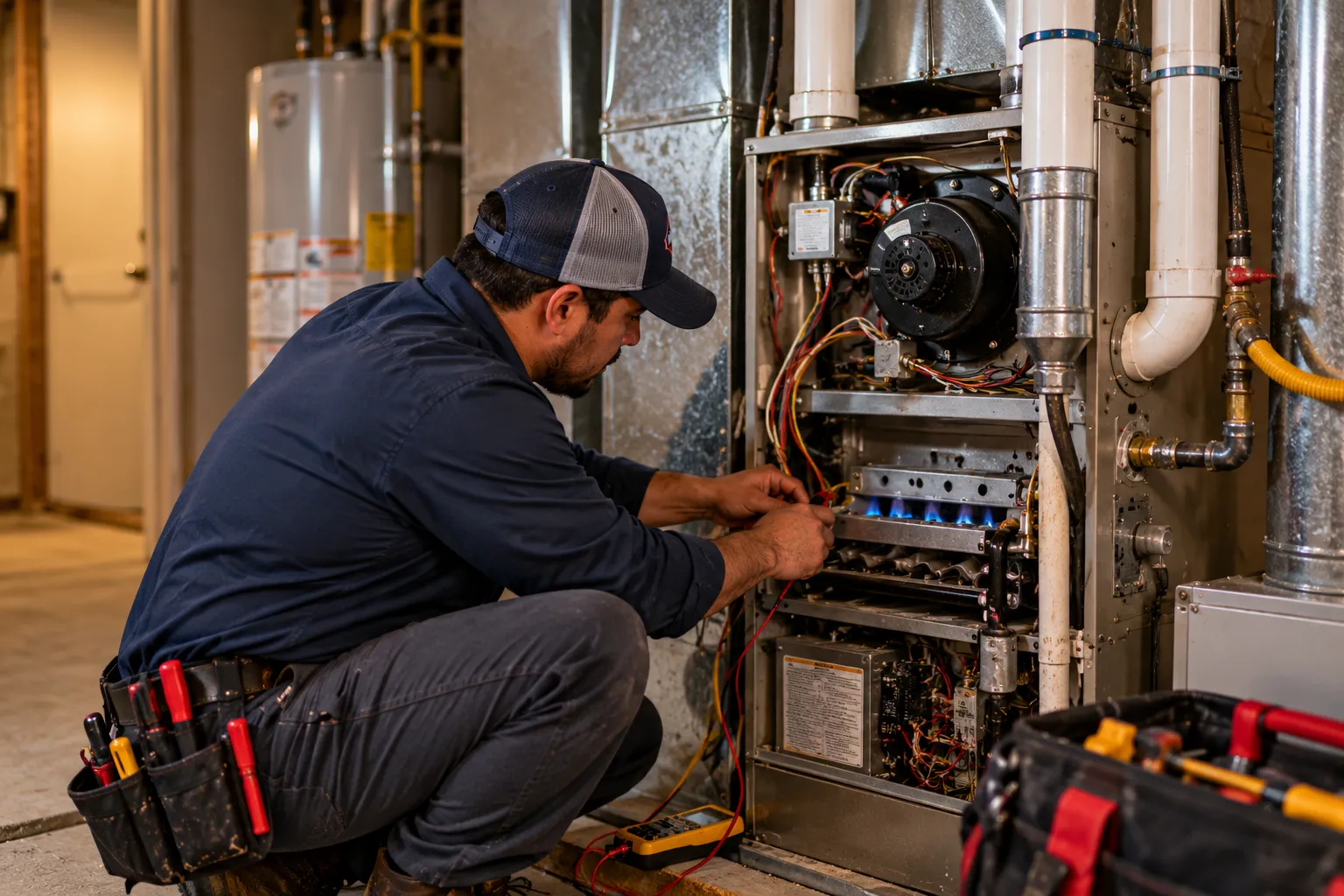
October in Houston means cold fronts. Not the sustained cold of a northern winter — but the sharp, fast temperature drops that arrive with little warning and demand that heating systems that haven't run since February perform reliably the first time they're called on. Most years, a meaningful number of them don't. The reasons are consistent: seven to eight months of sitting idle in Houston's high-humidity environment degrades specific components in ways that only show up when the system tries to run, and homeowners who didn't schedule a heating tune-up in September find out about those degraded components on cold October and November evenings when every HVAC company in Houston is fully booked with emergency calls.
A heating tune-up is what prevents that scenario. It's the professional inspection and service visit that evaluates the heating system's condition before the cold front tests it, addresses what needs to be addressed while there's time to do it calmly and cost-effectively, and gives the homeowner the confidence that the system is ready rather than the uncertainty of hoping it will work when needed.
This post covers exactly what a proper Houston heating tune-up includes, what it costs in 2026, and why scheduling one with Multipoint AC & Heating right now — this week — is the specific, time-sensitive action that protects your system through the fall and winter ahead.
WHY HOUSTON HEATING SYSTEMS NEED A TUNE-UP EVERY FALL WITHOUT EXCEPTION
The argument for annual heating tune-ups is straightforward in any climate. In Houston's climate, it's more compelling than anywhere else.
Houston's heating systems don't run through a gradual seasonal warm-up the way furnaces in cold climates do. They transition from complete dormancy — months of no operation whatsoever — to being called on suddenly when a cold front drops temperatures 40 degrees in a day. The idle-season degradation that occurs during those months of dormancy in Houston's humidity environment is real, consistent, and the primary driver of the October and November heating failure pattern that repeats across Greater Houston every year.
A flame sensor that was clean when the furnace last ran in February has been sitting in a humid environment for seven to eight months. Oxidation accumulates on the sensor surface during that idle period in ways that don't happen in the controlled combustion environment of active operation. When the furnace tries to light for the first time in October, the oxidized sensor can't generate the clean signal the control board needs to confirm the flame is present. The furnace attempts to light, briefly does, and shuts down. After two or three failed attempts it goes into lockout. The house doesn't heat.
An ignitor that was at 70 percent of its rated output when the furnace last ran in February has aged further during the idle period. It may have enough output to light the furnace reliably — or it may be at the margin where it lights sometimes, fails sometimes, and produces intermittent heating that's confusing and uncomfortable. The only way to know is to test it before the cold front makes the test involuntary and urgent.
A control board that had minor corrosion on its connections when the furnace last ran in February has had seven more months of Houston's humidity to develop that corrosion further. The board may function normally despite the corrosion, or the corrosion may have reached a point where specific functions are intermittent or failed.
None of these developing conditions produce any symptoms before the first heating demand of fall because the system isn't running. All of them reveal themselves under the same circumstances — the first cold front, the first call for heat, the moment when the system either performs or fails in front of a household that needs it.
The heating tune-up, performed in October before the cold front arrives, is what catches these conditions while there's still time to address them as planned repairs rather than emergency calls. This isn't a theoretical benefit — it's the direct, practical reason that Houston homeowners on maintenance plans who get their fall tune-up in September or early October consistently do not end up in the emergency call queue during the first cold front, while homeowners who didn't get the tune-up often do.
WHAT A PROPER HEATING TUNE-UP INCLUDES IN HOUSTON
The word tune-up gets applied to service visits ranging from a thorough two-hour inspection to a cursory twenty-minute visit that barely scratches the surface. In Houston's climate, with the idle-season vulnerability pattern described above, a thorough visit that covers all of the following is what actually protects the system.
Flame sensor inspection and cleaning. This is the single most important component of a Houston fall heating tune-up because it directly addresses the most common first-cold-front failure cause in this market. A technician evaluating the flame sensor should physically remove it from the furnace, inspect the sensing rod for oxidation and buildup, and clean it with appropriate materials to restore the clean surface that generates a reliable signal. The cleaned sensor should be reinstalled and the system run through a start cycle to confirm the flame sensor is generating a clean signal and the furnace is completing a full heating cycle without lockout.
Ignitor inspection and testing. The ignitor should be visually inspected for cracks, chips, or deterioration and tested for its current electrical output against the manufacturer's specification. An ignitor reading significantly below its rated output is approaching failure — the specific threshold varies by ignitor type, but a technician with the appropriate test equipment can identify whether the ignitor is within acceptable range or needs replacement before it fails under demand.
Heat exchanger inspection. The heat exchanger is the safety-critical component in gas furnace systems — the component that separates combustion gases from the air circulating through the home. A cracked or compromised heat exchanger allows carbon monoxide and other combustion byproducts into the supply airstream, which is a health and safety concern that requires immediate attention. Heat exchanger inspection requires appropriate equipment and experience — it's not a visual inspection through the furnace door, it's a systematic evaluation of the heat exchanger's integrity. A technician performing a genuine heat exchanger inspection can tell you the specific finding and explain what they observed, not just confirm they looked at it.
Gas pressure verification and burner inspection. The gas pressure at the furnace manifold should be measured and compared to the manufacturer's specification for the specific furnace model. Incorrect gas pressure — too high or too low — affects combustion efficiency, heat output, and in some cases creates combustion conditions that accelerate heat exchanger wear. The burners themselves should be inspected for debris, rust, or uneven flame pattern that indicates partial blockage or degradation affecting combustion quality.
Draft inducer motor inspection. The draft inducer is the motor that vents combustion gases from the furnace before and during operation. It's required to start before the gas valve opens — the control sequence is inducer first, then ignitor, then gas valve — and a failing inducer prevents the furnace from starting even when all other components are functional. The inducer motor should be inspected for bearing condition, verified to reach operating speed within the expected time frame, and confirmed to produce the draft pressure that the pressure switch monitors as a safety confirmation.
Pressure switch testing. The pressure switches — typically one or two per furnace — confirm that the draft inducer is operating correctly before allowing the gas valve to open. A pressure switch that's failed or that has a cracked sensing hose prevents the furnace from starting even when the inducer is working correctly. Pressure switches should be tested for correct operation and the sensing hoses inspected for cracks or deterioration.
Blower motor inspection. The blower motor moves air through the air handler and duct system during both heating and cooling operation. The blower motor's amperage draw should be measured against its rated specification — a motor drawing significantly more current than rated is working harder than it should, typically from restricted airflow, a capacitor issue, or developing motor wear. The blower wheel should be inspected for debris accumulation — a blower wheel coated with biological material and dust from Houston's summer moves less air per revolution and adds to the motor's load.
Capacitor testing. The capacitor supporting the blower motor should be tested against its rated specification, just as the AC tune-up tests the capacitors supporting the compressor and condenser fan motor. A degraded capacitor affects blower motor performance during heating season in the same ways it affects compressor performance during cooling season.
Safety control verification. The high-limit switch, the roll-out switch, and other safety controls that prevent operation under unsafe conditions should be verified to be functional. These controls exist to prevent overheating and other unsafe operating conditions and should be tested rather than simply assumed to be working.
Flue and venting inspection. The flue pipe that vents combustion gases from the furnace to the exterior should be inspected for physical integrity, secure connections, and the absence of blockages. A flue with a bird nest, debris accumulation, or a disconnected section allows combustion gases to accumulate in the mechanical space or enter the living area rather than venting safely to the exterior.
Carbon monoxide detector verification. While not strictly an HVAC service item, a technician performing a thorough heating tune-up should remind the homeowner to verify that working carbon monoxide detectors are present on each sleeping floor of the home and that their sensor age is within the functional range. A CO detector with an expired sensor that responds to the test button but can't actually detect carbon monoxide is a false sense of security against the exact risk that heat exchanger inspection is designed to catch before it becomes active.
System performance confirmation. After all components have been inspected and any issues addressed, the system should be run through a complete heating cycle — from thermostat call for heat through ignition, heating operation, and controlled shutdown — while the technician confirms that all operating parameters are within normal range and the system is performing as designed.
Written service report. The tune-up should conclude with written documentation of what was inspected, what readings were taken, what was found, what was done, and any recommendations for follow-up action. This documentation serves as your maintenance record for manufacturer warranty compliance and gives you a specific reference point for the system's condition at this inspection for comparison at future service visits.
WHAT A HEATING TUNE-UP COSTS IN HOUSTON IN 2026
A professional fall heating tune-up from a licensed, insured Houston HVAC company in 2026 runs approximately $100 to $250 for a standard single gas furnace system. This range reflects the cost of a proper service visit — the technician time, the consumables, and the thoroughness described above.
Maintenance plans that bundle the fall heating inspection with the spring cooling tune-up typically run $200 to $450 per year for a single system and represent a better per-visit value than booking each service separately. Maintenance plans also provide priority scheduling for service calls — a practical benefit that has real dollar value during the fall cold front season when non-member scheduling is compressed and emergency rates apply to after-hours calls.
If the tune-up finds components that need replacement — a flame sensor that's degraded beyond cleaning, an ignitor reading below specification, a pressure switch that's failed — those repairs are quoted separately from the tune-up itself. The tune-up cost covers the inspection; the repairs that come out of it are separate line items. This is standard and appropriate — the value of the tune-up is in finding these items while they're manageable rather than after they've produced a heating failure.
The total cost of a tune-up plus one or two common minor repairs — flame sensor cleaning, capacitor test and replacement if needed — is consistently lower than an emergency after-hours service call for a heating failure during a cold front. The emergency call involves premium rates, longer wait times, and the disruption of being without heat while waiting for service. The tune-up visit avoids all of that at a lower total cost.
THE SPECIFIC TIMING ARGUMENT FOR THIS WEEK
Today is October 7th. The first significant cold fronts of fall 2026 have already begun arriving in Greater Houston, with temperatures dropping into the 50s overnight in parts of the metro. Additional fronts are coming — that's the nature of Houston's fall — and each one tests heating systems that haven't been verified.
Scheduling a heating tune-up this week — not later this month, this week — gives you the best realistic chance of having the inspection completed before the next significant cold front tests your system. An inspection scheduled today for next week or the week after is an inspection that happens while there's still time to address anything found before that front arrives.
An inspection scheduled in three weeks — or after the next cold front makes the urgency obvious — may find the same things, but with less time or no time to address them before the heating demand that requires the system to perform is already active.
Multipoint AC & Heating is scheduling fall heating inspections throughout Greater Houston right now. Availability fills week by week as October progresses and more homeowners — including all the ones who didn't call last week — start calling at once. Calling today gets you a date that works for your schedule. Calling after the next cold front gets you whatever's available.
WHY MULTIPOINT AC & HEATING FOR YOUR HOUSTON HEATING TUNE-UP
There are hundreds of licensed HVAC contractors in the Greater Houston market. Here's specifically why Multipoint AC & Heating is the right call for your fall heating tune-up.
We're local. Multipoint AC & Heating is a family-owned company rooted in the Greater Houston area, serving Harris County, Fort Bend County, Montgomery County, and Austin County. We're not a multi-city chain with a Houston office — we're Houston HVAC professionals who live and work in the communities we serve. The technician who comes to your home knows the conditions in your neighborhood — the wooded settings of The Woodlands and Kingwood that produce specific condenser debris patterns, the waterway-adjacent humidity of Atascocita and Baytown that accelerates biological growth in HVAC systems, the established housing stock of Katy and Sugar Land that comes with duct systems that have decades of history.
We're transparent. When we perform a heating tune-up, we show you what we found. If the flame sensor needs cleaning, we show you the sensor before and after. If the ignitor is reading below specification, we show you the measurement and tell you what the specification is. If the heat exchanger shows something that concerns us, we explain specifically what we observed and what it means. You get the actual findings, not a summary designed to support a predetermined service recommendation.
We do the work right. A heating tune-up from Multipoint includes everything in the comprehensive list above — not a compressed version that skips the components that take time to evaluate properly. We know the idle-season failure pattern that Houston's climate creates, and we evaluate specifically for the components that pattern affects. The flame sensor gets cleaned. The ignitor gets tested. The heat exchanger gets inspected. The draft inducer gets verified. The blower motor gets checked. The safety controls get tested. The flue gets inspected. And you leave with written documentation of everything we found and did.
We're there when you need us. If something goes wrong with your heating system after a tune-up — or if you have an emergency at any point during the heating season — Multipoint AC & Heating provides 24/7 emergency service throughout Greater Houston. Our maintenance plan customers receive priority scheduling for those calls, but we answer for everyone who calls. Day or night, cold front or not, we're the company that picks up.
We build relationships. Our goal isn't to perform one tune-up and move on. It's to be your HVAC company — the team that knows your system's history, tracks its performance year over year, and gives you honest guidance about maintenance, repair, and replacement decisions across the life of the equipment. A Multipoint customer who called us for a tune-up three years ago knows us, trusts us, and calls us first when anything comes up with their HVAC system. That's the relationship we're building with every service visit.
WHAT HAPPENS WHEN YOU CALL MULTIPOINT AC & HEATING TODAY
When you call 832-963-3789 today to schedule your fall heating tune-up, here's exactly what happens.
We'll answer — not a voicemail, not a callback queue, a real person who can talk through your system's situation and get you on the schedule. We'll ask for your address and a few details about your system — approximate age if you know it, whether it's a gas furnace, heat pump, or other configuration, and whether you've had any heating issues in recent years. This gives us context before the technician arrives.
We'll schedule you at a time that works for your household — a morning or afternoon appointment that gives you a window you can plan around rather than an all-day wait. For customers who need to be home for the appointment, we'll give you the best estimate of when the technician will arrive within the scheduled window.
The technician will arrive, introduce themselves, and ask about any concerns or observations you have about the system before starting. Your observations — things you've noticed during the cooling season that might be relevant to the heating system, or anything unusual from the last time the heat ran — are useful diagnostic context that helps us focus the inspection appropriately.
We'll work through the complete inspection described above, share what we're finding as we go, and give you a clear summary at the end — what we did, what we found, what readings we took, and any recommendations for follow-up action. If we find something that needs repair, we'll quote it clearly and let you decide whether to proceed, with no pressure and no artificial urgency beyond what the actual condition warrants.
You'll leave the appointment knowing exactly where your heating system stands heading into Houston's fall and winter — with the confidence that comes from having had it professionally evaluated rather than the uncertainty of hoping for the best when the next cold front arrives.
Call Multipoint AC & Heating at 832-963-3789 today to schedule your fall heating tune-up. We're serving homeowners throughout Greater Houston right now — Harris County, Fort Bend County, Montgomery County, and Austin County. Don't wait for the next cold front to find out whether the system is ready.