Why Does My Electric Bill Spike in July and August in Houston?
Learn why electricity costs rise in Houston's summer months and discover ways to manage AC efficiency.
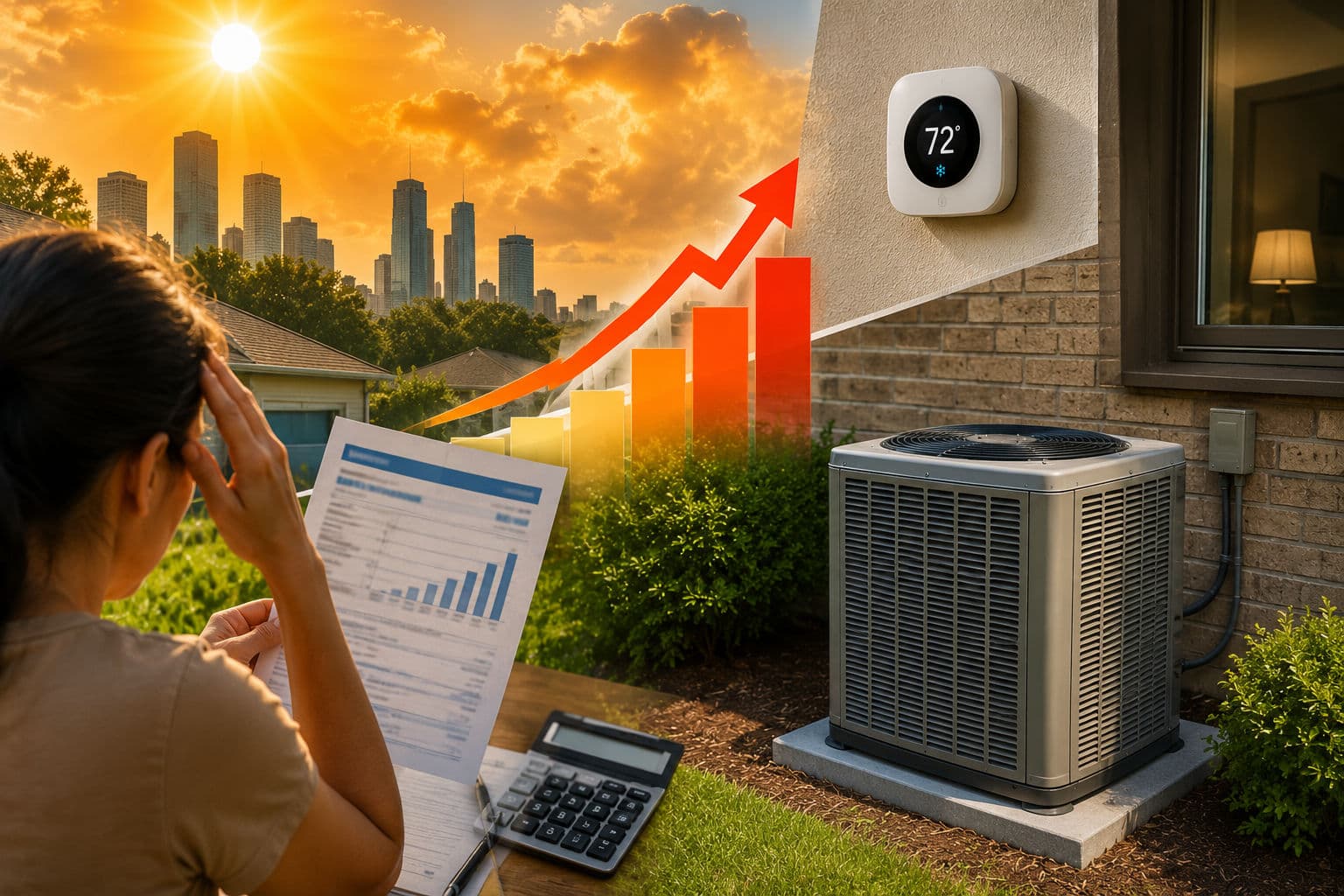
July and August are the most expensive months of the year for Houston homeowners when it comes to electricity. The combination of sustained high temperatures, relentless Gulf humidity, and AC systems running twelve or more hours a day pushes electric bills to their annual peak during these two months. Some of that is simply the cost of living in Houston in summer. But some of it is a sign that something with your HVAC system deserves attention — and knowing the difference can save you a significant amount of money both now and over the life of your equipment.
WHAT A NORMAL JULY AND AUGUST BILL LOOKS LIKE IN HOUSTON
For a typical Houston home between 1,800 and 2,500 square feet with a mid-efficiency AC system in reasonable condition, electric bills during July and August commonly run between $250 and $450 per month. Larger homes, homes with older less-efficient systems, and homes with poor attic insulation will run higher. Smaller homes or homes with newer high-efficiency equipment can run lower.
If your bill falls within a reasonable range for your home's size and your system's age, the spike is likely just Houston being Houston in peak summer. If your bill is significantly higher than previous summers without an obvious explanation — more people at home, a new appliance, extended time at home during the day — your AC system is worth having evaluated.
WHY BILLS SPIKE IN JULY AND AUGUST SPECIFICALLY
Houston's heat index during July and August regularly reaches 105 to 115 degrees Fahrenheit. At those conditions the difference between outdoor temperature and your indoor thermostat setting is at its widest point of the year — typically 30 to 40 degrees — and your AC system is working against the largest temperature differential it faces all season. The system runs longer per cycle, cycles more frequently, and in some cases runs nearly continuously during the hottest part of the afternoon.
The humidity load during these months is also at its peak. Your AC isn't just fighting heat during a Houston July — it's removing enormous volumes of moisture from the air simultaneously, and that moisture removal requires additional runtime beyond what temperature control alone would demand. In the communities along the Gulf Coast corridor and near Houston's major waterways — Baytown, Galveston Bay area, Crosby, Highlands, Kingwood, and Atascocita — the humidity component of the cooling load is even more significant than in drier parts of the metro.
WHEN A HIGH BILL IS A SIGN OF AN AC PROBLEM
Several AC conditions cause energy bills to climb beyond what peak summer conditions alone explain. These are worth knowing because they also indicate a system that's working harder than it should — which accelerates wear on components and shortens equipment life alongside driving up the electric bill.
Dirty condenser coils. The outdoor condenser unit releases the heat your AC pulls out of your home to the outside air. When the coil fins are clogged with dust, grass clippings, cottonwood, or in wooded communities like The Woodlands and Kingwood, pine needles and leaf debris, the system can't reject heat efficiently. It has to run longer to achieve the same cooling, which drives up energy costs directly. A condenser coil that's been accumulating debris since the last maintenance visit is one of the most common findings on high-bill service calls during peak summer.
Low refrigerant. When refrigerant charge drops below the correct level due to a system leak, the AC loses cooling and dehumidification capacity. The system compensates by running longer, but it can never fully make up for the capacity loss. Energy costs climb while comfort declines simultaneously. Low refrigerant is caused by a leak that needs to be located and repaired — adding refrigerant without fixing the leak is a temporary measure that leaves the underlying problem in place.
Dirty evaporator coil. The indoor evaporator coil is where the actual heat exchange happens. In Houston's humidity, biological growth accumulates on evaporator coil surfaces faster than in drier climates, reducing the coil's ability to transfer heat and moisture efficiently. A dirty evaporator coil causes the system to run longer for the same result, and in severe cases can cause the coil to ice over — which reduces cooling capacity dramatically and in some cases causes the system to stop cooling altogether.
Aging system losing efficiency. AC systems lose efficiency gradually as they age. A system that was rated at 14 SEER when it was installed ten years ago may be operating at the equivalent of 10 or 11 SEER today due to normal wear, accumulated debris, and component degradation. That efficiency loss means higher energy costs for the same cooling output, and the gap between what the system costs to run and what a newer system would cost widens every year. In Houston's peak summer months, when the system runs more hours per day than any other time of year, that efficiency gap shows up most clearly on the electric bill.
Duct leaks losing conditioned air to the attic. Leaky supply ducts allow cooled, dehumidified air to escape into your attic — where attic temperatures reach 130 to 150 degrees in Houston summers — before it reaches your living space. The system keeps running to replace the lost conditioned air, which never actually cools the house efficiently. If your system seems to run continuously but the house never fully reaches the thermostat setting, duct leakage is worth investigating alongside equipment condition.
Short cycling from an oversized system. An oversized AC unit cools the air temperature quickly and shuts off before removing adequate humidity. This sounds like it would lower energy costs — shorter run times — but oversized systems that short cycle tend to restart more frequently, and compressor startups draw significantly more power than steady-state operation. The frequent start-stop cycle also puts heavy wear on the compressor, which is the most expensive component in the system. Energy bills on a short-cycling oversized system are often higher than they would be on a correctly sized system running normal length cycles.
PRACTICAL STEPS TO LOWER YOUR JULY AND AUGUST BILL
Set your thermostat to 78 degrees when home and program it higher when away. Every degree below 78 during Houston's peak summer adds roughly 3 to 5 percent to your cooling cost. A programmable or smart thermostat that adjusts automatically when the house is empty during the day can make a meaningful difference across the full billing period.
Keep the outdoor unit clear. Make sure there's at least two feet of clearance around the condenser unit and that no vegetation, debris, or obstructions are restricting airflow through the coil. In Houston's peak summer, even partial obstruction of the condenser causes measurable efficiency loss.
Change your air filter. A clogged filter restricts airflow through the system, causing it to work harder for the same result and in severe cases triggering safety shutdowns that leave the house without cooling. During peak summer in Houston, checking the filter monthly and replacing it every 30 to 60 days is the right interval for most homes.
Use ceiling fans when rooms are occupied. Ceiling fans don't lower air temperature but they create a wind chill effect that makes the room feel several degrees cooler than it is. Running ceiling fans in occupied rooms allows most people to be comfortable at a thermostat setting two to three degrees higher than they would without the fan — which translates directly into lower AC runtime and lower bills.
Close blinds and window coverings during the hottest part of the day. Direct sunlight through windows during Houston's July and August afternoons adds significant heat load to the living space that the AC has to overcome. South and west-facing windows in particular contribute substantially to afternoon cooling load. Closing coverings on these windows between noon and 6pm reduces the heat gain the system has to manage.
Schedule a maintenance visit if you haven't had one this year. If your system hasn't been tuned up this season and your bills are higher than expected, a maintenance visit that includes coil cleaning, refrigerant check, and electrical component inspection will identify whether your system has a developing problem that's driving up costs — and in many cases the efficiency improvement from a professional coil cleaning alone is noticeable on the following month's bill.
IF YOUR BILL IS SIGNIFICANTLY HIGHER THAN LAST SUMMER
A bill that's noticeably higher than the same period last summer without a clear explanation — same household, same habits, similar temperatures — is one of the most reliable indicators that something with the AC system has changed. Equipment doesn't get more efficient with age. If the bill is going up and nothing else has changed, the system is working harder than it used to for the same result.
A diagnostic visit identifies what's driving the increase. In most cases it's one of the conditions described above — a dirty coil, low refrigerant, a failing component that's reducing efficiency — that can be corrected at a cost that pays back quickly in lower bills over the remainder of the summer.
Multipoint AC & Heating provides AC diagnostic, repair, and maintenance service throughout Greater Houston, including Harris County, Fort Bend County, Montgomery County, and Austin County. If your summer electric bills aren't where they should be, contact us to schedule a diagnostic visit.