How to Know If Your Ductwork Is Costing You Money in Houston
Learn how ductwork issues can inflate your energy bills and affect home comfort in Houston's climate. Uncover signs and solutions.
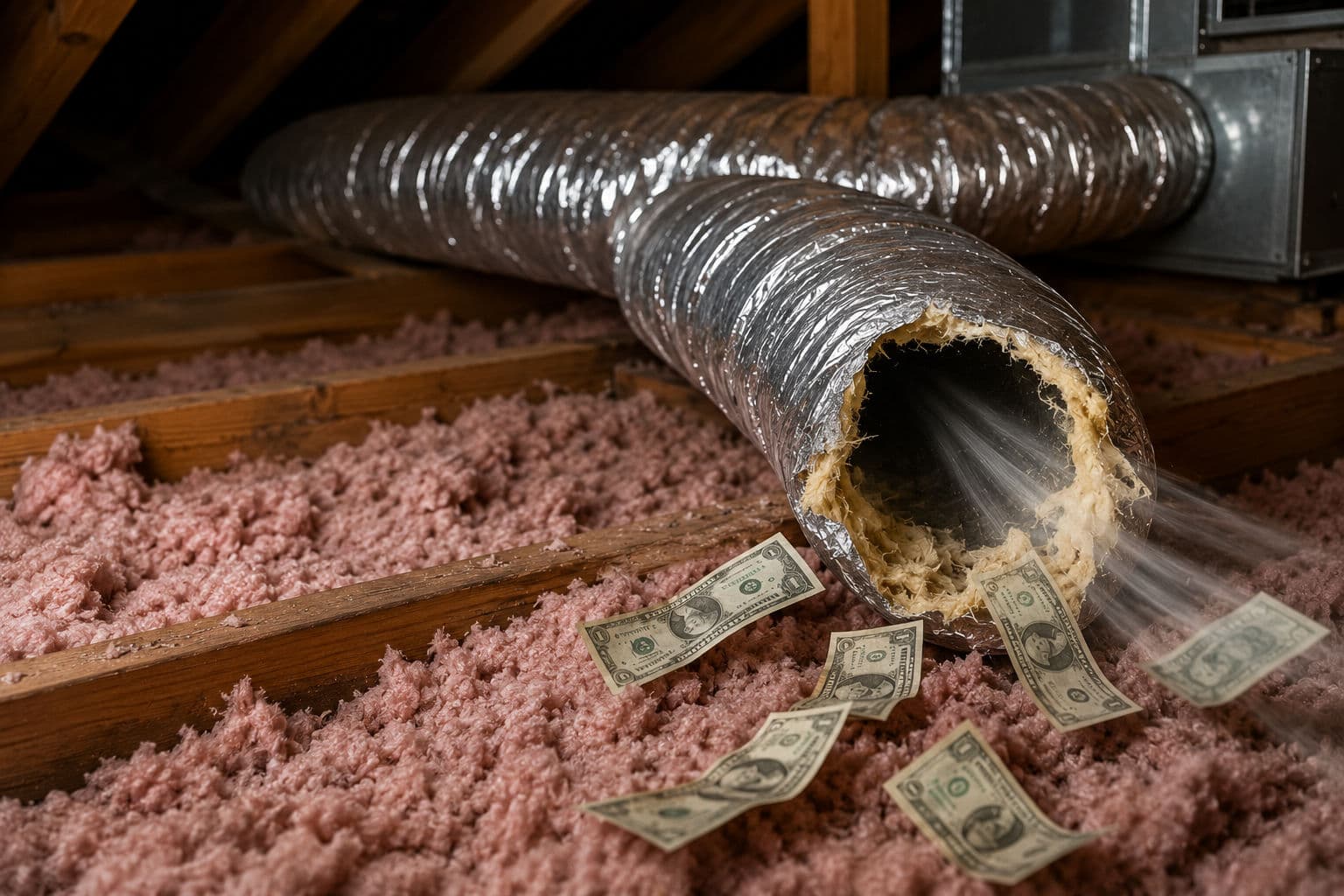
Most Houston homeowners think about their HVAC system in terms of the equipment — the outdoor condenser unit, the indoor air handler, the thermostat. When something isn't working right, the assumption is that one of those components has a problem. What gets overlooked far more often than it should is the duct system that connects all of it — the network of metal and flexible duct running through your attic and walls that carries conditioned air from the equipment to every room in your home.
In the Greater Houston area, ductwork problems are one of the most common and most underdiagnosed causes of high energy bills, uneven comfort, and HVAC systems that run constantly without fully doing their job. The Department of Energy estimates that homes with leaky ductwork lose 20 to 30 percent of conditioned air before it reaches the living space. In Houston's climate, where the AC runs for eight or more months per year, that kind of loss compounds into a significant cost over a cooling season.
Here's how to tell if your ductwork is the problem and what the solutions look like.
WHY HOUSTON HOMES ARE PARTICULARLY VULNERABLE TO DUCT PROBLEMS
Ductwork deteriorates over time, and the timeline is accelerated in Houston's climate compared to more moderate regions.
Houston's attic temperatures during summer regularly reach 130 to 150 degrees Fahrenheit. Flexible duct — the corrugated plastic tubing used in most residential duct systems installed over the past four decades — is exposed to those temperatures repeatedly over years of service. The plastic outer jacket becomes brittle, cracks develop, and the insulation surrounding the duct loses its effectiveness. Metal duct joints expand and contract with every heating and cooling cycle, and sealants applied at installation dry out and fail over time.
The humidity environment compounds the problem. Moisture works into deteriorating duct connections and promotes biological growth inside the duct system, which affects both air quality and airflow. In older homes across Houston's established communities — Katy, Sugar Land, Missouri City, Humble, Spring, Pearland, Friendswood, and similar neighborhoods with housing stock from the 1970s through 1990s — ductwork that's been in service for twenty or more years is the norm rather than the exception, and significant deterioration is common.
SIGNS YOUR DUCTWORK IS COSTING YOU MONEY
High energy bills without a clear explanation. If your electric bill has climbed over the past few years but your usage habits haven't changed and your AC system is in reasonable condition, duct leakage is one of the most likely culprits. Conditioned air escaping into your attic means the system runs longer to replace what's been lost, which translates directly into higher electricity costs. In Houston's cooling season, even a 15 percent duct leakage rate can add hundreds of dollars to annual energy costs.
Rooms that are consistently harder to cool or heat than others. Uneven comfort throughout the home is one of the clearest signs of a duct problem. When a supply duct serving a particular room has a significant leak or a disconnection at a fitting, less conditioned air reaches that room than the system is trying to deliver. The room stays warmer in summer and cooler in winter regardless of how long the system runs. If you've been compensating by setting the thermostat lower to bring that one room to a comfortable temperature, you're paying to over-cool the rest of the house to make up for a duct problem.
Your AC runs constantly but the house never fully cools. A system that runs for hours without reaching the thermostat setpoint is either undersized, losing refrigerant, or losing conditioned air through duct leaks before it can do its job. If the equipment checks out and refrigerant levels are correct, ductwork is the next place to look.
Excessive dust accumulation throughout the home. Leaky return ducts pull air from attic and wall spaces into the system's airstream. That air carries dust, insulation particles, and other debris that passes through the filter and distributes through the living space. If you're dusting more frequently than seems reasonable or if you notice dust settling quickly after cleaning, leaky return ducts are a possible cause.
Musty or stale odors when the system runs. Biological growth inside deteriorated ductwork, or attic air pulled into the system through leaky return ducts, introduces odors into the airstream. If your home has a musty smell when the AC runs that isn't traced to the equipment itself, duct condition is worth inspecting.
Your home feels humid despite the AC running correctly. Leaky supply ducts dump conditioned, dehumidified air into the attic rather than the living space. At the same time, leaky return ducts pull hot, humid attic air into the system. Both effects reduce the system's dehumidification output in the living space even when the equipment is performing correctly. For Houston homeowners already dealing with humidity management challenges, duct leakage makes the problem significantly worse.
Visible duct damage in the attic. If you've been in your attic recently and noticed disconnected flex duct sections, visible tears in the outer jacket, duct connections that have pulled apart at the fitting, or insulation that's fallen off sections of metal duct, those are direct evidence of leakage that's affecting your system's performance.
WHAT DUCT PROBLEMS LOOK LIKE IN HOUSTON HOMES
The most common duct problems we find in Houston homes during inspections fall into a few categories.
Disconnected flex duct sections are among the most dramatic findings and the most impactful on performance. When a flex duct run disconnects at a fitting — either because the strap holding it failed, the duct was never properly secured, or the connection was disturbed during attic work — the entire air supply intended for that branch of the system dumps directly into the attic. The room served by that duct gets no conditioned air at all, and the system runs continuously trying to reach a setpoint it can never achieve.
Torn or punctured flex duct outer jacket is more subtle but cumulatively significant. Small tears and punctures along the length of flex duct runs allow conditioned air to escape gradually. A single small tear may have minimal impact, but multiple deteriorating flex duct runs throughout the system add up to a meaningful total leakage rate.
Failed sealant at metal duct connections. The mastic sealant or metal tape applied to sheet metal duct joints at installation dries out and separates over time, particularly in attics that cycle through extreme temperature swings year after year. Metal duct systems in older Houston homes often have significant air leakage at every joint and connection throughout the system, even when the duct itself is structurally intact.
Collapsed or kinked flex duct restricts airflow rather than causing leakage, but the effect on the room being served is similar — reduced air delivery that makes the room harder to condition. Flex duct that was installed with too much slack, routed around obstacles without proper support, or compressed by something stored in the attic can develop restrictions that significantly reduce airflow to the rooms downstream.
Undersized return air. This isn't a deterioration issue but a design problem common in Houston homes from the 1970s and 1980s that produces symptoms similar to duct leakage — rooms that don't cool well, a system that runs longer than it should, and humidity that's harder to manage than the equipment should allow. Undersized return ducts restrict the volume of air the system can pull back from the living space, which limits how much conditioned air it can push out on the supply side and reduces the system's overall efficiency.
WHAT DUCT REPAIR AND SEALING INVOLVES
Duct repair and sealing is less invasive than most homeowners expect. The process involves inspecting the full duct system to identify leakage points and restrictions, sealing accessible connections and joints with mastic sealant or appropriate metal tape, repairing or replacing damaged flex duct sections, securing disconnected runs, and in some cases adding return air capacity where the existing configuration is undersized for the equipment.
For homes where the ductwork has deteriorated to the point where repair isn't a cost-effective path — typically older systems where multiple flex duct runs have failed, insulation has degraded throughout, and the overall leakage rate is very high — full duct replacement is the more practical solution. New ductwork installed correctly, properly sealed at every connection, and insulated to current standards performs significantly better than patched deteriorating ductwork and delivers those performance gains consistently for the life of the new system.
For homeowners replacing an aging HVAC system, duct evaluation and any necessary repairs or replacement should happen at the same time. Installing new, high-efficiency equipment on a deteriorated duct system limits what that equipment can deliver and prevents you from realizing the full efficiency benefit of the upgrade.
THE RETURN ON DUCT SEALING IN HOUSTON'S CLIMATE
The return on duct sealing is higher in Houston than in most other climates because the AC runs longer here than almost anywhere else in the country. A 20 percent reduction in duct leakage on a system that runs eight or more months per year delivers energy savings across a much longer operating window than the same improvement would in a climate with a three-month cooling season. In practical terms, duct sealing often pays back its cost in energy savings within two to three Houston cooling seasons, while also improving comfort and reducing the load on the AC equipment — which extends system life as an additional benefit.
If you've been noticing higher-than-expected energy bills, uneven temperatures across your home, or rooms that never feel quite right regardless of what the thermostat says, ductwork is worth having evaluated. The problem is often simpler and less expensive to address than homeowners expect, and the improvement in both comfort and energy costs is usually immediate and noticeable.
Multipoint AC & Heating provides duct work inspection, sealing, repair, and replacement throughout Greater Houston, including Harris County, Fort Bend County, Montgomery County, and Austin County. Contact us to schedule a duct evaluation for your home.