What to Do When Your AC Stops Working on a Houston Weekend or Holiday
Learn what to do when your AC breaks in Houston on weekends. Follow our troubleshooting steps to stay cool and find reliable emergency services.
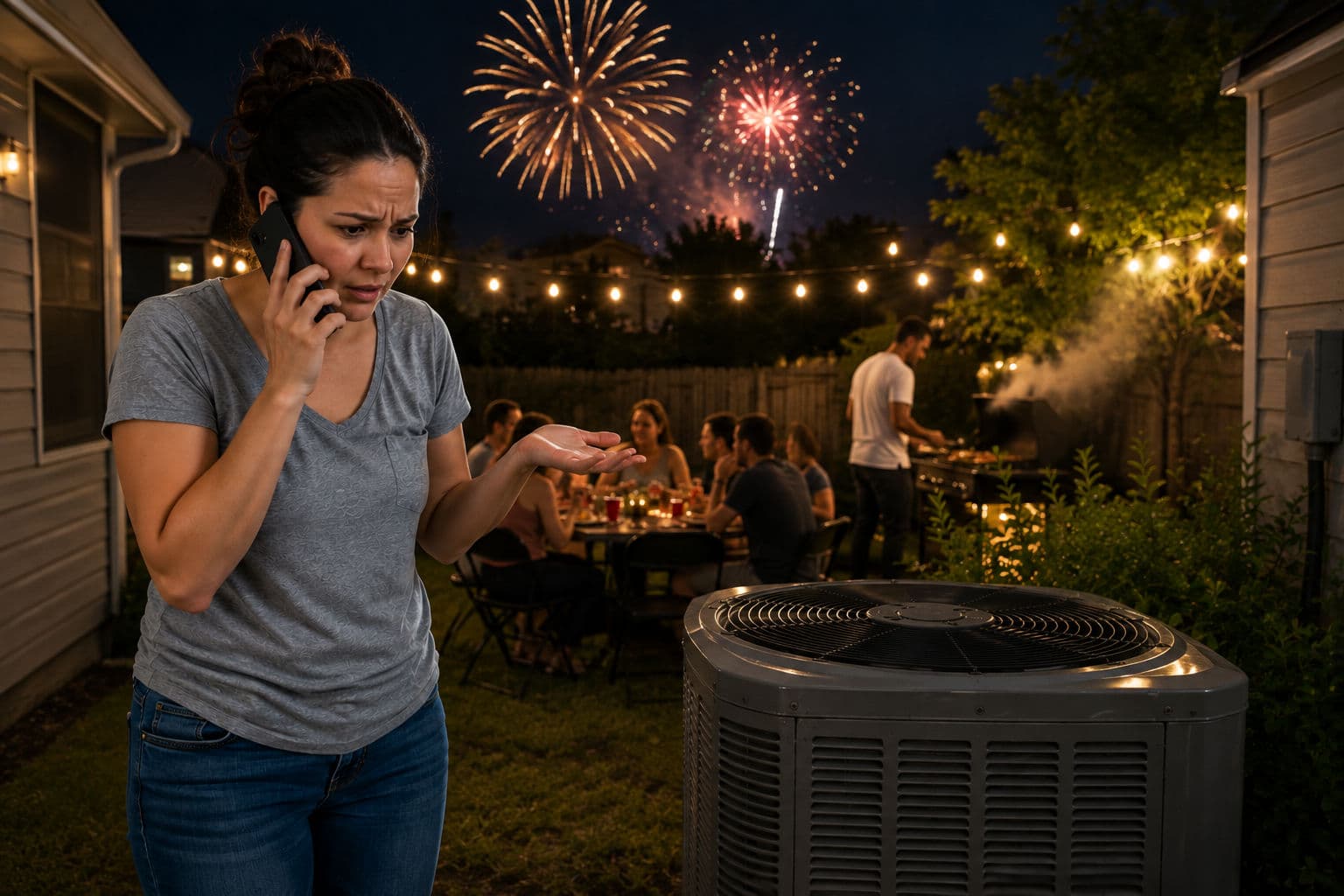
An air conditioner that stops working on a Tuesday afternoon in April is an inconvenience. The same failure on a Saturday afternoon in July in Houston is a different situation entirely. Indoor temperatures in a Houston home without AC can climb to dangerous levels within a few hours on a peak summer day, the discomfort is immediate and significant, and the options for getting help quickly are more limited than on a regular business day when every HVAC company in the metro is fully staffed.
Knowing exactly what to do when this happens — what to check yourself before calling, how to manage the situation while waiting for help, and how to find a technician who will actually respond on a weekend or holiday — saves time and reduces the risk of a bad situation becoming worse.
START WITH THESE CHECKS BEFORE CALLING ANYONE
A meaningful percentage of weekend AC failure calls turn out to be something the homeowner can resolve without a technician. Working through these checks first saves you the cost of an emergency service call if the problem turns out to be straightforward.
Check the thermostat first. Verify that it's set to cool rather than heat or fan only, that the set temperature is below the current indoor temperature, and that the display is on and responsive. A thermostat that's lost battery power goes dark or displays an error — replacing the batteries resolves this immediately. A thermostat that's been accidentally switched to heat mode or fan only is producing the symptom of no cooling without any equipment failure.
Check both circuit breakers for the HVAC system. Your system has two — one for the indoor air handler and one for the outdoor condenser unit, in most cases in the main electrical panel. Both should be fully in the on position. A breaker that's tripped sits in a middle position between on and off and may not be obviously different from the on position — look carefully. If one has tripped, switch it firmly to off first and then back to on. If it trips again immediately after being reset, stop — a breaker that keeps tripping indicates an electrical problem that needs professional diagnosis rather than repeated resets. Do not keep resetting a repeatedly tripping breaker.
Look at the outdoor unit. Go outside and look at the outdoor condenser unit while the system is supposedly running. The condenser fan on top of the unit should be spinning and moving air. If the outdoor unit is completely silent and nothing is running while the indoor unit is operating, the outdoor unit has lost power or has shut down on a safety control. A tripped breaker for the outdoor unit is the most common cause of this.
Check the air filter. Pull the filter out and look at it. A severely clogged filter can cause the evaporator coil to freeze, which stops cooling even though the system appears to be running. If the filter is visibly clogged with debris, replace it. If the system has been running on a clogged filter, the coil may have frozen — in which case the system needs to thaw before it will cool again.
Look for ice on the system. Check the copper refrigerant lines running from the outdoor unit into the home and look at the indoor air handler for visible ice. A frozen evaporator coil is a common cause of a system that runs but doesn't cool. If you see ice, turn the system off completely and allow it to thaw — which can take one to several hours depending on how much ice has built up — before restarting. Trying to run the system with a frozen coil causes compressor damage.
Check the condensate drain pan. If your air handler is in a location where you can access the drain pan, check whether it's overflowing. Many systems have a float switch in the drain pan that shuts the system down when the pan fills with water — this is a safety feature that prevents water damage but it does stop the AC. A pan that's full of water indicates a clogged condensate drain line. Clearing the clog allows the float switch to drop and the system to restart.
Check the outdoor disconnect. There's typically a disconnect box mounted on the wall near the outdoor unit that allows the power to be cut to the outdoor unit for service. Make sure this hasn't been accidentally switched off or that the fuses inside it haven't blown. Pulled or blown fuses in the outdoor disconnect are an occasional cause of an outdoor unit that won't start.
IF THE SYSTEM STILL ISN'T WORKING AFTER THESE CHECKS
If you've worked through the above checks and the system still isn't functioning, the problem requires professional diagnosis and you need to make the call. A few things to do while preparing to contact a technician.
Write down what you've already checked. When you call for service, telling the technician that you've already verified the breakers are on, the thermostat settings are correct, the filter is clean, there's no ice visible, and the outdoor unit isn't running — or whatever combination you've verified — helps them prepare for the call and sometimes helps identify the likely cause before they arrive. It also saves them time on arrival because they won't need to re-verify what you've already confirmed.
Note any sounds or symptoms that preceded the failure. A system that made a new noise for a week before stopping, that had been producing less cooling than usual for several days, or that stopped suddenly without any warning are different diagnostic starting points. Recent symptoms are useful information for the technician.
Check the indoor temperature and be honest about urgency. A home that's currently 78 degrees with the outdoor temperature at 92 degrees has more time before conditions become seriously uncomfortable than a home that's already 85 degrees with the outdoor temperature at 100 degrees. Being honest about the current indoor temperature when you call helps the dispatch team prioritize appropriately.
HOW TO FIND HVAC SERVICE ON A WEEKEND OR HOLIDAY IN HOUSTON
The challenge on weekends and holidays isn't that HVAC service is unavailable — it's that not all companies who advertise 24/7 service actually provide it consistently, and demand on the busiest summer weekends means response times vary significantly between companies.
Look for companies that explicitly state 24/7 emergency service rather than those that list general contact information without specifying availability. A company with a dedicated emergency line or a phone number that's answered live rather than going to voicemail during off-hours is better positioned to actually respond on a Saturday night in July.
Call rather than email or submit a web form. On weekends and holidays when staffing may be limited, a phone call is more likely to reach someone who can dispatch a technician than a web form submission that may not be reviewed until business hours.
Be prepared for emergency service pricing. Most HVAC companies charge a premium for weekend, evening, and holiday service calls — an emergency service rate that's typically higher than standard business-hours pricing. This is standard industry practice and reflects the real cost of maintaining after-hours availability. Knowing this in advance prevents the surprise when the technician quotes the service call rate.
If you're a maintenance plan customer, call the maintenance plan line rather than the general service line. Many companies prioritize emergency service calls from maintenance plan customers, meaning shorter response times than the general queue. This is one of the practical benefits of a maintenance plan that's easy to overlook until you actually need it on a Sunday afternoon in August.
MANAGING THE HEAT WHILE WAITING FOR A TECHNICIAN
In Houston's summer heat, managing the indoor temperature while waiting for service is genuinely important — particularly for households with children, elderly family members, or anyone with a health condition affected by heat.
Close all blinds and window coverings immediately. Sunlight through windows is one of the fastest pathways for heat to enter the home once the AC is off. Close every window covering, particularly on south and west-facing windows, to slow the rate at which indoor temperature climbs.
Move to the lowest level of the home. Heat rises, and in a multi-story Houston home, the ground floor will be several degrees cooler than the upper floors once the AC has been off for a while. Concentrate household activity on the lowest level available.
Use ceiling fans in the rooms you're occupying. Ceiling fans don't lower air temperature but they create a wind chill effect that makes elevated temperatures more tolerable. Running ceiling fans in rooms where people are gathered slows the rate at which conditions become uncomfortable.
Minimize internal heat generation. Avoid cooking on the stove or oven, running the dishwasher, or using the clothes dryer — all of which add heat to the indoor environment at exactly the moment you're trying to minimize it. Eat cold food, use the microwave minimally, and defer any heat-generating household tasks until the AC is restored.
Open windows after dark if outdoor temperatures drop below indoor temperatures. Houston summer nights sometimes — though not always — see temperatures drop to the low to mid 80s after midnight. If the outdoor temperature drops below the indoor temperature, opening windows creates natural ventilation that slows the indoor temperature increase and in some cases stabilizes it. Close them again before the outdoor temperature climbs in the morning.
Know the signs of heat-related illness and take them seriously. Heat exhaustion — heavy sweating, weakness, cold and pale skin, weak pulse, nausea — requires moving the affected person to a cooler location, hydrating, and applying cool wet cloths. Heat stroke — high body temperature above 103 degrees, hot and red skin, rapid and strong pulse, possible unconsciousness — is a medical emergency requiring immediate 911 contact. In a Houston home that's been without AC for several hours on a peak summer day, these risks are real rather than theoretical, particularly for vulnerable household members.
If indoor temperatures are reaching levels that are genuinely unsafe for household members — particularly elderly, very young, or medically vulnerable individuals — don't wait for the technician to arrive. Move to an air-conditioned location. Nearby options include family or neighbors with functioning AC, shopping malls, libraries, movie theaters, and in extreme situations, the city of Houston and Harris County operate cooling centers during heat emergencies that are free and open to the public.
AFTER THE TECHNICIAN ARRIVES
When the technician arrives for an emergency weekend call, the service visit itself follows the same diagnostic process as a regular service call — but under time pressure and in conditions where you're already uncomfortable. A few things that help the visit go as efficiently as possible.
Give the technician the information you gathered before calling — what you checked, what you found, any symptoms that preceded the failure. This starts the diagnostic process with context rather than from scratch and often shortens the time to identifying the problem.
Be present and available for communication during the visit. An emergency weekend technician working through a diagnostic on a hot afternoon needs to be able to ask you questions and relay findings without hunting for you around the house.
Ask for a clear explanation of what failed, what the repair involves, and what the cost is before approving work. Emergency weekend service calls operate under time pressure but that doesn't change your right to understand what you're approving. A reputable technician explains the diagnosis and the proposed fix before starting work.
Ask whether any additional components are showing wear that may be worth addressing while the technician is already on site. Finding the immediate failure that caused the weekend breakdown is the priority, but if the technician notices a capacitor that's reading borderline or a contactor that's showing early wear signs, addressing those at the same time as the primary repair saves another service call — and another potential breakdown — in the near future.
PREVENTING THE NEXT WEEKEND BREAKDOWN
The most effective step for avoiding a future weekend or holiday AC failure in Houston is scheduling a spring maintenance tune-up in March or April before the heavy cooling season begins. The majority of summer emergency breakdowns trace to developing conditions that an annual maintenance visit would have caught — a capacitor reading below spec, a condenser coil that's fouled enough to cause pressure problems on hot days, a refrigerant level that's dropping from a slow leak. These are findable and fixable during a scheduled visit in mild weather. They become emergency calls in July.
Maintenance plan customers who receive priority scheduling for emergency service calls have a practical advantage when a weekend breakdown does occur — the priority queue means shorter wait times when the situation is genuinely urgent.
Multipoint AC & Heating provides 24/7 emergency AC service throughout Greater Houston, including Harris County, Fort Bend County, Montgomery County, and Austin County. If your AC has stopped working on a weekend, holiday, or any other time when you need help fast, contact us — we answer the call.