- Home
- Blog
- Houston AC Questions Answered — Everything You Need to Know About Air Conditioning in the Greater Houston Area
Houston AC Questions Answered — Everything You Need to Know About Air Conditioning in the Greater Houston Area
Find answers to common Houston AC questions. Learn about lifespan, costs, settings, repairs, and efficiency tips.
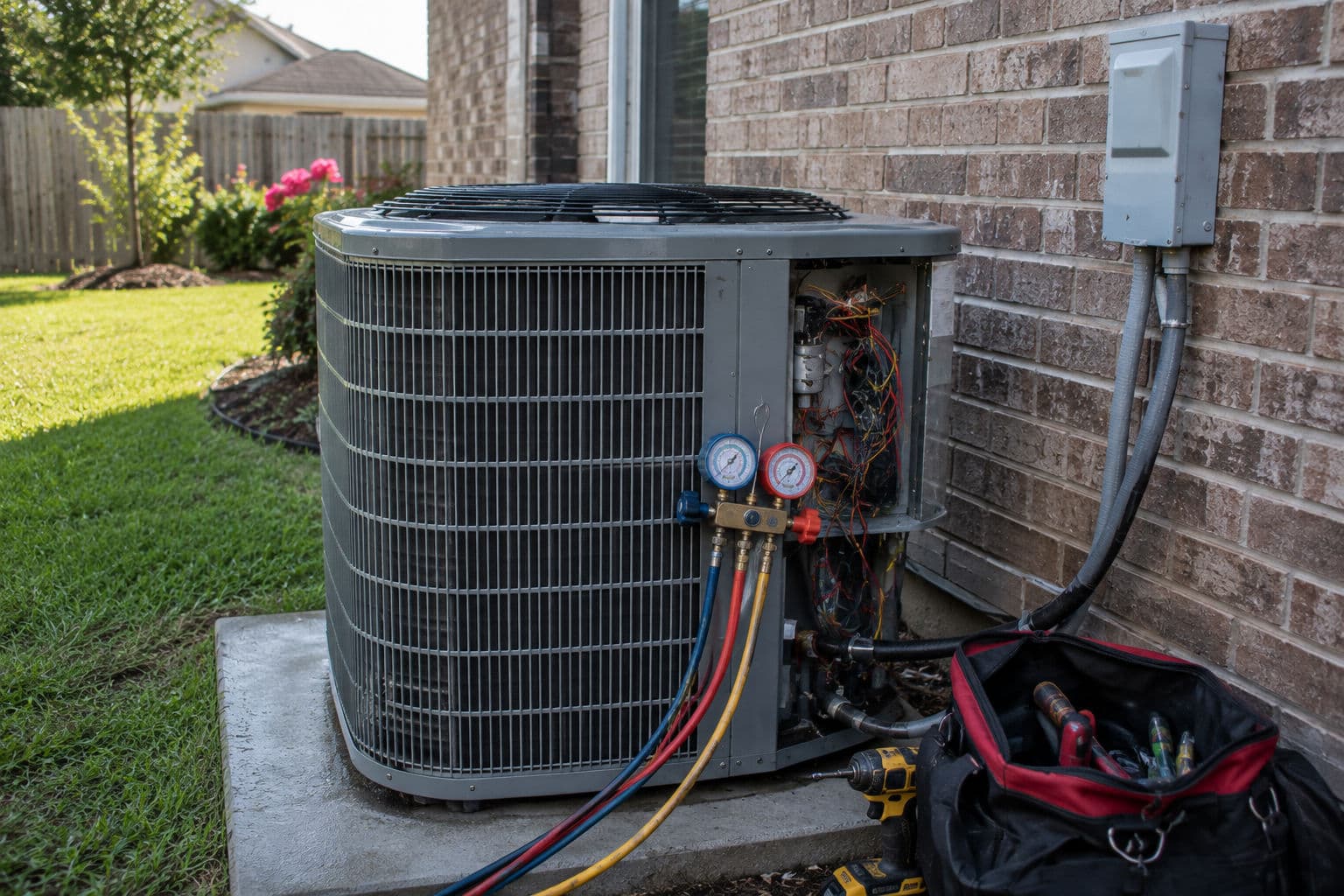
Houston homeowners search for AC information more than homeowners in almost any other city in the country — and for good reason. The system runs for most of the year, the consequences of it failing are immediate and significant, and the decisions around repair versus replacement, maintenance scheduling, and equipment selection involve real money. Most of the information available online is either generic advice that doesn't account for Houston's specific climate or marketing content from companies that have a financial interest in the answers they provide.
These are the questions Houston homeowners actually search for, answered honestly.
HOW LONG SHOULD AN AC LAST IN HOUSTON?
In Houston's climate, a well-maintained AC system realistically lasts 12 to 15 years. The nine-month cooling season means Houston systems accumulate annual operating hours that are significantly greater than systems in moderate climates — a Houston system's service life in calendar years understates how much the equipment has actually worked. Systems in Houston that have been consistently maintained tend toward the upper end of that range. Systems with minimal maintenance history typically reach the replacement decision point earlier. The national average of 15 to 20 years that manufacturers cite assumes operating conditions that Houston's climate doesn't match.
WHAT TEMPERATURE SHOULD I SET MY THERMOSTAT TO IN HOUSTON?
The Department of Energy recommends 78 degrees when home and 80 to 85 degrees when away during summer. In Houston's humidity environment, comfort depends as much on indoor relative humidity as on temperature — a home at 76 degrees and 45 percent relative humidity feels genuinely comfortable, while the same home at 76 degrees and 65 percent relative humidity feels sticky and uncomfortable. If your home feels uncomfortable despite the thermostat being at a reasonable setting, humidity management rather than a lower thermostat is usually the more effective solution.
WHY IS MY ELECTRIC BILL SO HIGH IN HOUSTON IN SUMMER?
Air conditioning typically accounts for 50 to 60 percent of a Houston home's summer electricity bill, and on peak summer days it can account for 70 percent or more. The combination of extreme heat, Gulf humidity requiring continuous dehumidification alongside cooling, and a system that runs for most of the day drives bills higher than most homeowners expect. If your bill is significantly higher than neighbors with similar homes, or higher than the same period last year without explanation, the most common causes are dirty condenser coils reducing system efficiency, low refrigerant from a system leak, an aging system losing efficiency from normal wear, or duct leaks allowing conditioned air to escape into the attic before reaching the living space.
HOW OFTEN SHOULD I CHANGE MY AC FILTER IN HOUSTON?
In Houston's climate, monthly checks and 30 to 60 day changes during the active cooling season is the appropriate interval for most homes. Houston systems run significantly more hours per year than moderate-climate systems, and filters accumulate biological material from the humidity alongside standard dust and debris, clogging faster than the 60 to 90 day intervals that manufacturers suggest for average conditions. Homes with pets should check monthly and change every three to four weeks during peak season. Using the correct MERV rating for your system — typically MERV 8 to 11 for most Houston residential systems — matters alongside the change interval.
WHY DOES MY HOUSTON HOME FEEL HUMID EVEN WITH THE AC RUNNING?
This is one of the most common comfort complaints in Greater Houston and almost always has one of three causes. The system is oversized and short cycling — it cools the air temperature quickly but shuts off before running long enough to remove adequate moisture. The system has low refrigerant from a leak, which reduces dehumidification capacity even when it maintains temperature. Or the home's humidity load from Houston's Gulf climate simply exceeds what the AC cycle alone can consistently manage, which is common in waterway-adjacent communities like Kingwood, Atascocita, Baytown, and Crosby. A whole-home dehumidifier is the most effective long-term solution for persistent indoor humidity that persists despite a properly functioning AC system.
HOW MUCH DOES AC REPAIR COST IN HOUSTON?
Common AC repairs in Houston range from $150 to $600 for most standard component repairs. A capacitor replacement — one of the most frequent repairs in the Houston market — typically runs $150 to $350. A refrigerant leak repair and recharge ranges from $250 to $600 depending on the refrigerant type and the amount needed. A contactor replacement runs $150 to $350. Blower motor replacement costs $300 to $600. Compressor replacement is the most expensive common repair at $1,200 to $2,500 or more, and on systems past 12 years in Houston's climate, compressor failure is typically the decision point for full system replacement rather than repair.
HOW MUCH DOES A NEW AC UNIT COST IN HOUSTON?
A complete AC system replacement in Houston typically ranges from $4,500 to $12,000 depending on system size, efficiency rating, equipment brand, and whether ductwork modifications are needed. Standard single-stage systems at the base efficiency tier start around $4,500 to $6,500 installed. Mid-efficiency two-stage systems run $6,500 to $9,000. High-efficiency variable-speed systems range from $9,000 to $12,000 or more. The right system for your home depends on accurate load calculation, existing ductwork condition, and your long-term energy cost goals rather than simply matching the size of what was previously installed.
WHEN SHOULD I REPLACE MY AC INSTEAD OF REPAIRING IT?
The 5,000 rule is a useful starting point — multiply the system's age in years by the repair cost in dollars. If the result exceeds $5,000, replacement is typically the more financially sound decision. In Houston's climate, the age threshold for this rule should be applied more conservatively than in moderate climates because Houston systems accumulate operating hours faster. A 12-year-old Houston system with a significant repair need is often at the replacement decision point regardless of what the 5,000 rule calculation produces. Additional factors that point toward replacement include R-22 refrigerant with a leak, a compressor failure on a system past 12 years, or a history of multiple repairs in the past two to three seasons.
WHY IS MY AC NOT COOLING MY HOUSE IN HOUSTON?
When the AC is running but the home won't reach the thermostat setting, the most common causes are low refrigerant from a system leak reducing cooling capacity, a dirty condenser coil preventing the outdoor unit from rejecting heat effectively, a frozen evaporator coil blocking airflow through the system, a failing compressor losing capacity, or a system that's genuinely undersized for the home's heat load. In Houston's climate, the humidity dimension of this complaint matters alongside the temperature dimension — a system that's maintaining temperature but not dehumidifying adequately produces a home that feels hot even when the thermostat reads correctly. A proper diagnostic identifies which of these is causing the problem before any repair is recommended.
WHY IS MY AC RUNNING CONSTANTLY IN HOUSTON?
An AC that runs continuously in Houston during peak summer has several possible explanations. Some continuous operation on the hottest days — when the outdoor temperature is 98 to 100 degrees and the heat index is above 105 — is normal for a correctly sized system. A system that runs continuously in mild weather or that never reaches the thermostat setpoint regardless of conditions is either undersized for the actual heat load, losing cooling capacity from low refrigerant or dirty coils, or fighting a home envelope that's allowing more heat gain than the system can overcome — from inadequate attic insulation, duct leaks, or excessive solar heat gain through windows.
DOES HOUSTON NEED A FURNACE OR JUST A HEAT PUMP?
Houston's mild winters make the region well-suited for heat pump performance. A heat pump handles both heating and cooling from a single system and operates at its highest efficiency in the temperature range that Houston's heating season produces — temperatures rarely drop far below freezing in most of the metro, which is where heat pumps are most efficient. A conventional split system with a gas furnace remains appropriate for homes with existing gas infrastructure, larger homes with significant heating loads, or homeowners in upper Montgomery County communities where below-freezing temperatures are more frequent. Either can work well in Houston — the right choice depends on your specific home, existing infrastructure, and long-term energy cost priorities.
HOW DO I KNOW IF MY AC CAPACITOR IS BAD IN HOUSTON?
Common signs of a failing capacitor include the outdoor unit humming but not running, the AC struggling to start or taking longer than usual to reach full operation, the system running but not cooling as well as it should, and the outdoor condenser fan spinning slowly or not at all while the compressor appears to be running. Capacitor failure is one of the most common repairs in the Houston market — the combination of extreme summer heat and the long cooling season degrades capacitors faster than in moderate climates. A technician tests the capacitor's actual capacitance reading against its rated specification to confirm failure rather than relying on visual inspection alone.
HOW OFTEN SHOULD I SERVICE MY AC IN HOUSTON?
In Houston's climate, a minimum of once per year — a spring cooling season tune-up in March or April before peak season — is the standard recommendation. A twice-yearly approach that adds a fall heating inspection in October is better and appropriate for most Houston homeowners. For systems in particularly demanding environments — heavily wooded settings like The Woodlands and Kingwood where organic debris accumulates on condenser coils faster, or waterway-adjacent communities where ambient humidity accelerates biological growth in the air handler — twice-yearly service with between-visit attention to outdoor unit condition is the appropriate standard.
WHAT IS THE BEST AC BRAND FOR HOUSTON?
Houston's major HVAC manufacturers — Trane, Carrier, Lennox, Daikin, York, Rheem, Goodman, and others — all produce equipment that performs reliably in Houston's climate when correctly sized and properly installed. The difference in real-world reliability between major brands is smaller than marketing would suggest, and installation quality matters more than brand selection in determining how a system performs. A premium brand installed incorrectly underperforms a value brand installed properly. The efficiency tier, correct sizing from a proper load calculation, and installation quality are more important variables than brand preference for most Houston homeowners.
WHY DOES MY AC SMELL MUSTY IN HOUSTON?
A musty smell from AC vents is almost always biological growth — mold, mildew, or bacteria — somewhere in the HVAC system. In Houston's humidity environment, the evaporator coil and condensate drain pan are the most common locations. The coil stays wet from condensation during operation and in the ambient humidity between cycles, creating ideal conditions for biological growth that releases material into the supply airstream. Professional coil cleaning removes the established growth, and a UV germicidal system installed at the air handler prevents it from reestablishing between annual cleanings. This is a maintenance issue, not an equipment defect, and it's more prevalent in Houston than in drier markets because of the persistent moisture environment.
SHOULD I LEAVE MY AC ON WHEN I LEAVE THE HOUSE IN HOUSTON?
Don't turn it off completely, and don't leave it at full comfort settings. The right approach is a setback temperature — raising the thermostat to 78 to 82 degrees while away rather than turning the system off or maintaining full cooling in an empty home. A complete shutdown in Houston summer allows indoor temperatures to reach 90 to 100 degrees within hours, which damages heat-sensitive belongings, creates conditions for humidity and mold growth, is dangerous for pets, and requires the system to work against its maximum heat load to recover when restarted. A programmable or smart thermostat automates the setback and recovery schedule so the house is comfortable when you arrive without paying to cool an empty home to full comfort levels throughout the day.
WHAT CAUSES AN AC TO FREEZE UP IN HOUSTON?
AC freezing — ice forming on the evaporator coil or refrigerant lines — is caused by either restricted airflow or low refrigerant. Restricted airflow from a clogged filter is the most common cause and the one you can address yourself — replace the filter and allow the ice to thaw completely before restarting. Closed supply vents, a failing blower motor, or a dirty evaporator coil can also restrict airflow enough to cause freezing. Low refrigerant from a system leak causes the coil to operate colder than designed, leading to ice formation that recurs after thawing if the refrigerant issue isn't addressed. If your system freezes again after thawing with a clean filter, a refrigerant problem is likely and requires a professional diagnosis and leak repair.
DO I NEED A WHOLE-HOME DEHUMIDIFIER IN HOUSTON?
Not every Houston home needs a whole-home dehumidifier, but more do than most homeowners realize. If your home consistently feels damp or uncomfortable despite the AC running, if indoor humidity readings are consistently above 55 to 60 percent, if household members experience allergy or respiratory symptoms that are worse at home than elsewhere, or if you live in a waterway-adjacent community where ambient moisture is chronically elevated, a whole-home dehumidifier makes a significant difference in comfort and indoor air quality. For homes where the AC system is correctly sized and functioning properly but Houston's humidity load still pushes indoor relative humidity above comfortable levels during shoulder seasons and evenings, dehumidification is the right supplemental solution.
WHAT'S THE DIFFERENCE BETWEEN AC REPAIR AND HVAC SERVICE IN HOUSTON?
AC repair addresses a specific problem — a component that has failed or is failing, a refrigerant leak, a system that's stopped functioning correctly. HVAC service or a tune-up is preventive — inspecting, cleaning, testing, and adjusting a system that's currently functioning to catch developing problems before they become failures and to verify that the system is operating at its designed efficiency. In Houston's climate, both are necessary — repair when something breaks, preventive service annually before peak cooling season to reduce how often something breaks and to extend how long the system lasts before replacement becomes necessary.
Multipoint AC & Heating provides AC repair, HVAC maintenance, system installation, and 24/7 emergency service throughout Greater Houston, including Harris County, Fort Bend County, Montgomery County, and Austin County. Contact us at 832-963-3789 for any AC question or to schedule service.