Heater Not Working in Houston? Here's What to Check Before You Call
Discover quick checks for a non-working heater in Houston before calling a technician. Save time and possibly fix issues yourself.
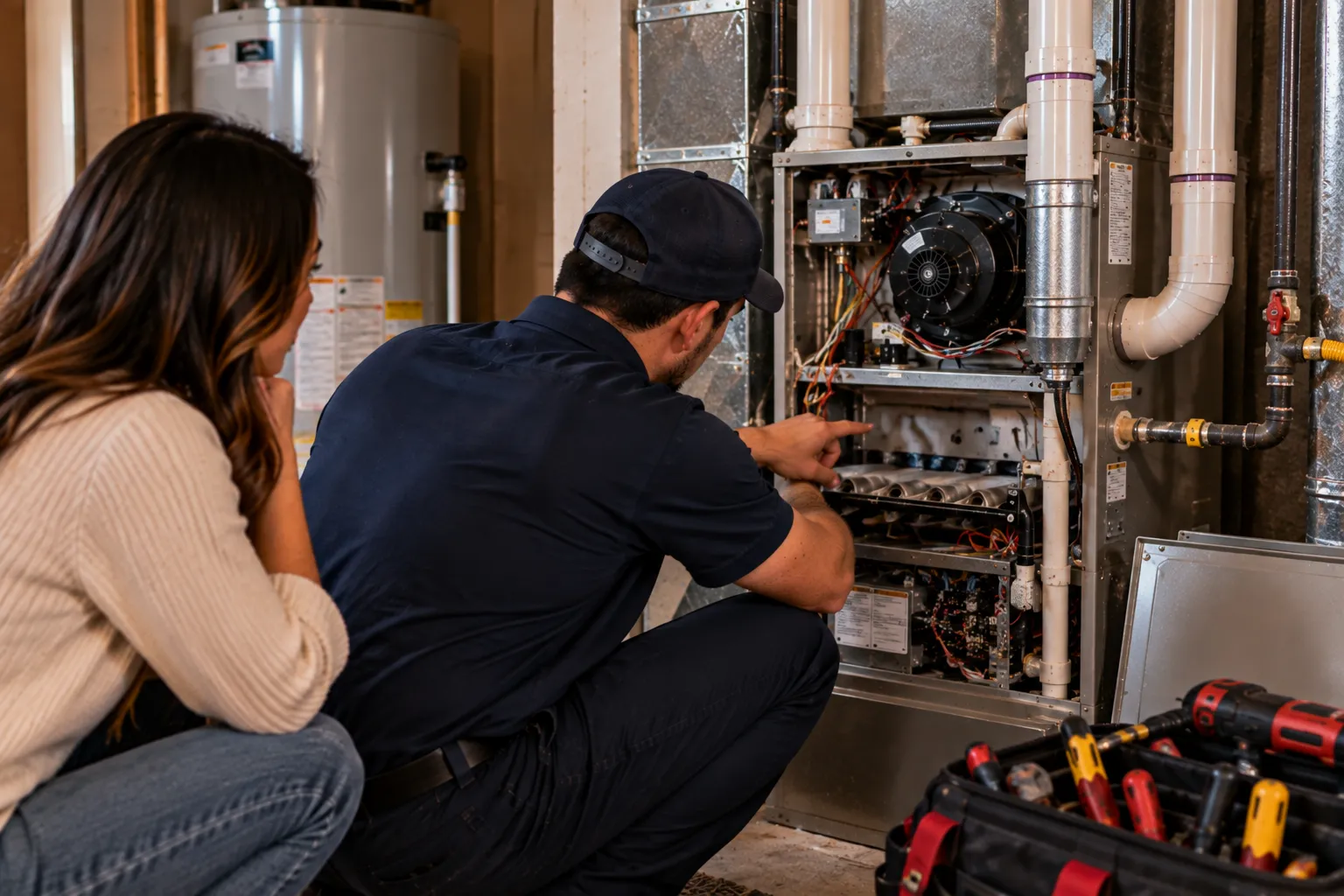
It's early October in Houston and the first cold fronts of fall 2026 are arriving. Temperatures that were in the upper 80s last week are dropping into the 50s overnight. The thermostat gets switched to heat for the first time since February or March — and nothing happens. Or something happens briefly and then stops. Or warm air never comes out of the vents despite the system appearing to run.
If your heater is not working in Houston right now, you are not alone. This exact scenario plays out across Harris County, Fort Bend County, and Montgomery County at the beginning of every fall cold front season. Houston heating systems sit idle for seven to eight months in a high-humidity environment and develop problems during that dormancy that only reveal themselves the first time the thermostat calls for heat.
Some of those problems require a professional technician. But a meaningful number of Houston heating failures are caused by something simple — something you can check and potentially resolve in the next five to ten minutes before calling anyone.
Work through this list first.
CHECK THE THERMOSTAT — THIS SOLVES MORE PROBLEMS THAN YOU EXPECT
The thermostat is the first stop for a heater that isn't responding, and the specific settings to check go beyond simply verifying that it's set to heat mode.
Verify the mode setting. The thermostat should be in HEAT mode, not COOL, not FAN ONLY, not AUTO-only. On a standard thermostat this is a physical switch or a setting in the menu. On a smart thermostat it may be buried in the interface. If the thermostat was left in cooling mode from the summer, it will not call for heat regardless of the set temperature.
Verify the set temperature is above the current indoor temperature. If the indoor temperature is 68 degrees and the thermostat is set to 65 degrees in heat mode, the system won't call for heat because the indoor temperature is already above the setpoint. Raise the set temperature to at least two to three degrees above whatever the current indoor temperature reads.
Check the thermostat display. A thermostat with a blank or dim display has lost power. For battery-powered thermostats — including most smart thermostats — replace the batteries. A dead battery is one of the most common reasons a Houston home suddenly has no heating or cooling response despite having a functioning HVAC system. The batteries in a thermostat that's been running since last year may be depleted enough to prevent operation without being depleted enough to completely blank the display.
Check for an error code or alert on the display. Smart thermostats and newer programmable thermostats may display a code or alert when a system fault has been detected. A code on the display is useful information to have when you call for service — note it down before resetting the thermostat.
Look at the thermostat's heat anticipator or schedule settings if it's a programmable model. Some programmable thermostats have separate heating and cooling schedules, and the heating schedule may be set to a lower temperature than you expect for the current time of day. Check the schedule programming specifically for the heating season rather than assuming the schedule that worked for cooling will call for heat at the right times.
CHECK THE CIRCUIT BREAKER PANEL
The HVAC system has at least one circuit breaker in the home's main electrical panel — and in most Houston homes, at least two. The indoor air handler has its own circuit, and the outdoor unit has its own circuit. For a gas furnace, the air handler circuit is what matters for heating. For a heat pump, both circuits matter.
Locate the panel and look for any breaker that's not in the fully-on position. A tripped breaker doesn't always look obviously different from a breaker in the on position — it typically sits in a middle position between fully on and fully off rather than flipping all the way to off. Look carefully at each breaker rather than glancing at the panel.
If you find a tripped breaker for the HVAC system, reset it by switching it firmly to the off position first and then back to on. Don't just push it toward on — move it fully to off first, feel the click, then move it to on and feel the second click.
If the breaker resets and stays on and the system responds, the tripped breaker may have been a one-time event from a power fluctuation. Monitor it. If the breaker trips again within a short period of operation, stop resetting it — a breaker that keeps tripping is protecting against an electrical fault in the system that needs professional diagnosis. Repeatedly resetting a repeatedly tripping breaker risks damage to the electrical components.
FIND THE FURNACE POWER SWITCH
Most gas furnaces and air handlers have a dedicated power switch located on or near the unit itself. This switch looks exactly like a standard household light switch and is typically mounted on the wall near the unit or directly on the air handler cabinet.
If this switch was accidentally turned off — during the summer when someone was working in the utility closet, during cleaning, or by a household member who didn't recognize it — the furnace receives no power regardless of what the thermostat is doing. Find the switch, verify it's in the on position, and if it was off, turn it on and give the system a moment to restart.
CHECK THE FURNACE DOOR OR ACCESS PANEL
Most furnaces and air handlers have a safety switch on the access panel — a small button or switch that prevents the system from operating when the panel is open or improperly seated. If the access panel was opened at some point and not fully closed and latched, this safety switch prevents operation.
Check the access panel on the air handler or furnace cabinet and verify it's fully closed and properly seated. Press it firmly into place if there's any question about whether it's fully latched. If the panel has a visible latch or screw, verify it's engaged.
LOOK AT THE AIR FILTER
A severely clogged air filter can cause a furnace to overheat and trip the high-limit safety switch — a thermal protection device that shuts the furnace off when air handler temperature exceeds the safe design limit. A furnace that starts, runs for a few minutes, and then shuts off — and then does the same thing again — is often tripping the high-limit switch from restricted airflow rather than experiencing a mechanical failure.
Pull the filter out and look at it. If you can't see light through the filter media, it needs to be replaced right now. Replace the filter, then allow the furnace to cool for twenty to thirty minutes before trying to restart it. The high-limit switch resets automatically once the air handler cools to a safe temperature.
If the furnace restarts normally after the filter replacement and the cool-down period and runs through a complete cycle without shutting off early, a clogged filter was the likely culprit. Monitor it through a few more cycles to confirm it's operating normally.
CHECK FOR A PILOT LIGHT — OLDER FURNACES ONLY
This applies only to older furnaces with a standing pilot light rather than electronic ignition. If your furnace is from the 1980s or early 1990s and has a small window or inspection port where you can see a small flame during normal operation, it uses a pilot light.
A pilot light that has gone out during the idle season prevents the furnace from lighting when it's called on. Relighting the pilot follows a specific procedure printed on a label on the furnace cabinet — typically involving turning the gas valve to the pilot position, holding down a reset button while lighting the pilot manually, and then transitioning the valve to the on position once the pilot is established. Follow the label instructions on your specific furnace rather than a generic description, as the procedure varies between models.
Modern furnaces use electronic ignition rather than standing pilots and don't have this issue. If you're not sure whether your furnace has a pilot light, look for the inspection window on the furnace cabinet during operation — if you see a small continuous flame when the furnace isn't actively heating, it's a pilot light. If you see a glowing element only during ignition attempts, it's electronic ignition.
CHECK THE CONDENSATE DRAIN — HIGH-EFFICIENCY FURNACES
This applies to high-efficiency furnaces — typically 90 percent AFUE or higher — that produce condensate as a byproduct of the combustion process. These furnaces have a condensate drain system similar to the AC's condensate drain, and many have a safety switch that prevents the furnace from operating when the condensate drain is blocked and water has backed up to a level that could damage the furnace.
If your furnace is a high-efficiency model and you're experiencing an intermittent shutdown or a no-start condition, check whether water is backing up in the condensate trap or drain pan near the furnace. A condensate drain that was partially blocked with biological growth during the summer — and that didn't receive attention during a fall maintenance visit — may reach the level that triggers the safety switch when the furnace begins producing condensate during heating operation.
Clearing a blocked condensate drain on a high-efficiency furnace is typically a professional service item rather than a homeowner fix, but identifying that this is the issue before calling for service helps the technician prepare for the specific repair.
CHECK THE GAS SUPPLY — GAS FURNACES ONLY
If the furnace is attempting to start — you hear the ignition sequence — but isn't lighting or is lighting and immediately going out, and you've ruled out the flame sensor issue described elsewhere, verify that the gas supply to the furnace is on.
The gas shutoff valve near the furnace — typically a lever handle on the gas line leading to the unit — should be in the open position, which means the lever is parallel to the pipe. A lever perpendicular to the pipe means the valve is closed.
If other gas appliances in the home — the gas range, the gas water heater — are also not working, the issue may be with the gas supply to the home rather than the furnace specifically. Contact your gas utility if you suspect a supply issue rather than an appliance-specific problem.
WHAT TO DO AFTER THE CHECKS — WHEN IT STILL ISN'T WORKING
If you've worked through all of the above and the heating system still isn't producing heat, the problem requires professional diagnosis. Here's how to make the service call as efficient as possible.
Write down what you found during your checks. Tell the technician or dispatcher which items you've already verified — the thermostat is set correctly, the breakers are on, the power switch is on, the filter is new, the access panel is properly seated. This information eliminates the time a technician would spend re-checking what you've already confirmed and starts the diagnostic at the point where your checks ended.
Describe the specific symptom as precisely as you can. The system doesn't respond at all is different from the system starts and shuts off after a few seconds is different from the system runs but produces no warm air is different from the system produces warm air for ten minutes and then shuts off. Each description points toward a different diagnostic starting point and helps the technician prepare before arriving.
Note any sounds or smells. A clicking sound at startup that isn't followed by ignition, a brief flash of flame visible through the inspection port, a sulfur smell, a burning smell that doesn't clear — all of these are useful diagnostic information. If you smell gas at any point during these checks, stop, do not attempt to restart the system, leave the home, and call your gas utility from outside before calling an HVAC technician.
Be specific about the timeline. When did this first happen? Was this the first time the system was called on this fall, or has it worked since the last cold front and just stopped today? Did anything change recently — a filter replacement, a power outage, any work done near the system? Timeline information helps distinguish between a first-startup idle-season failure and a new problem that developed after the system was already running this fall.
WHAT MOST OCTOBER HEATING FAILURES IN HOUSTON ACTUALLY ARE
Understanding the most common causes of first-cold-front heating failures in Houston helps calibrate expectations about what the technician is likely to find and what the repair is likely to involve.
The most common cause by a significant margin is an oxidized flame sensor. The flame sensor is a thin metal rod that the furnace's control board uses to confirm the burner has lit. After seven months in Houston's humidity without operation, the sensor surface oxidizes in a way that prevents it from generating the clean signal the control board needs. The furnace attempts to start, the burner briefly lights, and the control board shuts the gas off because it can't confirm the flame is present. Two or three failed attempts and the furnace goes into lockout mode. This is a $100 to $250 repair — a flame sensor cleaning or replacement — and is one of the most straightforward furnace repairs in the Houston market.
The second most common cause is a failed or failing ignitor. Electronic ignitors have a defined service life and age toward failure during the idle season as well as during active operation. An ignitor that's failed completely prevents the furnace from starting at all. An ignitor that's degraded may start the furnace intermittently — working on some attempts and not others. Ignitor replacement runs $150 to $350 depending on the furnace model.
Control board issues — corrosion on board connections from Houston's idle-season humidity exposure, a failed component on the board — are the third most common category. Control board failures can produce a range of symptoms from complete no-response to intermittent operation to specific functions failing while others work. Control board replacement runs $400 to $900 depending on the furnace brand and model.
Draft inducer motor failures — the motor that vents combustion gases before and during burner operation — produce a symptom where the furnace attempts to start but the inducer doesn't run, preventing the gas valve from opening. A non-running draft inducer produces a characteristic sound — or absence of sound — at the beginning of the startup sequence. Draft inducer motor replacement runs $350 to $700.
None of these are catastrophic failures. None of them require replacing the furnace. They're component-level repairs on a system that otherwise has useful life remaining — which is what the vast majority of October first-cold-front heating failures in Houston turn out to be when properly diagnosed.
THE ONES THAT DO REQUIRE REPLACEMENT
The failure that does change the repair-versus-replace calculation is a cracked heat exchanger on an older system. The heat exchanger is the component that separates combustion gases from the air that circulates through the home. A cracked heat exchanger allows combustion byproducts — including carbon monoxide — into the supply airstream, which is a safety issue that doesn't have a simple repair solution on a heat exchanger that's significantly deteriorated.
On a furnace under ten years old, a heat exchanger finding may warrant heat exchanger replacement as a standalone repair. On a furnace past twelve to fifteen years old in Houston's climate, a heat exchanger finding is typically the conversation that leads to full system replacement — because the heat exchanger cost relative to the system's remaining service life makes replacement the more financially sound decision.
This is why heat exchanger inspection as part of the fall heating inspection — ideally done in September before the first cold front — is the most important professional service item for older Houston furnaces. Finding it in September gives you time to make the replacement decision thoughtfully and on your schedule. Finding it on a cold October evening compresses that decision under conditions that aren't ideal for thoughtful planning.
WHY THIS HAPPENS EVERY OCTOBER IN HOUSTON — AND HOW TO AVOID IT NEXT YEAR
The pattern that produces October heating failures across Greater Houston every fall is entirely predictable and almost entirely preventable.
Houston furnaces sit idle for seven to eight months. Houston's ambient humidity is high throughout that period. Components that are susceptible to idle-season degradation — flame sensors, ignitors, control board connections — deteriorate during that dormancy without any symptoms, because the symptoms only appear when the system tries to run. The first cold front arrives, the system gets called on, and the degraded components fail their first test.
A fall heating inspection performed in September — before the first cold front — is the intervention that catches these conditions while there's still time to address them without emergency pressure. The flame sensor that needs cleaning costs less to clean in a scheduled September service visit than it costs to clean as an emergency call on an October cold-front evening. The ignitor that's reading at the margin of its specification is cheaper to replace as a proactive September repair than as an emergency October repair after it has fully failed.
The homeowners who are reading this because their heater isn't working right now are dealing with what a September inspection would have prevented. The homeowners who want to avoid being in this position next October — and every October after that — should put "schedule fall heating inspection in September" on the calendar for September 2027, not October.
If the system is working after running through these checks, the other piece of advice is equally simple: call to schedule the fall inspection now, while the system is running and while it can be evaluated before the next cold front arrives. Finding out the flame sensor is borderline while the system is currently functional is a better starting position than finding out it has failed when the system isn't.
Multipoint AC & Heating provides emergency heating repair, furnace diagnostic, fall heating inspection, and 24/7 HVAC service throughout Greater Houston, including Harris County, Fort Bend County, Montgomery County, and Austin County. If your heater isn't working in Houston today, contact us at 832-963-3789. We answer the call day or night.