Why Does My Furnace Keep Blowing Its Fuse?
A furnace control fuse can fail while the house breaker stays on. Learn what the repair should address before another fuse, thermostat or transformer is replaced.
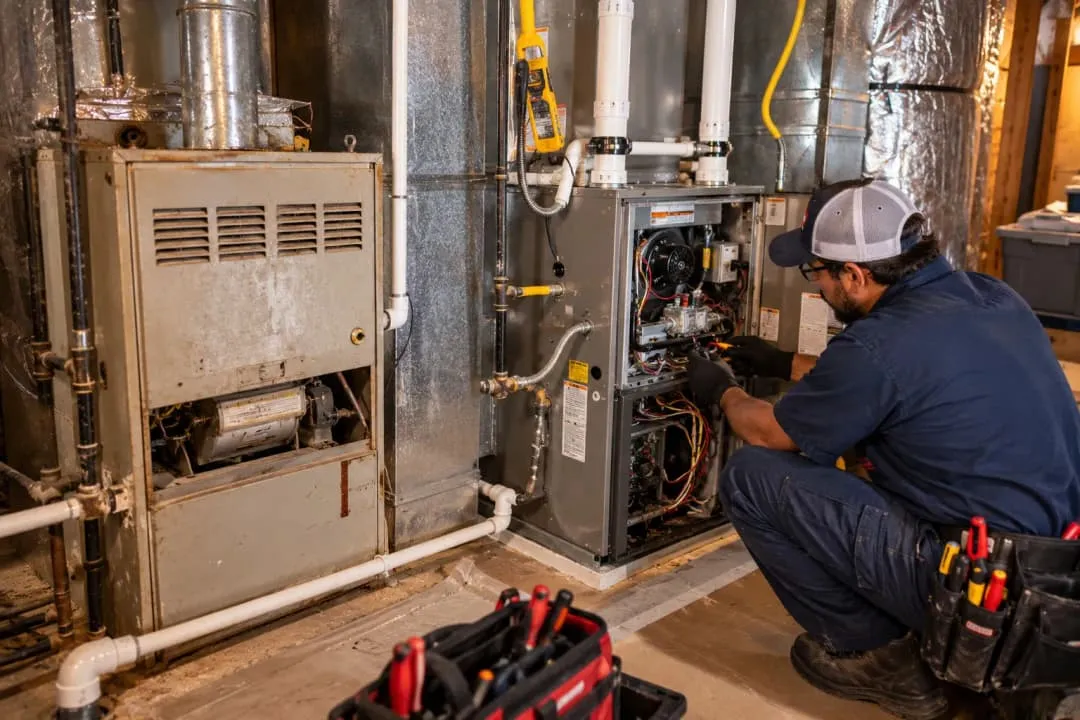
If your furnace keeps blowing its control fuse, stop replacing the fuse and arrange a diagnosis. A short in the control wiring or a faulty connected component can cause another failure. The repair needs to address that cause before normal operation is restored.
For a Houston-area homeowner, the practical question is what failed and what the proposed repair will correct. A blank thermostat or a furnace that will not start does not, by itself, identify the bad part.
Is the furnace fuse the same as the house breaker?
No. Many systems have a small fuse protecting the low-voltage control circuit inside the indoor equipment. A transformer supplies that control circuit, commonly at about 24 volts. The house breaker protects a different electrical circuit supplying the equipment.
The control fuse can open while the house breaker remains on. The thermostat may go blank, or the equipment may stop responding. Those symptoms can have other causes, so fuse failure needs to be confirmed.
If the protective device in your electrical panel is tripping, use our separate guide to a furnace that keeps tripping the breaker. Tell the service company which problem you observed; you do not need to open either enclosure to investigate it yourself.
What can make a furnace control fuse fail repeatedly?
Damaged or incorrectly connected wiring
Insulation damage, a pinched cable or an incorrect connection can create an unintended electrical path. The fault may involve thermostat wiring or another part of the control circuit. A replacement fuse does not repair that wiring.
A connected component drawing excessive current
A fault is not always a visibly damaged wire. A control coil or another connected device can draw excessive current. Testing should identify the affected circuit and component before parts are ordered.
A problem following a thermostat or accessory change
Tell the technician if the failures began after a thermostat replacement, zoning change or other HVAC work. That history helps focus the inspection, but it does not prove that the newest part is defective. Avoid changing wires or ordering a second thermostat based only on when the problem began.
What if the fuse blows only when the heat starts?
That timing is useful information for the technician. It can point attention toward the circuits energized during a heating call, but it does not establish a specific failed part.
Describe what already happened: whether the thermostat went dark immediately, the equipment tried to start, or the problem also occurred in cooling. Do not repeatedly recreate the failure to collect more clues.
What can you safely do before the appointment?
Stop calling for heating and leave the affected equipment off if safe to do so. Record any thermostat message already visible, note recent HVAC work and explain whether another system in the home still operates normally.
Do not remove electrical covers, bypass switches or install another fuse to test the system. Electrical and gas components require qualified service. If you smell gas, leave without operating electrical switches and contact your gas utility or emergency services from a safe location.
What should you ask before approving the repair?
Ask for an explanation of the confirmed fault and the work proposed to correct it. Useful questions include:
Was the failed protection a control fuse or the house breaker?
Which wiring or component needs repair, and what testing supports that finding?
Does the estimate include the identified repair and an operating check afterward?
If a thermostat, board or transformer is recommended, why does that part need replacement?
A parts list alone does not explain the diagnosis. For furnace service, request a written repair scope and price before approving the work. If broader equipment problems are found, compare the specific repair proposal with any replacement option on its own merits.
Frequently asked questions
Can a larger fuse stop the problem?
Do not increase the fuse rating or bridge it with a wire. The correct replacement must match the equipment manufacturer's specified type and rating. Different equipment can require different protection; a familiar fuse color or another unit's rating is not a reliable substitute for the correct specification.
Will a new transformer solve it?
Only if testing shows what failed and the cause is addressed. An unresolved short or overload can damage a replacement transformer too. Ask what was checked before approving another one.
Does a blown fuse mean the whole furnace needs replacement?
The symptom alone does not establish that. Ask for the confirmed fault, the proposed repair and any separate equipment-condition findings before deciding. A replacement recommendation deserves a clear explanation of why repair is unsuitable or why replacement better fits your needs.
Schedule furnace troubleshooting near Houston
Multipoint AC & Heating serves homeowners in Richmond, Katy and Cinco Ranch, Fulshear and Sugar Land, along with nearby Houston-area communities.
The diagnostic fee is $69 and is not waived. An additional $100 after-hours or weekend fee applies when applicable; repairs are quoted separately. Emergency service available after hours, except Sunday 3 PM to Monday 6 AM.
Call 832-963-3789 or request a service appointment. When booking, mention the repeated fuse failure and any recent thermostat or HVAC work.