How to Extend the Life of Your AC System in Houston — Practical Steps That Actually Work
Discover effective ways to extend your AC's lifespan in Houston with regular maintenance, proper filter care, and protective measures against electrical stress.
Replacing an air conditioning system in Houston is a significant expense — typically $5,000 to $12,000 depending on system size, efficiency tier, and installation complexity. Getting the maximum useful life out of the system you have before that replacement becomes necessary isn't just about deferring a cost — it's about getting the return on the investment you've already made. A system that lasts 15 years instead of 10 in Houston's climate is a system that delivered several additional years of value before requiring replacement.
The challenge is that Houston's climate is genuinely harder on HVAC equipment than most other markets. The nine-month cooling season, Gulf humidity, extreme summer heat, and the demanding operating conditions described throughout this blog series all accelerate wear on AC components in ways that shorten the gap between a well-maintained system and a neglected one faster than in moderate climates.
The good news is that the factors that most significantly shorten AC system life in Houston are almost entirely within the homeowner's control. Here's what actually makes a difference.
THE MOST IMPACTFUL THING — ANNUAL PROFESSIONAL MAINTENANCE WITHOUT EXCEPTION
If there's one practice that extends AC system life more than any other in Houston's climate, it's annual professional maintenance performed consistently, not occasionally. This isn't a marketing statement from an HVAC company — it's the straightforward reality of what happens to components that run for eight or more months per year in Houston's heat and humidity without professional attention versus what happens to the same components when they're regularly inspected, cleaned, and tested.
A dirty condenser coil forces the compressor to run at higher refrigerant pressures and temperatures than it was designed for. Every hour the system operates in that condition is an hour of accelerated compressor wear. Over a full Houston cooling season — three thousand or more operating hours on a busy system — the accumulated compressor stress from a season of running against a fouled condenser coil is substantial and not recoverable. The compressor doesn't announce when it's been damaged by a dirty coil — it just fails earlier than it would have with proper maintenance, often without warning during a peak demand period.
A capacitor that's reading below specification but hasn't yet failed is putting additional current draw stress on the motors it supports. Running a blower motor and compressor motor on inadequate capacitor support accelerates bearing wear and winding degradation in both motors — components that are significantly more expensive to replace than the capacitor itself. Catching the capacitor at its annual test and replacing it before it fails prevents that motor damage from accumulating.
A refrigerant level that's been slowly dropping from a small leak changes the pressure and temperature profile inside the compressor — conditions the compressor wasn't designed to run at. Unlike a sudden refrigerant loss that produces obvious symptoms, a slow leak may allow the system to continue cooling adequately while the compressor accumulates damage from months of operation at the wrong refrigerant charge. Annual refrigerant verification catches this before the accumulated damage becomes significant.
These aren't low-probability scenarios — they're the conditions we find on systems throughout the Greater Houston area that haven't been regularly maintained, and they're the most common explanation for systems that fail earlier than their expected service life.
FILTER MAINTENANCE — THE DAILY HABIT THAT COMPOUNDS INTO YEARS OF SYSTEM LIFE
The air filter is the one HVAC maintenance task that happens between professional visits, and it has a compounding effect on system life that most homeowners significantly underestimate.
Every hour the system runs with a clogged filter is an hour the blower motor is working against increased resistance, drawing more current than it should, running hotter than designed. Every hour the system runs with a clogged filter is an hour the evaporator coil is operating with reduced airflow, running colder than designed, and at risk of icing — a condition that, if it occurs repeatedly, introduces liquid refrigerant into the compressor and causes mechanical damage that isn't reversible.
In Houston's climate, where the system runs for eight or more months per year and where filters accumulate biological material from the humidity alongside standard dust and debris, the clogging rate is faster than the filter change intervals appropriate for moderate climates. Monthly checks and 30 to 60 day changes during the active cooling season — consistently, not aspirationally — is what protecting the system through the filter actually requires in Houston.
The compounding effect works in the positive direction too. A homeowner who has changed their filter consistently on a monthly schedule for ten years has given the blower motor and evaporator coil ten years of operating in the conditions they were designed for, rather than periodically fighting against restricted airflow when the filter gets forgotten for two or three months. That difference shows up in system longevity.
KEEPING THE OUTDOOR UNIT CLEAN AND CLEAR YEAR-ROUND
The outdoor condenser unit is exposed to Houston's environment continuously — not just during the cooling season. Debris accumulates on the coil fins year-round from whatever's in the air around the unit, and vegetation grows toward and around the unit regardless of whether it's running.
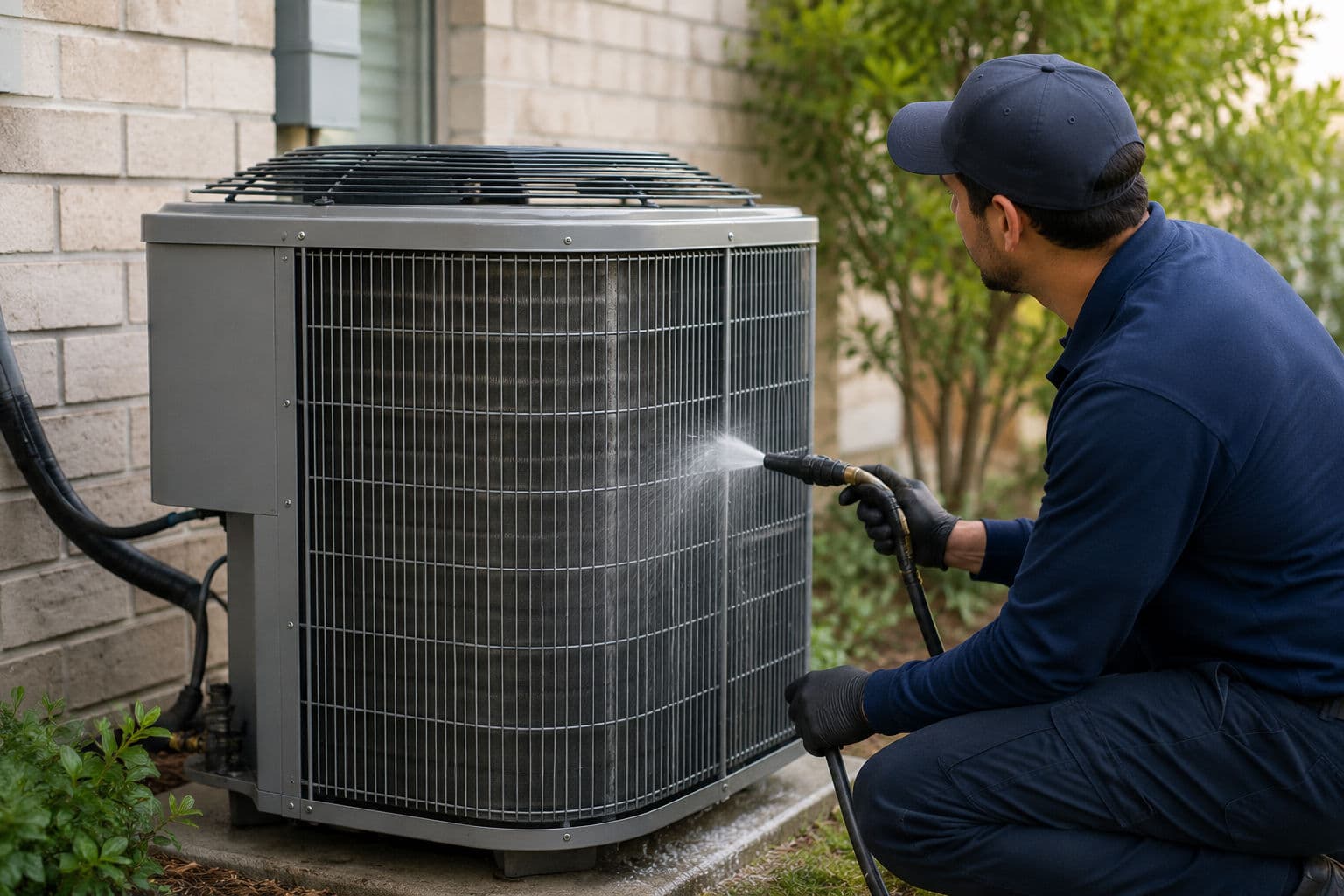
The maintenance habits that protect the outdoor unit between professional visits are simple and take minimal time. Periodically rinsing the coil from the inside out with a garden hose after turning the system off removes surface debris before it packs into the fins deeply enough to require professional cleaning to remove. Monthly visual checks of the clearance around the unit — two feet on all sides, nothing obstructing airflow above — catch vegetation growth before it affects performance. After significant wind events or peak leaf fall season in wooded Houston communities, checking for debris accumulation inside the top grille catches anything that might be affecting the fan before it causes damage.
These between-visit habits don't replace annual professional cleaning — a garden hose doesn't clean the depth of fouling that builds up over a season the way professional coil cleaning does. But they slow the rate of fouling between professional visits, which means the system operates closer to its design efficiency for more of the season rather than only for the weeks immediately following the annual cleaning.
PROTECTING THE SYSTEM FROM ELECTRICAL STRESS
Electrical stress is one of the less visible contributors to shortened system life in Houston — less visible because the damage it causes accumulates in components that don't produce obvious symptoms until they fail.
Power surges from summer thunderstorms, from utility switching events, and from the voltage fluctuations that occur when power is restored after an outage expose the capacitors, control boards, and motor windings in your HVAC system to electrical conditions they weren't designed for. Houston's summer storm frequency makes this a recurring exposure rather than an occasional event.
A whole-home surge protector installed at the electrical panel protects all circuits in the home from surge damage. A dedicated HVAC surge protector installed at the outdoor disconnect provides additional targeted protection for the AC system specifically. Neither is standard equipment in most Houston homes, and their absence means the system is directly exposed to every surge event that Houston's summer storm season produces.
The investment in surge protection is small relative to the cost of a control board replacement — typically $300 to $800 — or a capacitor damaged by a surge. For a system that's going to be exposed to Houston's summer thunderstorm activity for twelve to fifteen years, the cumulative risk reduction from surge protection is meaningful.
The restart protocol after power outages also affects system longevity. Restarting the AC immediately after an extended outage without allowing the refrigerant to redistribute and the crankcase heater to warm the compressor oil risks liquid slugging — liquid refrigerant entering the compressor at startup, which causes mechanical damage to the compressor internals. Waiting a minimum of 30 minutes after power is restored before restarting the AC protects the compressor from this specific form of damage.
ADDRESSING SMALL PROBLEMS BEFORE THEY BECOME LARGE ONES
The most consistent pattern in premature AC system failure is a small developing problem that was noticed but deferred until it became a significant failure. A noise that started six weeks ago and seemed to get slightly worse but hasn't stopped the system from running. A room that's been harder to cool since July but the rest of the house is fine. An electric bill that's been a bit higher than last summer but not dramatically so.
Each of these observations is the system communicating that something is developing. A noise that's been getting slowly worse is a component in progressive failure — often a motor bearing, a compressor developing a mechanical issue, or a fan blade that's damaged and vibrating. A room that's suddenly harder to cool is often a duct problem, a refrigerant issue, or a blower motor losing capacity — all of which are less expensive to address before they affect the whole system than after. A bill that's trending higher is efficiency declining from coil fouling, refrigerant loss, or capacitor degradation — all of which are caught and corrected during a service visit before they compound.
The compressor is the most expensive component in the system. Many compressor failures in Houston aren't sudden and isolated — they're the end point of a process that included warning signs the homeowner noticed but didn't act on. A compressor that's been running for months with a developing issue — a refrigerant charge that's been slowly dropping, a capacitor that's been providing inadequate support, a condenser coil that's been forcing it to run at elevated pressures — has been accumulating damage the entire time. Addressing warning signs promptly rather than deferring them is the practice that most directly prevents the kind of compressor damage that ends a system's life prematurely.
MANAGING THE OUTDOOR UNIT'S OPERATING ENVIRONMENT
The operating environment of the outdoor condenser unit affects how hard the compressor works to reject heat, which directly affects compressor longevity. Several environmental factors around the outdoor unit are within the homeowner's control.
Temperature of the air around the unit matters. An outdoor unit sitting in direct afternoon sun in a south or west-facing location is rejecting heat into air that's hotter than the ambient temperature because the sun is heating the unit's surfaces and the surrounding air. Shade that reduces the temperature of the air immediately around the unit — from a tree, a fence, or a shade structure that maintains adequate clearance — reduces the condensing temperature the compressor works against. The efficiency gain from condenser shading is modest but real, and the compressor longevity benefit from running at lower condensing temperatures over a fifteen-year service life is measurable.
Clearance around the unit determines how efficiently the condenser fan can move air through the coils. Vegetation that encroaches to within a foot of the unit on multiple sides creates a recirculation condition where the hot air the fan exhausts upward begins to recirculate back around the sides of the unit and reenter the coil intake — effectively increasing the temperature of the air the coil is trying to use for heat rejection. Maintaining the minimum two feet of clearance prevents this recirculation effect.
The concrete pad the outdoor unit sits on should be level. A unit that has tilted out of level from pad settling, tree root movement, or ground shifting can develop compressor oil pooling issues that affect lubrication and in severe cases contribute to premature compressor wear. Periodically checking that the unit is still approximately level — a bubble level placed on the unit takes five seconds — and having the pad releveled if significant tilt has developed is a low-effort practice that protects the compressor over the long term.
UNDERSTANDING WHAT EXTENDED LIFE LOOKS LIKE IN HOUSTON'S CONTEXT
In Houston's climate, an AC system that reaches 15 years of service life with consistent maintenance represents a genuinely well-maintained system. The nine-month cooling season, the humidity environment, the electrical stress from summer storms, and the general demanding nature of Greater Houston's climate mean that 15 years is near the upper end of what consistently maintained systems achieve here rather than an average expectation.
Extending a Houston system's life from 10 years to 15 years — by consistently following the maintenance practices described above — represents five additional years of value from a $7,000 to $10,000 investment. The cumulative cost of five years of annual maintenance visits, consistent filter changes, and the occasional small repair caught before it became a larger one is a fraction of the replacement cost those practices deferred.
The goal isn't to run a system forever — all equipment reaches the point where replacement is the more financially sound decision, and in Houston's climate that point comes sooner than in more moderate markets. The goal is to get to that point on your schedule, with a system that's given you its full useful life, rather than arriving there years early because developing problems that could have been caught went unaddressed.
Multipoint AC & Heating provides AC maintenance, repair, and installation throughout Greater Houston, including Harris County, Fort Bend County, Montgomery County, and Austin County. Contact us to schedule your spring maintenance visit or to discuss a maintenance plan that keeps your system serviced consistently through Houston's demanding cooling season.