How Commercial HVAC Differs From Residential in the Greater Houston Area
Discover the differences between commercial and residential HVAC systems in Houston, including unique challenges and maintenance needs.
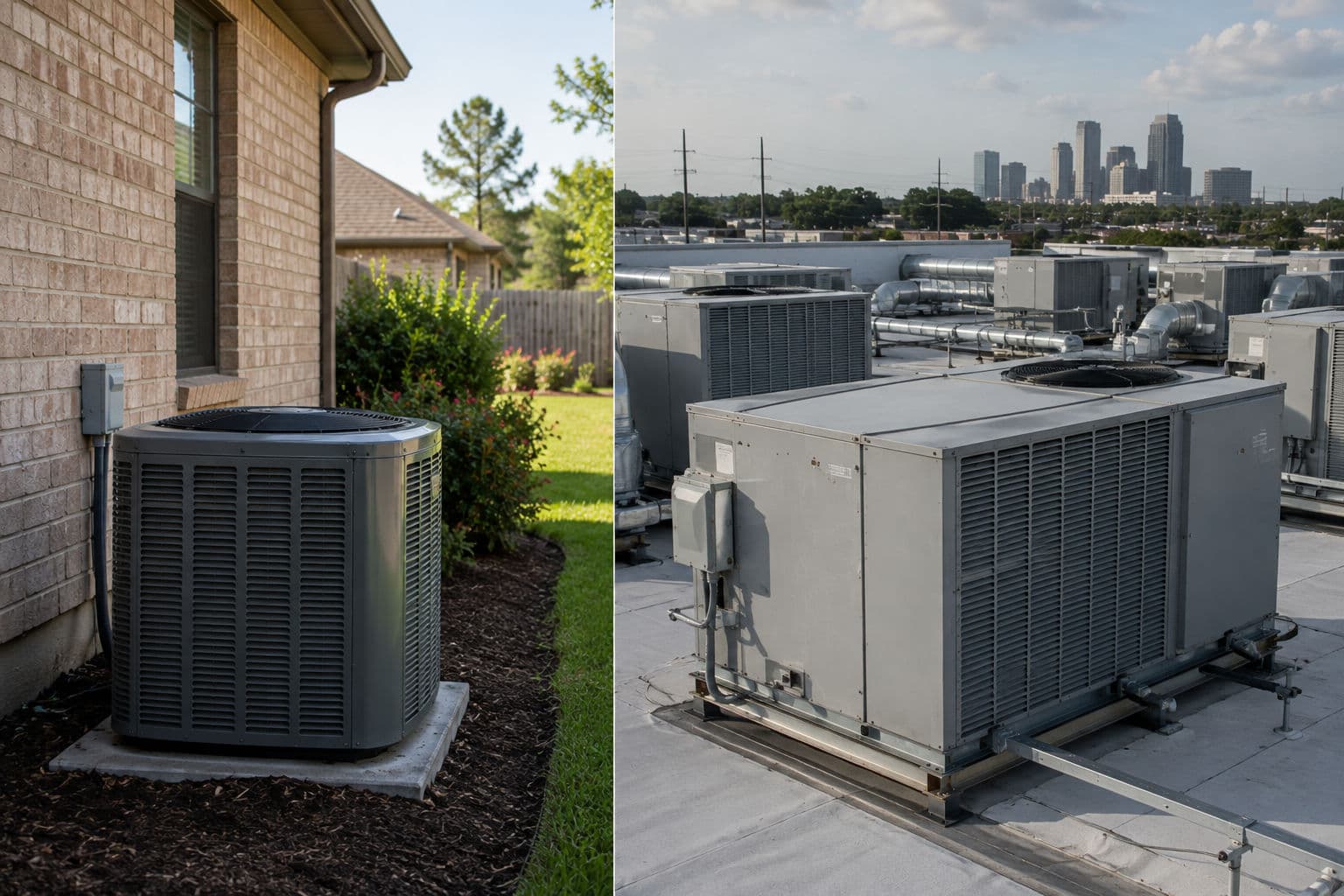
Most of the HVAC content aimed at Greater Houston property owners focuses on residential systems — the split systems, heat pumps, and furnaces that serve single-family homes across Harris County, Fort Bend County, and Montgomery County. But a significant portion of the properties in the Houston metro are commercial — office buildings, retail spaces, restaurants, warehouses, medical offices, light industrial facilities, and the full range of commercial real estate that supports the region's economy. The HVAC systems serving those properties operate differently from residential systems in ways that matter for business owners, property managers, and commercial tenants who are responsible for the heating and cooling in their space.
Understanding the differences between commercial and residential HVAC helps business owners in Greater Houston make better decisions about maintenance, repair, and replacement — and helps avoid the common mistake of applying residential HVAC thinking to commercial situations where it doesn't translate.
SCALE AND SYSTEM CONFIGURATION
The most obvious difference between commercial and residential HVAC is scale. A residential system serves a single family's comfort in a home that's typically 1,500 to 4,000 square feet. A commercial system may serve a single retail space, a multi-tenant office building, a restaurant with a kitchen that generates significant heat load, or a warehouse with a footprint many times the size of any residential property.
That scale difference means commercial HVAC equipment is physically larger, more complex, and more varied in its configuration than residential equipment. Rooftop units — packaged HVAC systems mounted on the roof of a commercial building — are the most common configuration for light commercial buildings in Houston, replacing the split system configuration where the indoor and outdoor components are separate units connected by refrigerant lines. Rooftop units package the cooling, heating, and air handling functions in a single cabinet mounted on the roof, which simplifies installation and service access in multi-tenant buildings.
Larger commercial buildings use chillers, cooling towers, variable refrigerant flow systems, or other configurations that have no residential equivalent. These systems serve hundreds or thousands of square feet through complex distribution networks and require specialized commercial HVAC expertise to design, install, and service.
For the light commercial segment — small office buildings, retail spaces, restaurants, and similar properties in the 2,000 to 20,000 square foot range that makes up a large portion of Houston's commercial real estate — rooftop units are the most common system type, and understanding how they work and what they require is the most practical HVAC knowledge for most Houston business owners.
HOW ROOFTOP UNITS WORK AND WHAT MAKES THEM DIFFERENT
A rooftop unit is a self-contained HVAC system. Unlike a residential split system where the compressor and condenser are in an outdoor unit at ground level and the air handler and evaporator coil are inside the building, a rooftop unit combines all of these components in a single cabinet that sits on the roof. Ductwork runs from the rooftop unit through the roof deck and distributes conditioned air through the building interior.
The rooftop location has advantages for commercial buildings — the unit doesn't occupy ground-level space, service access doesn't require entering the occupied space, and in multi-tenant buildings the system serves only the leased space it's assigned to without shared infrastructure with adjacent tenants. It also creates specific challenges. The rooftop environment in Houston is extremely harsh — intense summer sun, high ambient temperatures, and in some areas salt air influence from the Gulf Coast or industrial particulates from the Ship Channel corridor. These conditions accelerate component wear on rooftop equipment faster than ground-level equipment experiences.
Access for maintenance is also different from residential. A technician servicing a residential system works around the home at ground level. Servicing a rooftop unit requires roof access — appropriate footwear, safety awareness about roof condition and edge proximity, and in some cases coordination with the building owner about roof traffic management. This access consideration is part of why commercial HVAC maintenance rates are typically higher than residential rates on a per-unit basis.
THE MAINTENANCE DEMANDS OF COMMERCIAL HVAC IN HOUSTON
Commercial HVAC systems in Houston operate under the same demanding climate conditions as residential systems — long cooling seasons, Gulf humidity, extreme summer heat — but with additional factors that increase maintenance demands beyond what residential systems experience.
Operating hours are typically higher for commercial systems than residential. A retail space or office building that's occupied Monday through Saturday for ten to twelve hours per day accumulates more annual operating hours than a residential system in the same climate. More operating hours means faster component wear and more frequent maintenance needs.
Occupancy loads in commercial spaces add heat generation that residential systems don't face at the same level. People, lighting, computers, kitchen equipment in restaurants, and other internal heat sources in commercial spaces contribute to the cooling load in ways that residential design doesn't fully account for. A meeting room with twenty people generates significantly more heat than the same square footage as an unoccupied office — and HVAC systems that are sized for average occupancy may struggle during peak occupancy events.
Kitchen and cooking environments present specific HVAC challenges for Houston restaurants. Commercial kitchen exhaust removes large volumes of air from the building that must be replaced through makeup air systems — a component that doesn't exist in residential HVAC but is essential for proper kitchen operation and building pressurization in food service environments. The heat load from commercial cooking equipment is also substantially higher than any residential heat source, and the AC system serving the dining area must manage the heat that migrates from the kitchen alongside the standard cooling load.
Rooftop unit coil fouling in Houston's climate follows the same pattern as residential condenser coil fouling but with additional sources specific to commercial locations. Buildings near Houston's industrial corridors accumulate industrial particulates on rooftop coils faster than residential units at ground level. Flat commercial roofs with HVAC drainage can develop standing water near rooftop units that creates biological growth conditions beyond what Houston's ambient humidity alone produces.
COMMERCIAL HVAC REPAIR VERSUS RESIDENTIAL — KEY DIFFERENCES
Commercial HVAC repair follows the same fundamental principles as residential — diagnose the specific problem, repair or replace the failing component, verify system performance — but with operational considerations that residential service doesn't have.
Business continuity matters in a way that residential comfort doesn't. A homeowner without AC in July is uncomfortable. A business without AC in July may need to close — particularly a restaurant, retail space, or office where comfortable temperatures are necessary for customer-facing operations or employee productivity. The urgency and priority of commercial AC failure in Houston's summer is often higher than residential failure, and response time expectations are correspondingly different.
Parts availability for commercial equipment can be different from residential. Rooftop units and commercial HVAC equipment use some of the same basic components as residential systems — compressors, capacitors, contactors, refrigerant — but in different configurations and sizes. A part that's routinely stocked for residential repair may need to be ordered for a commercial application, which can extend repair timelines.
System complexity in commercial HVAC means diagnostic expertise is more specialized. A technician who services residential split systems competently may not have the experience with rooftop unit configurations, commercial control systems, variable air volume systems, or other commercial HVAC technologies to diagnose commercial system problems accurately. Using a contractor with specific commercial HVAC experience rather than assuming residential expertise translates directly is worth considering.
Lease agreements in commercial real estate often specify who is responsible for HVAC maintenance and repair — landlord or tenant — and what the obligations are. Tenants who are responsible for maintaining commercial HVAC under their lease terms should understand what that maintenance includes and ensure it's being performed, both for system performance and for compliance with their lease obligations. Landlords who retain responsibility for HVAC should have a maintenance program in place rather than waiting for tenant complaints to identify system problems.
ENERGY EFFICIENCY IN COMMERCIAL HVAC
Energy efficiency in commercial HVAC has financial implications at a different scale than residential — a commercial system running at degraded efficiency for months affects energy costs that may be several times the residential equivalent.
Commercial electricity pricing structures often include demand charges based on peak power draw in addition to consumption charges. A commercial HVAC system that short cycles, has a failing component that causes it to start and stop repeatedly, or has one rooftop unit failing and causing another to work harder creates peak demand events that drive up demand charges independently of total energy consumption. Maintaining commercial HVAC systems in good operating condition has an energy cost dimension beyond the consumption efficiency that residential maintenance focuses on.
Building automation systems in larger commercial properties allow more sophisticated control of HVAC operation than residential thermostats provide — scheduling, zone control, economizer operation that uses outdoor air for free cooling when conditions allow, and monitoring of system performance that can flag developing problems before they become failures. For smaller commercial properties without building automation, programmable commercial thermostats provide scheduling capability that prevents HVAC from running full cooling output in an unoccupied space during non-business hours.
INDOOR AIR QUALITY IN COMMERCIAL SPACES
Commercial spaces have indoor air quality obligations that residential properties don't face in the same way. ASHRAE Standard 62.1 establishes minimum ventilation rates for commercial buildings based on occupancy and space type, and HVAC systems in commercial buildings are required to provide the ventilation specified by code. Inadequate ventilation in a commercial space — which can result from a system that's not functioning correctly, ductwork that's been modified without updating ventilation calculations, or a system that was never properly commissioned — creates indoor air quality and code compliance issues alongside occupant health concerns.
Houston's humidity environment creates biological growth risks in commercial HVAC systems that parallel the residential risks — coil fouling, condensate drain blockages, and duct contamination — but at a scale that can affect a larger number of people. A contaminated commercial HVAC system serving a 5,000 square foot office with forty occupants affects all forty people simultaneously, which gives commercial indoor air quality issues a different level of urgency than residential situations.
WHAT HOUSTON BUSINESS OWNERS SHOULD KNOW ABOUT COMMERCIAL HVAC MAINTENANCE
Preventive maintenance is more important in commercial HVAC than residential because the consequences of failure are immediate business impacts rather than household discomfort. A commercial HVAC maintenance program should include regular rooftop unit inspections and coil cleaning, refrigerant charge verification, filter replacement on the schedule appropriate for the specific application and air quality environment, condensate management, electrical component testing, and documentation that satisfies lease obligations and tracks system condition over time.
The maintenance interval for commercial HVAC in Houston is typically quarterly rather than twice-yearly — the higher operating hours and greater consequences of failure justify more frequent inspection and service than a residential system requires. Some commercial applications — restaurants, medical offices, and other high-demand environments — benefit from monthly filter inspection and replacement between quarterly service visits.
Finding a commercial HVAC contractor who understands the specific demands of commercial systems in Houston's climate — rooftop unit service experience, familiarity with commercial control systems, ability to respond promptly when business operations are affected — is the same kind of due diligence that applies to residential contractor selection but with the additional dimension of commercial operational requirements.
Multipoint AC & Heating provides commercial and residential HVAC service throughout Greater Houston, including Harris County, Fort Bend County, Montgomery County, and Austin County. For commercial HVAC repair, maintenance, or installation questions, contact us to discuss your specific commercial property's needs.