- Home
- Blog
- Air Duct Cleaning in Houston, TX — What It Includes, What It Costs, and When to Call Multipoint
Air Duct Cleaning in Houston, TX — What It Includes, What It Costs, and When to Call Multipoint
Learn about air duct cleaning in Houston—its costs, benefits, and when to call Multipoint for professional service.
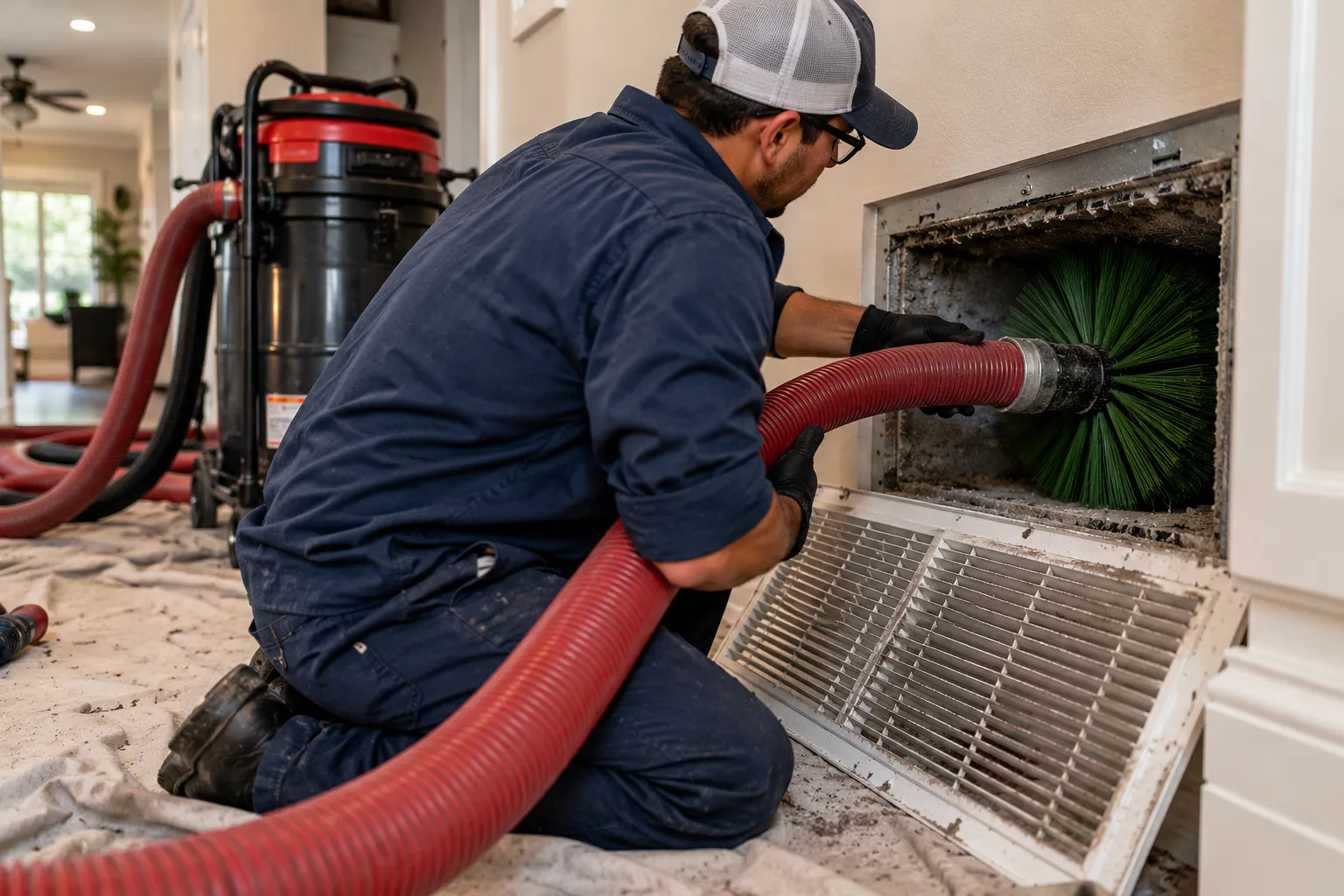
“Air duct cleaning near me” is one of the most searched HVAC-adjacent terms in the Houston market — and also one of the most misunderstood. The duct cleaning category in Greater Houston has a specific problem: it attracts a higher-than-average proportion of companies whose business model depends on homeowners not knowing what proper duct cleaning actually involves or when it’s genuinely needed.
Multipoint AC & Heating is going to give you the straight story. What duct cleaning actually is, what it should include, what it costs when done properly, when it’s genuinely worth doing, and when you’re better off spending your money on something else. Then we’ll tell you what we do for Houston homeowners whose duct systems need professional attention — and why calling Multipoint at 832-963-3789 is the right call when your home’s duct system is the issue.
WHAT AIR DUCT CLEANING ACTUALLY IS
The duct system in your Houston home is a network of supply and return ducts that distributes conditioned air from the air handler to each room and pulls return air back to the system for reconditioning. Over time, dust, debris, and in Houston’s humidity environment, biological material accumulate on the interior surfaces of those ducts.
Professional air duct cleaning uses specialized equipment — typically a large vacuum system with negative air pressure — to extract accumulated debris from the duct interior while agitating the duct surfaces with brushes or compressed air tools to dislodge material that has settled or adhered. Done correctly, it reduces the accumulation of dust, debris, and biological material inside the ductwork and removes the source of particles and odors that the system distributes through the living space every time it runs.
The key phrase is “done correctly.” The difference between thorough professional duct cleaning that addresses the entire duct system and a superficial cleaning that covers the accessible portions while leaving the majority of the system untouched is the difference between a service that genuinely improves the home’s indoor air quality and a service that primarily transfers money from the homeowner to the contractor without meaningful results.
A complete professional duct cleaning should include negative pressure cleaning of all supply and return ducts from the registers back to the air handler, cleaning of the air handler cabinet interior including the evaporator coil and drain pan area, cleaning of the blower wheel and blower compartment, and cleaning or replacement of the return grilles and supply registers. The process should be documented with before-and-after evidence that demonstrates what was removed.
What it should not be is a twenty-minute visit during which someone vacuums a few accessible duct openings and declares the job complete. This abbreviated approach — sometimes offered at suspiciously low prices — is not cleaning the duct system, it’s cleaning the first foot or two of accessible duct at each register opening while leaving the majority of the system untouched.
WHEN AIR DUCT CLEANING IN HOUSTON IS GENUINELY WORTH DOING
The Environmental Protection Agency and the National Air Duct Cleaners Association have both addressed when duct cleaning is and isn’t warranted, and their guidance is consistent — duct cleaning is not something every home needs annually as a routine maintenance item. It’s something specific homes need under specific circumstances.
After a flooding event. Houston homeowners in flood-affected communities — along the Brazos River corridor in Fort Bend County, in the San Jacinto River and Lake Houston watershed communities of Kingwood, Atascocita, and Highlands, in the Addicks-Barker reservoir watershed communities of west Houston, and throughout the broader Greater Houston area that has experienced flooding from Harvey, subsequent events, and chronic waterway flooding — may have duct systems that were contaminated by floodwater. Floodwater that entered the air handler or ductwork introduced biological and chemical contaminants that are distributed through the home every time the system runs. Post-flood duct cleaning is among the most clearly warranted applications of the service.
When visible mold growth is present inside the ductwork. If a technician or inspector identifies actual mold growth on interior duct surfaces — verified visually or through air quality testing that identifies elevated mold spore counts in the home — duct cleaning to remove that growth is appropriate. The caveat is that cleaning alone doesn’t address the underlying moisture condition that allowed the growth to establish. Fixing the moisture source — whether that’s a coil condensate issue, an air infiltration problem allowing humid outdoor air into the duct system, or a whole-home humidity management deficiency — must accompany or precede the cleaning, or the growth reestablishes.
When vermin have accessed the ductwork. Rodents, insects, or other animals that have entered and nested in the ductwork leave biological material, feces, and in some cases deceased animals inside the duct system. This is a genuine indoor air quality concern that duct cleaning addresses directly.
When the home has had a significant renovation. Construction generates fine dust from drywall, concrete, and other building materials that infiltrates the duct system through any available pathway during the renovation period. Homes that have had major renovations — kitchen remodels, room additions, whole-floor renovations — with the HVAC system running during or after the work often benefit from duct cleaning that removes the fine construction dust that has accumulated inside the system.
When the home has been vacant for an extended period. A home that’s been vacant and unoccupied for years, particularly if the HVAC system was not operating during that period, may have accumulated debris inside the ductwork from air infiltration through open registers, from pest activity, and from dust settlement over time.
When Houston’s aging housing stock has never had its ductwork cleaned. Established Greater Houston communities — Katy, Sugar Land, Missouri City, Humble, Spring, Pasadena, Pearland, and others — have significant housing stock from the 1970s through 1990s where the ductwork has been in service for decades without professional cleaning. The specific evidence that warrants cleaning in these older systems is visible dark staining around supply registers, musty odors from the vents that persist after evaporator coil cleaning, or air quality testing that identifies elevated particulate or biological material in the home’s air.
WHEN AIR DUCT CLEANING IS NOT WORTH DOING
This is the part that many duct cleaning companies don’t tell you — because they make their money when you buy the cleaning whether or not you need it.
Routine annual duct cleaning as a maintenance item is not supported by evidence for most homes. A well-sealed duct system in a well-maintained home with consistent filter changes does not accumulate debris at a rate that requires annual professional cleaning. The EPA’s position, based on available scientific evidence, is that duct cleaning has not been shown to prevent health problems and that there is no evidence that cleaning ducts prevents the small amounts of particles that typically accumulate in duct systems from causing harm to healthy people.
The specific situations where duct cleaning is NOT worth the investment include homes with no specific triggering condition — no flooding history, no visible mold, no pest activity, no major renovation, no air quality symptoms that trace to the duct system. These homes typically have ductwork that isn’t significantly cleaner after professional cleaning than a properly maintained system’s natural accumulation would warrant spending several hundred dollars to address.
If the evaporator coil is clean, the filter is being changed consistently, and household members don’t have air quality symptoms that trace to the duct system, duct cleaning is lower priority than the maintenance items that do have clear documented impact — coil cleaning, refrigerant verification, capacitor testing, condensate drain clearing.
The $49 dryer vent cleaning offer that includes “free duct inspection” and then discovers that your ducts “urgently need cleaning” is a business model, not a diagnostic. Be appropriately skeptical of any duct cleaning recommendation that arrives alongside heavily discounted introductory service from a company you haven’t used before.
WHAT ACTUALLY MATTERS MORE THAN DUCT CLEANING FOR MOST HOUSTON HOMEOWNERS
For most Houston homes, the duct system’s impact on indoor air quality and system performance is more significantly affected by duct sealing than duct cleaning.
A duct system that is clean but leaky allows conditioned air to escape into the attic — delivering less of the system’s output to the living space and pulling unconditioned, potentially contaminated attic air into the return air stream. A duct system with 20 to 30 percent leakage — common in Greater Houston’s established communities where ductwork from the 1980s and 1990s has developed leakage at joints and connections over decades — is delivering meaningfully less conditioned air to the living space than a clean, well-sealed system would, and is simultaneously introducing attic air into the return stream.
Duct sealing — addressing the leakage at duct joints and connections with appropriate sealant and tape applied by a qualified technician — reduces energy waste, improves the ratio of conditioned air that actually reaches the living space, and reduces infiltration of unconditioned outdoor and attic air into the system. For most Greater Houston homes with ductwork from the 1980s and 1990s, duct sealing produces a more measurable improvement in system performance and indoor air quality than duct cleaning alone.
The appropriate sequence is duct evaluation to assess both cleanliness and leakage, followed by whatever intervention the specific findings warrant — cleaning if the specific conditions that warrant it are present, sealing if leakage is found at levels that affect performance, or both if both conditions are present.
HOW MULTIPOINT AC & HEATING APPROACHES DUCT SYSTEM EVALUATION IN HOUSTON
When Multipoint AC & Heating evaluates a Houston home’s duct system, we evaluate what’s actually there and what condition it’s in — rather than recommending the most expensive intervention regardless of what the system needs.
Our duct system evaluation includes a visual inspection of accessible duct sections and register openings for visible accumulation, debris, or biological material; an assessment of the air handler interior condition including the evaporator coil, drain pan, and blower compartment; a check for evidence of pest activity or moisture intrusion in the duct system; airflow measurement at registers to identify uneven distribution that suggests duct restrictions or disconnections; and where appropriate, duct leakage testing to quantify how much conditioned air is being lost to the attic.
Based on what we find, we give you a specific recommendation. If the duct system is reasonably clean and the primary issue is leakage, we recommend duct sealing — and we explain specifically where the leakage is and what sealing it will do for your system’s efficiency and performance. If there are specific triggering conditions that warrant cleaning — flood history, visible mold, pest evidence, post-renovation contamination — we tell you that cleaning is appropriate and explain what the cleaning process will involve and what it costs. If neither condition is present and the system is in normal condition for its age, we tell you that too.
What we don’t do is walk into a Houston home, find a duct system that has the normal accumulation of a fifteen-year-old system in a well-maintained home, and tell you it urgently needs cleaning to generate a service transaction. We’re building a long-term relationship with every Houston homeowner we serve, and that relationship depends on giving you accurate information rather than convenient recommendations.
WHAT DUCT CLEANING COSTS IN HOUSTON IN 2026 — AND WHAT TO WATCH FOR
Professional duct cleaning from a legitimate Houston HVAC company in 2026 runs approximately $350 to $700 for a standard single-story home with a single system, and $500 to $900 or more for larger homes, two-story homes, or homes with two systems. This range reflects the time and equipment required for a thorough cleaning that addresses the full duct system rather than just accessible portions.
Prices significantly below this range — $99 whole-house duct cleaning, $149 specials — almost always reflect a service scope that doesn’t include thorough cleaning of the full duct system. The equipment required, the technician time needed, and the overhead of operating a licensed, insured HVAC business in the Greater Houston market don’t support genuinely comprehensive duct cleaning at prices well below the range above.
When evaluating a duct cleaning quote, ask specifically what the scope covers: Does it include all supply and return ducts from registers back to the air handler? Does it include the air handler cabinet interior, blower wheel, and evaporator coil area? Does it include before-and-after documentation? Is the negative air pressure equipment large enough to cover the entire duct system rather than just sections? A company that answers these questions clearly and specifically is more likely to deliver what’s being paid for than one that provides vague assurances without scope details.
THE DRYER VENT CLEANING QUESTION
Dryer vent cleaning is a distinct service from air duct cleaning that many Houston homeowners ask about when evaluating duct maintenance options. Unlike the HVAC duct system, where the cleaning-versus-not recommendation is nuanced, dryer vent cleaning has a clear maintenance case — a clogged or restricted dryer vent is a fire hazard.
Dryer vents accumulate lint from the clothes dryer’s exhaust airflow. Over time this lint can build up to levels that restrict airflow — causing longer drying times and driving up energy consumption — and in severe cases can ignite from the dryer’s heat. The U.S. Fire Administration and the Consumer Product Safety Commission both identify clogged dryer vents as a significant residential fire cause.
Professional dryer vent cleaning using appropriate brush and vacuum equipment that clears the full length of the vent from the dryer connection to the exterior termination is a legitimate maintenance service with clear safety value. Multipoint can evaluate dryer vent condition as part of a comprehensive home HVAC and ventilation evaluation.
WHAT TO DO IF YOU HAVE AIR QUALITY SYMPTOMS THAT YOU THINK TRACE TO YOUR DUCT SYSTEM
If household members are experiencing allergy or respiratory symptoms that seem to be worse at home than elsewhere, if there’s a persistent musty or dusty smell from the vents that doesn’t resolve after evaporator coil cleaning, if visible dark staining is appearing around supply registers, or if there’s a specific history event — flooding, major renovation, pest activity — that makes duct contamination a reasonable concern, the appropriate next step is a professional evaluation by a qualified HVAC technician who will assess the duct system’s actual condition before recommending specific treatment.
That evaluation should address the coil condition first — because biological growth on the evaporator coil is far more common in Houston’s humidity environment than duct contamination, and it’s also far more directly addressed by professional coil cleaning and UV treatment than by duct cleaning. If coil cleaning and UV treatment address the symptoms, the duct system may not have needed cleaning after all. If symptoms persist after coil treatment, the ductwork itself warrants evaluation and potentially cleaning.
Multipoint AC & Heating’s approach to indoor air quality concerns in Houston homes starts with the most likely source — the evaporator coil — and works outward from there based on what’s actually found rather than assuming the most expensive intervention is the most appropriate one.
CALL MULTIPOINT AC & HEATING FOR HOUSTON DUCT SYSTEM EVALUATION AND SERVICE
If you’ve been searching for air duct cleaning near me in Houston and you want an honest assessment of what your duct system actually needs before committing to a service — call Multipoint AC & Heating at 832-963-3789.
We serve homeowners throughout Greater Houston — Harris County, Fort Bend County, Montgomery County, and Austin County. We evaluate duct systems honestly, recommend what the specific situation warrants, and deliver the work clearly and at fair prices. Whether what your home needs is duct cleaning, duct sealing, coil cleaning, UV treatment, or simply confirmation that your system is in acceptable condition and doesn’t need intervention — we’ll tell you what we actually find.
For Houston homeowners with post-flood duct contamination concerns, for homes where air quality symptoms have persisted after other interventions, for established communities where decades-old ductwork has never been professionally evaluated — Multipoint is the call to make.
832-963-3789 — call or text, any time. We’re ready to help.