The Difference Between AC Repair and AC Replacement in Houston — How to Make the Right Call
Learn how to choose between AC repair and replacement in Houston by evaluating costs, system age, and potential savings.
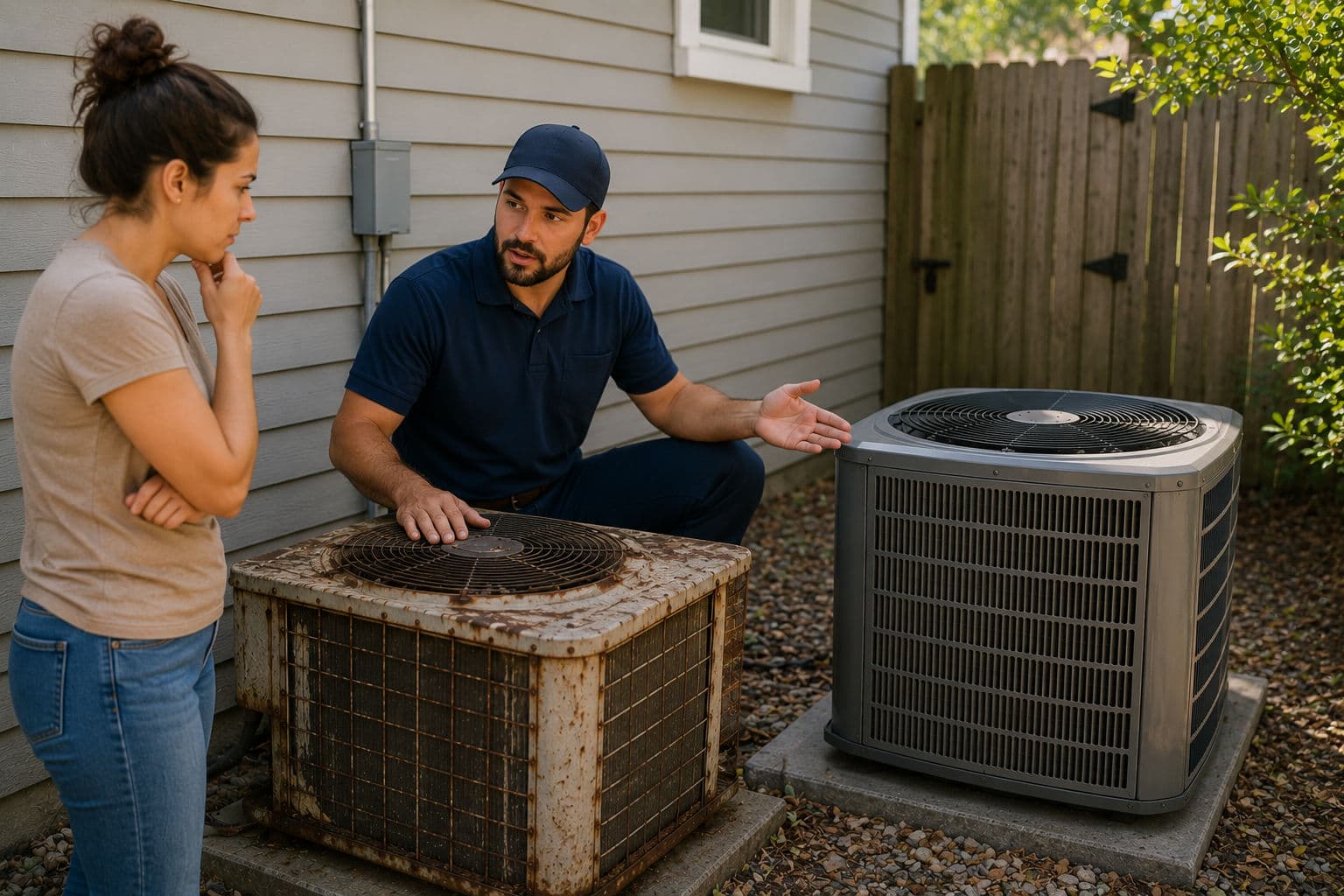
At some point during the life of every air conditioning system in Houston, a repair estimate arrives that's significant enough to make you wonder whether fixing the system makes more sense than replacing it. It's one of the more consequential home decisions a Houston homeowner makes, and it's one that's easy to get wrong in either direction — paying for a repair on a system that's going to need replacement within a year or two, or replacing a system that had several good seasons left in it.
Making this decision well requires understanding a few things about your specific system, the nature of the repair being recommended, and the honest financial comparison between the two paths. Here's how to think through it.
THE FUNDAMENTAL QUESTION IS TOTAL COST, NOT REPAIR COST
The mistake most homeowners make when evaluating repair versus replacement is comparing the repair cost to the replacement cost in isolation. The repair costs $600 and replacement costs $7,000, so the repair is obviously the right call — except that framing ignores everything that happens after the repair.
The right comparison is the total cost of each path over a relevant time horizon. The repair path includes the cost of today's repair plus the cost of future repairs as other components fail on an aging system, plus the ongoing energy cost of running an aging system that's operating well below its original efficiency. The replacement path includes the upfront cost of the new system offset by the energy savings from running more efficient equipment, the reduced repair costs on a new system under warranty, and the value of knowing the system won't need another significant repair for several years.
When you look at it over three to five years rather than today alone, the comparison often looks quite different than it does when you're staring at a single repair estimate.
THE 5,000 RULE — A USEFUL STARTING POINT
The most commonly cited guideline for this decision is the 5,000 rule: multiply the system's age in years by the estimated repair cost in dollars. If the result exceeds $5,000, replacement is typically the more financially sound decision.
A 10-year-old system needing an $800 repair: 10 × $800 = $8,000. The rule suggests replacement. A 5-year-old system needing the same $800 repair: 5 × $800 = $4,000. The rule suggests repair.
The 5,000 rule is a useful screen but not a complete analysis. It doesn't account for the specific nature of the repair, the system's maintenance history, or Houston's specific climate conditions that affect how quickly systems age. Use it as a starting point rather than a final answer.
In Houston's climate specifically, the age threshold for this rule should be understood as lower than it would be in a moderate climate. A Houston system at 12 years has accumulated significantly more operating hours than a 12-year-old system in Chicago or Denver, and the wear profile is correspondingly more advanced.
WHEN REPAIR IS CLEARLY THE RIGHT ANSWER
A system under 8 years old with a straightforward component failure — a capacitor, a contactor, a thermostat, a minor refrigerant leak that's been located and repaired — is almost always worth repairing without much deliberation. These systems have years of useful life ahead of them, the repair cost is modest relative to replacement, and the components being replaced are not indicative of systemic decline.
A system between 8 and 12 years old with a first significant repair and a history of consistent maintenance is still usually worth repairing, particularly if the repair is under $1,000. A well-maintained 10-year-old system with its first major component failure is different from a neglected 10-year-old system with a history of multiple repairs — the former likely has several seasons of reliable life ahead of it after the repair, while the latter is showing you a pattern that suggests ongoing repair costs ahead.
WHEN REPLACEMENT IS CLEARLY THE RIGHT ANSWER
A system past 15 years of age in Houston's climate with any significant repair need is almost always at the replacement decision point. The compressor, capacitors, contactor, blower motor, and other components have all accumulated the same operating hours and are all approaching end of life simultaneously. Repairing one component on a system where every other component is in the same age-related decline often produces a cycle of repairs — fix this, then fix that, then fix the next thing — that cumulatively costs as much or more than a replacement would have while leaving you with an aging system rather than a new one.
A compressor failure on a system over 12 years old almost always points toward replacement rather than repair. The compressor is the most expensive single component repair on an AC system, typically $1,200 to $2,500 or more, and on a system past 12 years in Houston's climate, that investment buys you an unknown remaining life on aging equipment while a replacement starts a new 12 to 15 year service life with a manufacturer warranty.
A refrigerant leak in the evaporator coil on an R-22 system of any significant age is another clear case for replacement. R-22 refrigerant is expensive and in diminishing supply, evaporator coil replacement on R-22 systems is costly, and the combined expense of coil replacement and R-22 recharge on aging equipment often exceeds a meaningful fraction of new system cost.
A system that has needed repairs in each of the past two or three cooling seasons is telling you something important about where it stands regardless of what each individual repair cost. The frequency pattern matters as much as any single repair amount.
THE SITUATIONS IN THE MIDDLE — WHERE IT REQUIRES MORE ANALYSIS
The cases that require more thought are typically systems between 10 and 14 years old with moderate repair needs — not clearly past end of life but not clearly early in their service life either.
For these cases, a few additional questions help clarify the decision.
How has the system been maintained? A 12-year-old system with a documented history of annual maintenance visits, clean coils, and no previous major repairs is a different case than a 12-year-old system that hasn't been serviced in five years. The well-maintained system has a reasonable chance of delivering several more seasons of reliable service after a repair. The neglected system may be entering the repair cycle that characterizes end-of-life equipment.
What is the nature of the repair? A capacitor replacement on a 12-year-old system is a different calculation than an evaporator coil replacement on the same system. The capacitor replacement costs a few hundred dollars and is a completely isolated failure that says nothing about the rest of the system. The evaporator coil replacement costs ten times as much, involves a major system component, and on an R-22 system adds refrigerant cost on top. The same age system can present very different repair versus replacement calculations depending on what specifically needs to be fixed.
How is the system performing beyond the repair that's been identified? A 12-year-old system that's been keeping the house comfortable, running efficiently, and not showing comfort or energy bill decline has better remaining useful life prospects than a 12-year-old system that's been struggling to maintain the set temperature on hot days and producing higher energy bills for the past two seasons. The repair versus replacement decision on the first system has more flexibility than on the second.
What will you save on energy costs with a new system? This question is worth answering with real numbers rather than assumptions. If your current system is 12 years old and was originally installed at 12 SEER, it's likely operating at the equivalent of 9 or 10 SEER today due to age and efficiency degradation. A new 16 SEER system reduces cooling energy consumption by approximately 40 to 45 percent relative to what the old system is actually delivering. In a Houston home spending $1,800 per year on cooling energy, that's $700 to $800 per year in energy savings — meaningful money when evaluated against the net replacement cost after the repair cost you're avoiding.
WHAT TO WATCH OUT FOR IN THE RECOMMENDATION YOU RECEIVE
A technician recommending repair has a financial incentive to recommend repair. A technician recommending replacement has a financial incentive to recommend replacement — or at a minimum, the company they work for does. Neither recommendation is automatically suspect, but understanding the incentive structure helps you evaluate what you're being told.
The recommendation should be supported by specific diagnostic findings — measurements, test results, observed component conditions — rather than a general statement about the system's age or condition. A repair recommendation should specify exactly what's failing and why. A replacement recommendation should include specifics about what other components are showing wear or why the system has reached the point where replacement makes more financial sense than repair.
A recommendation to replace a system that was installed seven years ago and has only one identified failing component, without specific evidence of broader systemic problems, deserves scrutiny. Equally, a recommendation to repair a 16-year-old system that's already needed multiple significant repairs, without any discussion of the replacement option, is worth questioning.
Ask directly: what would you do in my position? A technician who gives you a straight answer to that question is worth trusting more than one who hedges entirely or defaults immediately to the most expensive option without walking you through the reasoning.
GET A SECOND OPINION ON SIGNIFICANT DECISIONS
For any repair estimate over $1,000 on a system past 10 years of age, a second opinion from a different qualified contractor is a reasonable step before committing to either path. The cost of a diagnostic visit from a second contractor is small relative to the decision being made, and the additional perspective either confirms what you've been told or reveals a different view of the situation.
In Houston's competitive HVAC market, most established contractors will provide a diagnostic visit and quote. A second opinion isn't an insult to the first contractor — it's a prudent approach to a significant financial decision.
Multipoint AC & Heating provides honest repair and replacement assessments throughout Greater Houston, including Harris County, Fort Bend County, Montgomery County, and Austin County. If you've received a repair estimate and want a second opinion, or if you'd like an assessment of where your aging system stands, contact us to schedule a diagnostic visit.