AC Repair Near Me in Houston — What to Search, What to Look For, and Who to Call
Learn what to search for in Houston's competitive AC repair market. Discover how to choose the right HVAC company and ensure reliable service when you need it most.
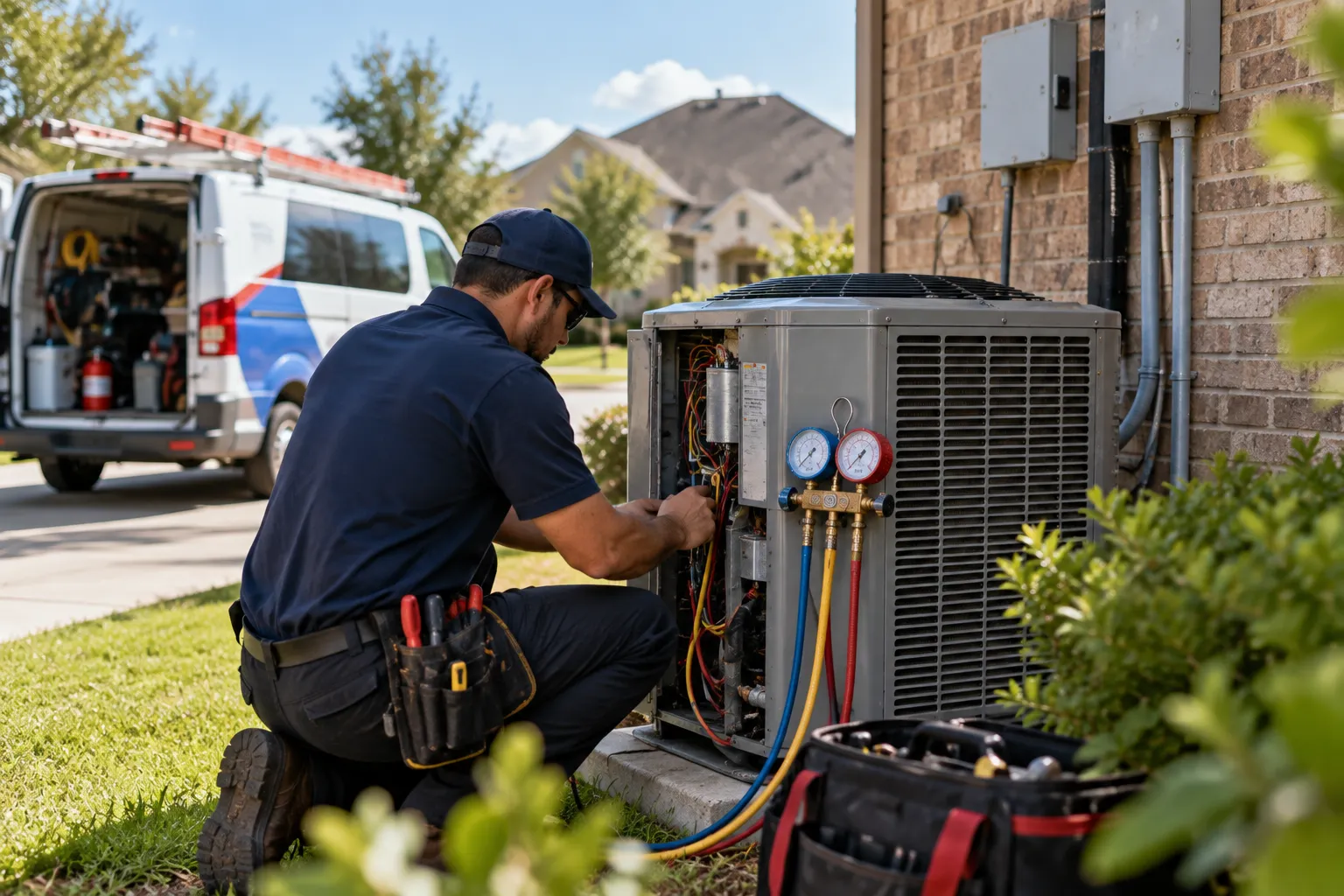
If you've typed "AC repair near me" into Google on a hot Houston afternoon, you're in good company. It's one of the most searched phrases in the entire country — and in Houston's market, where the AC runs for most of the year and a system failure in summer is a genuine emergency, it's a search that happens hundreds of times per day across Harris County, Fort Bend County, and Montgomery County.
The problem with that search is that it returns a lot of results and very little guidance on how to choose between them. Fourteen HVAC companies with Google Business Profile listings, a map pack, paid ads at the top, and organic results below — all competing for the same searcher who needs help now and doesn't have time to evaluate a dozen options carefully.
This post is designed to make that search more useful. Here's what the top Houston HVAC search terms actually tell you about what people need, what separates a company worth calling from one that isn't, and what to do when the AC stops working and you need to find help fast.
THE SEARCHES HOUSTON HOMEOWNERS MAKE AND WHAT THEY MEAN
Understanding what people search for when they need HVAC help — and why — gives you a framework for evaluating what you find when the results come back.
"AC repair near me" and "air conditioning repair Houston" are the two highest-volume HVAC searches in the Houston market. These searches happen when the system has stopped working or is clearly malfunctioning — blowing warm air, not turning on, making a noise it wasn't making before. The searcher needs a technician, probably soon, and is looking for who to call first. The "near me" phrasing signals a preference for a local company rather than a national chain — someone familiar with Houston's specific conditions and reachable quickly.
"AC not cooling" is a diagnostic search — the system is running but not producing cold air. This search often happens when someone isn't sure whether they have an equipment problem or something simpler, and they're looking for information before they call. The blog you're reading right now is the kind of content that shows up for this search — and if you've found your way here through that search, the short answer is that the most common causes are low refrigerant from a system leak, a dirty condenser coil that can't reject heat, a frozen evaporator coil, or a failing compressor. All require a technician to diagnose and repair correctly.
"AC tune up near me" and "HVAC maintenance Houston" are the searches from homeowners who are ahead of the problem rather than reacting to one — people scheduling preventive service before something breaks. In Houston's market, these searches peak in spring before the cooling season and in fall before the heating season. A tune-up search is one of the most valuable customer relationships an HVAC company can develop because it converts a transactional repair customer into a long-term maintenance relationship.
"AC installation near me" and "new AC unit cost Houston" are the replacement searches — homeowners who have reached the decision point on a system that's failing or past its useful life. These searches often happen after a repair conversation where the technician has indicated the system is approaching or past end of life. The cost question is almost always the first thing people want to understand, which is why having a clear, honest answer to what replacement costs in Houston — and what determines it — is important.
"24 hour AC repair Houston" and "emergency AC repair near me" are the after-hours searches — system failures that happened at night, on weekends, or on holidays when standard scheduling doesn't apply. In Houston's summer, these searches have genuine urgency — a home reaching 95 degrees by midnight with children or elderly family members inside isn't a situation that can wait until Monday morning.
"Furnace repair near me" and "heating repair near me" spike in October and November in the Houston market when cold fronts arrive and heating systems that sat idle for seven or eight months fail their first-use test. These searches have a distinct Houston seasonal pattern — almost nonexistent from March through September, then spiking sharply with the first fall cold fronts.
WHAT THE SEARCH RESULTS DON'T TELL YOU — AND WHAT ACTUALLY MATTERS
Typing any of these searches into Google returns a list of companies. The list doesn't tell you which companies are licensed, which carry proper insurance, which have experience with your specific system type, or which will diagnose honestly rather than recommending the most profitable repair. Here's what actually separates companies worth calling from those that aren't.
Current Texas HVAC license. Texas requires HVAC contractors to hold a license from the Texas Department of Licensing and Regulation. This is not optional and not a formality — it indicates the company has met minimum state requirements for refrigerant handling, electrical work, and gas line connections. Verifying a license takes two minutes on the TDLR website. Any company that can't provide a license number on request should be removed from consideration immediately regardless of how their Google listing looks.
Verified insurance. General liability and workers' compensation coverage protect you if the contractor damages your property or if a technician is injured at your home. Ask for insurance certificates before work begins. A company that resists this request is one whose coverage shouldn't be assumed.
Consistent reviews with specific details. Google ratings matter, but how they're distributed and what they say matters more. A company with 400 reviews averaging 4.8 stars over three years tells a different story than one with 20 reviews averaging 5.0 stars from the past two months. Look for reviews that mention specific technicians by name, describe the diagnostic process, and address how the company handled anything that went wrong. The response to negative reviews often tells you more about a company's actual service culture than the positive reviews do.
As of 2026, Google's map pack ranking signals for Houston HVAC companies have shifted toward behavioral engagement and recent review velocity rather than raw review count — meaning a company with 400 current, specific, engaged reviews may outrank one with 4,000 older reviews across multiple locations. This has leveled the local playing field somewhat, which is good news for established local operators who genuinely serve their specific communities.
24/7 availability confirmation — not just the claim. Many HVAC companies list 24/7 availability on their Google Business Profile. Fewer actually answer the phone at 11pm on a Saturday in July. Before you're in an emergency situation, knowing whether a company you're considering actually answers after-hours calls is worth testing. The companies that are genuinely available around the clock typically have that availability confirmed across multiple reviews rather than just listed on their profile.
Diagnostic process transparency. A technician who arrives, spends three minutes at the outdoor unit, and recommends compressor replacement without running a systematic diagnostic is either cutting corners or identifying the most profitable conclusion without confirming it's necessary. Ask what the diagnostic process involves. A qualified technician measures refrigerant pressure, tests capacitor readings against specification, evaluates coil condition, checks electrical components, and measures system performance before recommending any repair. The diagnosis should produce measurements — numbers you can see and ask about — not just a conclusion and a price.
THE QUESTIONS HOUSTON HOMEOWNERS SEARCH MOST — ANSWERED DIRECTLY
Because this blog is built around what Houston homeowners are actually searching for, here are the direct answers to the questions behind the most common Houston HVAC searches.
How much does AC repair cost in Houston? Most common repairs range from $150 to $600. A capacitor replacement — the most frequent repair in Houston's market — runs $150 to $350. A refrigerant leak repair and recharge runs $250 to $600 depending on the refrigerant type and volume needed. A contactor replacement runs $150 to $350. Blower motor replacement costs $300 to $600. Compressor replacement is the most expensive common repair at $1,200 to $2,500 or more, and on systems past twelve years in Houston's climate often tips the decision toward full system replacement rather than repair.
How much does a new AC unit cost in Houston? A complete system replacement runs from approximately $4,500 to $12,000 installed depending on system size, efficiency rating, and whether ductwork modifications are needed. Standard single-stage systems at the base efficiency tier start around $4,500 to $6,500. Mid-efficiency two-stage systems run $6,500 to $9,000. High-efficiency variable-speed systems run $9,000 to $12,000 or more.
How long does AC repair take in Houston? Most common repairs are completed in a single visit of one to three hours depending on the repair type. A capacitor replacement takes thirty to sixty minutes. A refrigerant leak repair and recharge takes two to four hours depending on how quickly the leak is located. A blower motor replacement takes one to two hours. Compressor replacement takes a full day.
How do I know if I need AC repair or replacement? The 5,000 rule is the most commonly cited starting point — multiply the system's age by the repair cost. If the result exceeds $5,000, replacement is typically the more financially sound decision. In Houston's climate, apply this rule more conservatively than you would in a moderate climate because Houston systems accumulate operating hours faster and reach end of life earlier. A twelve-year-old Houston system facing a significant repair is often at the replacement decision point regardless of what the calculation produces.
How often should I service my AC in Houston? Minimum once per year — a spring cooling season tune-up before peak demand. Twice yearly is better, adding a fall heating inspection before the first cold fronts. Systems in wooded communities like The Woodlands, Kingwood, and Conroe that accumulate condenser coil debris faster benefit from more frequent professional coil cleaning than the standard annual interval.
What is an AC tune-up and what does it include? A proper Houston AC tune-up includes professional evaporator and condenser coil cleaning, refrigerant charge verification, capacitor and contactor testing and evaluation, condensate drain inspection and clearing, blower motor inspection, thermostat calibration check, and an overall system performance assessment. A visit that doesn't include coil cleaning and refrigerant verification isn't a complete tune-up — it's a partial inspection.
WHY LOCAL MATTERS MORE THAN BRAND IN HOUSTON'S HVAC MARKET
One of the clearest findings in Houston's HVAC market data is that local operators consistently outperform national chains and multi-city operators on the metrics that matter most to homeowners — review ratings, response time, and honest diagnosis. The reason is straightforward: a local company's reputation is built entirely on the Houston community it serves. There's no other market to fall back on if the Houston reputation suffers. The technicians are Houston residents who know the area, understand the specific climate conditions, and see the same homeowners year after year.
National chains and large multi-city operators have advantages in brand recognition and marketing spend that show up in search results. They don't consistently outperform local operators on service quality, pricing fairness, or the kind of long-term relationship that makes HVAC ownership in Houston's demanding climate more manageable.
The Houston HVAC market data shows local operators with ratings above 4.8 and confirmed 24/7 availability outranking national competitors with far larger review counts in the map pack — which reflects how homeowners actually experience service rather than just marketing recognition.
HOW TO USE THIS INFORMATION WHEN YOUR AC STOPS WORKING
When the AC fails and you're back to Google searching "AC repair near me" or "AC repair Houston TX," here's the practical sequence that produces the best outcome.
Check the obvious things first — thermostat settings, circuit breaker, outdoor unit running or not, air filter condition, ice on the refrigerant lines — before calling. A meaningful percentage of HVAC service calls are for issues the homeowner could have addressed without a technician. Spending five minutes on these checks potentially saves a service call fee and several hours of wait time.
If the obvious checks don't resolve it, call a licensed, insured Houston HVAC company with verified current reviews. Have the system's approximate age, the specific symptom, and any recent service history ready when you call — this information helps the dispatcher prioritize accurately and gives the technician useful context before arriving.
For after-hours situations where you need emergency service, tell the dispatcher specifically what the indoor temperature is and whether any household members are in a vulnerable category — infants, elderly individuals, anyone with a health condition aggravated by heat. This information affects how emergency calls are prioritized when multiple calls are incoming simultaneously.
For non-emergency situations — the system is cooling but less effectively than usual, there's a noise that wasn't there before, the electric bill has climbed without explanation — scheduling a diagnostic visit in the next few days rather than waiting to see if the problem resolves on its own is the approach that prevents a developing issue from becoming an emergency call.
Multipoint AC & Heating is a licensed, insured, family-owned HVAC company serving Greater Houston including Harris County, Fort Bend County, Montgomery County, and Austin County. We provide AC repair, HVAC installation, furnace service, heat pump repair, maintenance plans, and 24/7 emergency service. Contact us at 832-963-3789 — day or night, we answer the call.